Springpole Gold Project
Potential conditions under the Canadian Environmental Assessment Act, 2012
Document reference number: 97
The Impact Assessment Agency of Canada is contemplating the following potential conditions in relation to the Springpole Gold Project (the Designated Project) located in Ontario for recommendation to the Minister of the Environment (the Minister) for inclusion in a Decision Statement issued under the Canadian Environmental Assessment Act, 2012. If the Minister decides that the carrying out of the Designated Project is unlikely to cause significant adverse environmental effects as defined under subsections 5(1) and 5(2), or if the Minister decides that the Designated Project is likely to cause significant adverse environmental effects and the Governor in Council decides such effects are justified in the circumstances, the Designated Project would be allowed to proceed to the next stage of seeking permits and authorizations, and any conditions established by the Minister under the Canadian Environmental Assessment Act, 2012 would become legally binding. The decision statement would then be deemed to be a decision issued under the Impact Assessment Act.
1 Definitions
1.1 Abandonment means the phase of the Designated Project after the reflooded basin is reconnected to Springpole Lake and water treatment is no longer required to meet the pollution prevention provisions of the Fisheries Act pursuant to condition 3.5.
1.2 Agency means the Impact Assessment Agency of Canada.
1.3 Baseline means the environmental conditions prior to initiating construction of the Designated Project.
1.4 Construction means the phase of the Designated Project during which the Proponent undertakes the site preparation, building or installation of any components of the Designated Project, including periods during which these activities may temporarily cease.
1.5 Contact water means water that has come into contact with any Designated Project components.
1.6 Days means calendar days.
1.7 Decommissioning means the phase of the Designated Project during which the Proponent permanently ceases commercial production and commences removal from service of any components of the Designated Project, and that continues until the Proponent completes the final reclamation of the site of the Designated Project, including reconnecting the reflooded basin to Springpole Lake.
1.8 Designated Project means the Springpole Gold Project as described in Schedule 1 of this document.
1.9 Environment and Climate Change Canada means the Department of the Environment as established under subsection 2(1) of the Department of the Environment Act.
1.10 Environmental assessment means "environmental assessment" as defined in subsection 2(1) of the Canadian Environmental Assessment Act, 2012.
1.11 Environmental effects means "environmental effects" as described in section 5 of the Canadian Environmental Assessment Act, 2012.
1.12 Environmental Impact Statement means the December 2024 document entitled Springpole Gold Project Environmental Impact Statement (Canadian Impact Assessment Registry Reference Number 80149, document 22).
1.13 Fish means "fish" as defined in subsection 2(1) of the Fisheries Act.
1.14 Fish habitat means "fish habitat" as defined in subsection 2(1) of the Fisheries Act.
1.15 Fisheries and Oceans Canada means the Department of Fisheries and Oceans as established under subsection 2(1) of the Department of Fisheries and Oceans Act.
1.16 Follow-up program means "follow-up program" as defined in subsection 2(1) of the Canadian Environmental Assessment Act, 2012.
1.17 Heritage value means the aesthetic, historic, scientific, cultural, social or spiritual importance or significance for past, present or future generations.
1.18 Indigenous groups means the following Indigenous Peoples : Cat Lake First Nation, Lac Seul First Nation, Mishkeegogamang Ojibway Nation, Northwestern Ontario Métis Community, Slate Falls Nation, and Wabauskang First Nation.
1.19 Migratory bird means "migratory bird" as defined in subsection 2(1) of the Migratory Birds Convention Act, 1994.
1.20 Mitigation measures means "mitigation measures" as defined in subsection 2(1) of the Canadian Environmental Assessment Act, 2012.
1.21 Monitoring means collecting, analyzing, and using information to measure the environmental effects of the Designated Project or to verify the accuracy of the environmental assessment or to determine the effectiveness of any mitigation measure or any of these combined.
1.22 Natural Resources Canada means the Department of Natural Resources as established under subsection 3(1) of the Department of Natural Resources Act.
1.23 Offsetting plan means "offsetting plan" as described in Schedule 1 of the Authorizations Concerning Fish and Fish Habitat Protection Regulations.
1.24 Ontario Ministry of Citizenship and Multiculturalism means the Ministry of Citizenship and Culture established under Ontario's Ministry of Citizenship and Culture Act, RSO 1990.
1.25 Ontario Ministry of Natural Resources means the Ministry of Natural Resources established under the Ministry of Natural Resources Act, RSO 1990.
1.26 Operation means the phase of the Designated Project starting when commercial production begins and continuing until the start of decommissioning. This phase includes periods when commercial production may temporarily cease.
1.27 Participate means to directly or indirectly assist or support initiatives through the provision of resources, including knowledge, time, data, access and other means that are technically and economically feasible and within the care and control of the Proponent.
1.28 Project development area means the geographic area occupied by the Designated Project as described in Figures 2 to 3 of schedule 1 of this document.
1.29 Proponent means First Mining Gold Corporation and its successors or assigns.
1.30 Qualified individual means someone who, through education, experience and knowledge relevant to a particular matter, provides the Proponent with advice within their area of expertise. Knowledge relevant to a particular matter may include community and Indigenous knowledge.
1.31 Relevant authorities means any federal, provincial, or municipal authority that possesses specialist or expert information or knowledge, or has responsibility for administering a law or regulation related to the subject matter of a condition in this document.
1.32 Reporting year means January 1 to December 31 of the same calendar year.
1.33 Species at risk means a species that is listed on the List of Wildlife Species at Risk set out in Schedule 1 of the Species at Risk Act.
1.34 Structure, site or thing of historical, archeological, paleontological or architectural significance means a structure, site or thing that is determined by a qualified individual, on the basis of heritage value, to be associated with an aspect of the history or culture of the people of Canada, including Aboriginal peoples.
Potential conditions
These conditions may be established for the sole purpose of the Decision Statement issued under the Canadian Environmental Assessment Act, 2012. They do not relieve the Proponent from any obligation to comply with other legislative or other legal requirements of the federal, provincial, or local governments. Nothing in this document shall be construed as affecting what may be required of the Proponent to comply with all applicable legislative or legal requirements. In this document, a reference to a statute shall include every amendment to it, every regulation made under it, every amendment made to a regulation made under it and any law enacted in substitution for, or in replacement of, it.
2 General conditions
2.1 The Proponent shall ensure that its actions in meeting the conditions set out in this document during all phases of the Designated Project are considered in a careful and precautionary manner, are informed by the best information and knowledge available at the time the Proponent takes action, including the most recent version of policies, guidelines and directives and community and Indigenous knowledge, are based on methods and models that are recognized by standard-setting bodies, are undertaken by qualified individuals, and have applied the best available technically or economically feasible technologies, or both.
Consultation
2.2 The Proponent shall, where consultation is a requirement of a condition set out in this document :
provide a written notice of the opportunity for the parties being consulted to present their views and information on the subject matter of the consultation at least 15 days prior to the implementation of condition 2.2.2;
2.2.2 provide all available information that is relevant to the scope and the subject matter of the consultation and a reasonable period of time agreed upon with the parties being consulted, not to be less than 30 days, to prepare their views and information;
2.2.3 undertake an impartial consideration of all views and information presented by the parties being consulted on the subject matter of the consultation; and
2.2.4 advise as soon as feasible in writing the parties being consulted on how the views and information received have, or have not, been integrated into the subject matter of the consultation by the Proponent, including a rationale for why the views have, or have not, been integrated.
2.3 The Proponent shall, where consultation with Indigenous groups is a requirement of a condition set out in this document, seek mutual agreement with each Indigenous group with respect to the manner to satisfy the consultation requirements referred to in condition 2.2, including :
2.3.1 methods of notification;
2.3.2 the type of information, and the period of time to be provided when seeking input;
2.3.3 the period of time and the means to advise Indigenous groups of how their views and information were considered by the Proponent.
Follow-up programs
2.4 The Proponent shall, where a follow-up program is a requirement of a condition set out in this document, develop the follow-up program taking into account any guidance documents provided by the Agency and determine, as part of the development of each follow-up program and in consultation with the parties being consulted during the development of each follow-up program, the following information, unless otherwise specified in the condition :
2.4.1 a description of the effects predictions and mitigation measures that will be evaluated through the follow-up program;
2.4.2 the methodology, location, frequency, timing and duration of monitoring associated with the follow-up program;
2.4.3 the scope, content and frequency of reporting of the results of the follow-up program to the parties consulted for the development of the follow-up program;
2.4.4 the minimum frequency at which the follow-up program must be reviewed and, if necessary, updated;
2.4.5 the levels of environmental change relative to baseline that would require the Proponent to implement modified or additional mitigation measure(s), including instances where the Proponent may require Designated Project activities causing the environmental change to be stopped;
2.4.6 the technically and economically feasible mitigation measures to be implemented by the Proponent if monitoring conducted as part of the follow-up program shows that the levels of environmental change referred to in condition 2.4.5 have been reached or exceeded in order to return below the level referred to in condition 2.4.5;
2.4.7 the specific and measurable end points that must be achieved before the follow-up program can end. Those end points should indicate that the accuracy of the environmental assessment has been verified and that the mitigation measures are effective; and
2.4.8 the details of the results of the follow-up program to report to the Agency pursuant to condition 2.7.5.
2.5 The Proponent shall update the details determined for each follow-up program pursuant to condition 2.4 during the implementation of each follow-up program, at the minimum frequency determined pursuant to condition 2.4.4 and in consultation with the parties being consulted during the development of each follow-up program.
2.6 The Proponent shall provide the information determined for each of the follow-up programs referred to in conditions 3.7, 3.8, 3.9, 4.7,5.2, 5.3, 5.4 and6.6, including the information determined for each follow-up program pursuant to condition 2.4, to the Agency and to the parties being consulted during the development of each follow-up program prior to the implementation of each follow-up program. The Proponent shall also provide any update made pursuant to condition 2.5 to the Agency and to the parties being consulted during the development of each follow-up program within 30 days of the follow-up program being updated.
2.7 The Proponent shall, where a follow-up program is a requirement of a condition set out in this document :
2.7.1 implement the follow-up program according to the information determined pursuant to condition 2.4 and any requirement specified in conditions specific to each follow-up program;
2.7.2 conduct monitoring and analysis to verify the accuracy of the environmental assessment predictions as it pertains to the particular condition and to determine the effectiveness of any mitigation measure;
2.7.3 determine whether modified or additional mitigation measure(s) are required based on the monitoring and analysis undertaken pursuant to condition 2.4.5 and 2.7.2; and
2.7.4 if modified or additional mitigation measure(s) are required pursuant to condition 2.7.3, develop and implement these mitigation measure(s) as soon as feasible and monitor them pursuant to condition 2.7.2. The Proponent shall notify the Agency in writing within 24 hours of any modified or additional mitigation measure being implemented. If the Proponent implements any additional or modified mitigation measure not previously submitted to the Agency pursuant to condition 2.5, the Proponent shall submit a detailed description of the measure(s) to the Agency within 7 days of their implementation; and
2.7.5 report all results of the follow-up program, including whether assessment predictions are accurate and mitigation measures are effective to the Agency no later than 3 months following each reporting year during which the follow-up program is implemented and, subject to information determined pursuant to 2.4.3, to the parties being consulted during the development of the follow-up program.
2.8 Where consultation with Indigenous groups is a requirement of a follow-up program, the Proponent shall discuss the follow-up program with each group and shall determine, in consultation with each group, opportunities for participation and resources required to support their participation in the implementation of the follow-up program, including the conduct of monitoring, the analysis and reporting of follow-up results and the determination of whether modified or additional mitigation measure(s) are required, as set out in condition 2.7.
Annual reporting
2.9 The Proponent shall prepare an annual report for each reporting year that sets out :
2.9.1 the activities undertaken by the Proponent to comply with each of the conditions set out in this document;
2.9.2 how the Proponent complied with condition 2.1;
2.9.3 for conditions set out in this document for which consultation is a requirement, how the Proponent considered any views and information that the Proponent received during or as a result of the consultation;
2.9.4 the information referred to in condition 2.4 for each follow-up program and any update to that information made pursuant to condition 2.7;
2.9.5 a summary of the information reported pursuant to condition 2.7.5 for each follow-up program;
2.9.6 for any plan that is a requirement of a condition set out in this document, any update(s) to the plan that have been made during the reporting year; and
2.9.7 any modified or additional mitigation measure implemented or proposed to be implemented by the Proponent, as determined pursuant to condition 2.7.
2.10 The Proponent shall submit the annual report referred to in condition 2.9 to the Agency, including a plain language executive summary in both official languages, no later than 3 months following the reporting year to which the annual report applies.
2.11 The first reporting year for which the Proponent shall prepare an annual report pursuant to condition 2.9 shall start on the day the Minister of the Environment issues the Decision Statement pursuant to subsection 54 (1) of the Canadian Environmental Assessment Act, 2012.
Information sharing
2.12 The Proponent shall publish on the Internet, or any medium which is publicly available, the annual reports and the executive summaries referred to in conditions 2.9 and 2.10, the reports related to accidents and malfunctions referred to in conditions 11.2.1 and 11.4.3, the communication plan for accident and malfunction referred to in condition 11.5, the schedules referred to in conditions 2.17 and 2.18, and any update or revision to the above documents, upon submission of these documents to the parties consulted for the respective conditions. The Proponent shall keep these documents publicly available for 25 years following the end of operation, or until the end of decommissioning of the Designated Project, whichever comes first. The Proponent shall notify the Agency and Indigenous groups in writing of the availability of these documents within 3 business days of their publication.
2.13 When the development of any plan is a requirement of a condition set out in this document, the Proponent shall submit the plan to the Agency prior to implementation, unless otherwise required through the condition.
Change of Proponent
2.14 The Proponent shall notify the Agency and Indigenous groups in writing no later than 30 days after the day on which there is any transfer of ownership, care, control or management of the Designated Project in whole or in part.
Change to the Designated Project
2.15 If the Proponent is proposing to carry out the Designated Project in a manner other than described in Schedule 1 of this document, the Proponent shall notify the Agency in writing in advance of carrying out the proposed activities. As part of the notification, the Proponent shall provide :
2.15.1 a description of the proposed change(s) to the Designated Project and the environmental effects that may result from the proposed change(s);
2.15.2 any modified or additional measure to mitigate any environmental effect that may result from the proposed change(s) and any modified or additional follow-up requirement;
2.15.3 an explanation of how, taking into account any modified or additional mitigation measure referred to in condition 2.15.2, the environmental effects that may result from the proposed change(s) may differ from the environmental effects of the Designated Project identified during the environmental assessment; and
2.15.4 the results of consultation with Indigenous groups on the proposed change(s), if the proposed change(s) may adversely affect Indigenous groups, including any views on the environmental effects referred to in condition 2.15.1 and on the modified or additional mitigation measures and follow-up requirements referred to in condition 2.15.2.
2.16 The Proponent shall provide to the Agency any additional information required by the Agency about the proposed change(s) referred to in condition 2.15, which may include the results of consultation with relevant authorities on the proposed change(s) and environmental effects referred to in condition 2.15.1 and the modified or additional mitigation measures and follow-up requirements referred to in condition 2.15.2.
Schedules
2.17 The Proponent shall submit to Indigenous groups, the Agency and any other relevant authorities, and no later than 60 days prior to the start of construction, a schedule outlining all activities planned to fulfill each condition set out in this document, including consultation activities pursuant to condition 2.2. The schedule shall indicate the commencement and estimated completion month(s) and year(s) and duration for each of these activities.
2.18 The Proponent shall submit to Indigenous groups, the Agency and any other relevant authorities a schedule outlining all activities required to carry out all phases of the Designated Project no later than 60 days prior to the start of construction. The schedule shall indicate the commencement and estimated completion month(s) and year(s) and duration of each of these activities.
2.19 The Proponent shall submit to Indigenous groups, the Agency and any other relevant authorities in writing an annual update to the schedules referred to in conditions 2.17 and 2.18 no later than 3 months after the end of each reporting year, until completion of all activities referred to in each schedule.
Record keeping
2.20 The Proponent shall maintain all records relevant to the implementation of the conditions set out in this document. The Proponent shall retain the records and make them available to the Agency during construction and operation, and for 25 years following the end of operation or until the end of decommissioning of the Designated Project, whichever comes first. The Proponent shall provide the records to the Agency upon demand within a timeframe specified by the Agency.
2.21 The Proponent shall retain all records referred to in condition 2.20 at a facility in Canada and shall provide the address of the facility to the Agency. The Proponent shall notify the Agency in writing at least 30 days prior to any change to the physical location of the facility where the records are retained and shall provide the address of the new location to the Agency.
2.22 The Proponent shall notify the Agency in writing of any change to the contact information of the Proponent within 30 days of the change in contact information.
3 Fish and fish habitat
3.1 The Proponent shall develop, to the satisfaction of Fisheries and Oceans Canada and in consultation with Indigenous groups, and implement any offsetting plan for activities that may result in the harmful alteration, disruption, or destruction of fish habitat, and death of fish associated with the Designated Project, taking into account Fisheries and Oceans Canada's Policy for Applying Measures to Offset Harmful Impacts to Fish and Fish Habitat. The Proponent shall submit the approved offsetting plan(s) to the Agency prior to implementation.
3.2 The Proponent shall, for any fish habitat offsetting measure proposed in any offsetting plan referred to in condition 3.1 that may cause adverse environmental effects, develop, in consultation with Indigenous groups and relevant authorities, and implement measures to mitigate those effects. The Proponent shall submit these measures to the Agency prior to implementing them.
3.3 The Proponent shall develop, to the satisfaction of Fisheries and Oceans Canada and in consultation with Indigenous groups and Ontario Ministry of Natural Resources, and implement, prior to conducting any Designated Project activity requiring the removal of fish habitat, a protocol to salvage and relocate fish in waterbodies, including Springpole Lake. As part of the protocol, the Proponent shall identify opportunities for Indigenous groups to participate in the salvage and relocation of fish activities, and potential traditional use of salvaged fish.
3.4 The Proponent shall develop, prior to decommissioning and to the satisfaction of Fisheries and Oceans Canada and in consultation with Indigenous groups, measures to restore fish habitat in the reflooded basin, and implement these measures following the connection of the reflooded basin to Springpole Lake. The Proponent shall submit these measures to the Agency prior to implementing them.
3.5 The Proponent shall collect contact water from the Designated Project area, including the Co-disposal Facility, surficial soil stockpile, ore stockpiles and open pit during all phases of the Designated Project and treat, as necessary, before it is deposited into the receiving environment in accordance with the pollution prevention provisions of the Fisheries Act and its regulations including the Metal and Diamond Mining Effluent Regulations.
3.6 The Proponent shall manage, during all phases of the Designated Project and in consultation with relevant authorities, acid-generating and metal-leaching or potentially acid-generating and metal-leaching tailings and excavated or disturbed materials, including from the Co-disposal facility, and stockpile areas. In doing so, the Proponent shall :
3.6.1 characterize, prior to construction, the acid rock drainage and metal-leaching potential of tailings, overburden, mine rock, and other excavated materials, taking into account the Mine Environment Neutral Drainage Program's Prediction Manual for Drainage Chemistry from Sulphidic Geologic Materials (2009);
3.6.2 only use materials that are not acid-generating, non-potentially acid-generating, and non-metal-leaching during construction, including for earthworks and grading, unless not technically or economically feasible. If not technically or economically feasible, the Proponent shall preclude water and oxygen ingress into the materials used;
3.6.3 conduct geochemical testing of tailings, mine rock, and other excavated materials during construction and operation to identify metal-leaching, acid generating, or potentially acid-generating materials, and update predictions of the magnitude and onset of metal leaching and acid rock drainage based on site-specific data;
3.6.4 taking into account results of geochemical testing referred to in conditions 3.6.1 and 3.6.3, implement, during operations and decommissioning, measures to delay or reduce the onset and magnitude of metal leaching and acid rock drainage; and
3.6.5 cover all acid-generating, potentially acid-generating and potentially metal-leaching tailings and mine rock during operations, decommissioning and abandonment with an oxygen-limiting barrier in a manner determined by a qualified individual.
3.7 The Proponent shall develop, prior to construction and in consultation with Indigenous groups and relevant authorities, and implement, during all phases of the Designated Project, a follow-up program to verify the accuracy of the environmental assessment and determine the effectiveness of mitigation measures with respect to adverse environmental effects from the Designated Project on fish and fish habitat resulting from changes to surface water quality. As part of the follow-up program, the Proponent shall :
3.7.1 monitor surface water quality for contaminants of potential concern, including aluminum, antimony, arsenic, cadmium, cobalt, mercury, selenium, silver, uranium and zinc at the seepage face in Birch Lake, Lake 16 and Springpole Lake; and
3.7.2 if the results of monitoring referred to in condition 3.7.1 indicate that contaminants of potential concern exceed thresholds of the Canadian Council of Ministers of the Environment's Canadian Water Quality Guidelines of the Protection for Aquatic Life, implement modified or additional mitigation measures pursuant to condition 2.7.4, such as pump back wells. The Proponent shall submit these measures to the Agency before implementing them.
3.8 The Proponent shall develop, prior to construction and in consultation with Indigenous groups, Fisheries and Oceans Canada, the Ontario Ministry of Natural Resources, and any other relevant authorities, and implement, during all phases of the Designated Project, including after reconnection of the reflooded basin, a follow-up program to verify the accuracy of the environmental assessment and determine the effectiveness of mitigation measures with respect to adverse environmental effects from the Designated Project on lake trout (Salvelinus namaycush) in Springpole Lake.
3.9 The Proponent shall develop in consultation with Indigenous groups and Fisheries and Oceans Canada, and implement after reconnection of the reflooded basin, a follow-up program to determine the effectiveness of mitigation measures implemented to restore fish habitat in the reflooded basin pursuant to condition 3.4.
4 Migratory birds
4.1 The Proponent shall carry out the Designated Project in a manner that protects migratory birds and avoids capturing, killing, taking, injuring or harassing migratory birds or destroying, taking or disturbing their eggs, or damaging, destroying, removing or disturbing nests protected under the Migratory Birds Convention Act, 1994 and its regulations or the Species at Risk Act or both, while taking into account Environment and Climate Change Canada's Guidelines to avoid harm to migratory birds.
4.2 The Proponent shall determine, under the direction of a qualified individual and using non-intrusive methods selected based on habitat type, the presence, or likely presence of migratory bird nest(s) protected under the Migratory Birds Convention Act, 1994 and its regulations and residences protected under the Species at Risk Act that may be adversely affected by any Designated Project activity prior to initiating the activity.
4.3 The Proponent shall establish and delineate, as determined by and under the direction of a qualified individual, set back distances around the nest(s) and residence(s) whose presence or likely presence is determined pursuant to condition 4.2, within which that activity shall not occur while those nests are protected under the Migratory Birds Convention Act, 1994 and its regulations or the Species at Risk Act, or both. When establishing setback distances, the Proponent shall take into account Environment and Climate Change Canada's Guidelines to avoid harm to migratory birds – Establishing buffer zones and setback distances.
4.4 The Proponent shall control Designated Project lighting, during all phases of the Designated Project, to mitigate attraction and disorientation of migratory birds while meeting operational, health and safety requirements, and taking into account the Convention on Migratory Species' International Light Pollution Guidelines for Migratory Species. As part of these measures, the Proponent shall :
4.4.1 use directional lighting that targets only the areas where lighting is needed;
4.4.2 optimize lighting design to reduce the total amount of lighting needed;
4.4.3 use shielded fixtures to reduce glare and light leakage in directions where light is not needed; and
4.4.4 use automatic sensors or strobe lighting in areas where continuous light is not needed.
4.5 The Proponent shall implement, under the direction of a qualified individual, line marking devices on transmission lines at locations and intervals to increase transmission line visibility to migratory birds and reduce collisions, while taking into account the Aviation Power Line Interaction Committee's Reducing Avian Collisions with Power Lines.
4.6 The Proponent shall take all reasonable measures to prevent migratory birds from accessing sources of water that consistently exceed the Canadian Council of Ministers of the Environment's Canadian Water Quality Guidelines for the Protection of Aquatic Life. Should migratory birds attempt to access these sources of water, the Proponent shall implement deterrents, while taking into account Environment and Climate Change Canada's Guide for Developing Beneficial Management Practices for Migratory Bird Conservation.
4.7 The Proponent shall develop, prior to construction and in consultation with Indigenous groups, Environment and Climate Change Canada and any other relevant authorities, and implement during all phases of the Designated Project, a follow-up program to verify the accuracy of the environmental assessment and determine the effectiveness of mitigation measures with respect to adverse environmental effects from the Designated Project on migratory birds, including waterfowl.
5 Health and socio-economic conditions of Indigenous peoples
5.1 The Proponent shall implement, during all phases of the Designated Project, measures to mitigate fugitive dust emissions attributable to the Designated Project, including dust associated with vehicles and the handling and storage of granular materials while taking into account Environment and Climate Change Canada's Best Practices for the Reduction of Air Emissions from Construction and Demolition Activities (2005). In doing so, the Proponent shall :
5.1.1 establish and enforce speed limits on all Designated Project roads;
5.1.2 apply water or any alternative dust suppressant determined in consultation with Indigenous groups and relevant federal authorities, on Designated Project roads or other areas that may generate dust;
5.1.3 cover all materials stored or transported within the Project development area that are a potential source of fugitive dust, where technically and economically feasible; and
5.1.4 avoid handling and loading non-enclosed granular materials during high wind conditions, where technically and economically feasible.
5.2 The Proponent shall develop, prior to construction and in consultation with Indigenous groups, and implement during all phases of the Designated Project, a follow-up program to verify the accuracy of the environmental assessment predictions and to determine the effectiveness of mitigation measures with respect to adverse environmental effects from the Designated Project on the health of Indigenous Peoples due to changes in air quality. In doing so, the Proponent shall :
5.2.1 Identify, prior to construction, contaminants of potential concern to be monitored, including total suspended particulates, PM10, and PM2.5 and the locations where these contaminants of concern shall be monitored; and
5.2.2 monitor, during construction, operation and continuing through decommissioning, ambient air for contaminants of potential concern identified pursuant to condition 5.2.1 at locations identified pursuant to condition 5.2.1.
5.3 The Proponent shall develop, prior to construction and in consultation with Indigenous groups, and relevant authorities, and implement during all phases of the Designated Project, a follow-up program to verify the accuracy of the environmental assessment and determine the effectiveness of mitigation measures with respect to adverse environmental effects from the Designated Project on the health of Indigenous Peoples resulting from changes in drinking water quality. In doing so, the Proponent shall :
5.3.1 Identify, prior to construction, contaminants of potential concern to be monitored in drinking water that may be adversely affected by the Designated Project and the locations where these contaminants shall be monitored; and
5.3.2 monitor, during all phases of the Designated Project, concentrations of contaminants and at the locations identified pursuant to condition 5.3.1.
5.4 The Proponent shall develop, prior to construction and in consultation with Indigenous groups and relevant authorities and implement a follow-up program to verify the accuracy of the environmental assessment and determine the effectiveness of mitigation measures with respect to adverse environmental effects from the Designated Project on the health of Indigenous Peoples resulting from changes in country foods. As part of the implementation of the follow-up program, the Proponent shall :
5.4.1 identify, prior to construction, the species of fish, vegetation, and wildlife consumed as country foods and the locations where these species shall be monitored; and
5.4.2 monitor, during all phases of the Designated Project, changes in concentrations of contaminants of potential concern in species and at the locations identified pursuant to condition 5.4.1, using sampling methods that are non-lethal unless non-lethal methods are not technically feasible.
6 Current use of lands and resources for traditional purposes
6.1 The Proponent shall conduct, in consultation with Indigenous groups, progressive reclamation of areas disturbed by the Designated Project, including along the mine access road and the transmission line, to progressively return physically disturbed areas to a state as close to baseline conditions as possible or better, as soon after the disturbance as feasible, and to mitigate fugitive dust emissions. In doing so, the Proponent shall :
6.1.1 identify plant species native to the region and that support habitat restoration for species used for traditional purposes;
6.1.2 invite Indigenous groups to participate in the planting or reclamation activities.
6.2 The Proponent shall prohibit Designated Project employees and contractors from fishing, hunting, trapping, plant gathering and using off-road vehicles for recreational purposes within the Project development area or using the Project development area to access surrounding areas for these purposes unless an employee or contractor is provided access by the Proponent for exercising Indigenous rights, to the extent that such access is safe.
6.3 The Proponent shall develop, prior to construction, and in consultation with Indigenous groups, Environment and Climate Change Canada, and the Ontario Ministry of Natural Resources, and implement during all phases of the Designated Project, habitat offsetting measures to mitigate adverse effects from the Designated Project on woodland caribou (Rangifer tarandus caribou).
6.4 The Proponent shall manage, in consultation with Indigenous groups, Environment and Climate Change Canada, and the Ontario Ministry of Natural Resources, woody vegetation along the new transmission line right-of-way to achieve visual barriers for predators in areas of woodland caribou (Rangifer tarandus caribou) use identified in section 6.13 of the Environmental Impact Statement, where technically and economically feasible.
6.5 The Proponent shall undertake construction activities, including vegetation clearing, outside the woodland caribou (Rangifer tarandus caribou) calving and nursery period (May 1 to June 30), in calving and nursery areas identified in figure 6.13-7 of the Environmental Impact Statement, unless otherwise authorized by relevant authorities.
6.6 The Proponent shall develop, prior to construction and in consultation with Indigenous groups, Environment and Climate Change Canada, and the Ontario Ministry of Natural Resources, and implement, during all phases of the Designated Project, a follow-up program to verify the accuracy of the environmental assessment and determine the effectiveness of mitigation measures with respect to adverse environmental effects from the Designated Project on the current use of lands and resources for traditional purposes related to woodland caribou (Rangifer tarandus caribou). As part of the follow-up program, the Proponent shall :
6.6.1 monitor, during construction and operation, the quantity and quality of woodland caribou (Rangifer tarandus caribou) obtained through harvesting and hunting activities for traditional purposes, based on information provided by Indigenous groups;
6.6.2 monitor, during construction and operation, Designated Project-related noise levels at calving and nursery areas identified in figure 6.13-7 of the Environmental Impact Statement located within 10 kilometers of the Designated Project area; and
6.6.3 monitor, during all phases of the Designated Project, predator use of linear corridors.
7 Physical and cultural heritage of, and structures, sites or things of historical, archaeological, paleontological or architectural significance to, Indigenous peoples
7.1 The Proponent shall develop, prior to any construction activities affecting Waabizheshi Agaasademon Onigam and in consultation with Cat Lake First Nation, Lac Seul First Nation and Slate Falls Nation, and implement during all phases of the Designated Project, a protocol to mitigate adverse effects form the Designated Project on the physical and cultural heritage of the Waabizheshi Agaasademon Onigam site. As part of the protocol, the Proponent shall :
7.1.1 document the site and commemorate its physical and cultural heritage, including selecting Indigenous languages for commemoration where requested;
7.1.2 delineate buffer zones around known resources of cultural or archaeological value within the Waabizheshi Agaasademon Onigam site as no-work zones;
7.1.3 establish procedures for the handling, temporary custody, and relocation of any artifacts or cultural materials discovered during construction activities affecting the site, in consultation with the Indigenous groups referred to in condition 7.1; and
7.1.4 establish procedures for Indigenous groups to safely access the site prior to any project activities for ceremonial purposes.
7.2 The Proponent shall develop, prior to construction and in consultation with Cat Lake First Nation, Lac Seul First Nation and Slate Falls Nation, and implement during construction and operation of the Designated Project, a design plan for an alternative route for Waabizheshi Agaasademon Onigam to be used during construction and operation.
7.3 The Proponent shall develop, prior to decommissioning and in consultation with Cat Lake First Nation and Lac Seul First Nation, and implement following decommissioning, a design plan for the re‑establishment of Waabizheshi Agaasademon Onigam.
7.4 The Proponent shall develop, prior to construction and in consultation with Indigenous groups, and relevant authorities, and implement, during all phases of the Designated Project, a chance-find protocol for any previously unidentified structures, sites or things of historical, archaeological, paleontological or architectural significance discovered within the Project development area by the Proponent or brought to the attention of the Proponent. As part of the chance-find protocol, the Proponent shall :
7.4.1 immediately halt work at the location of a discovery, except for actions required to protect the integrity of the discovery;
7.4.2 delineate an area around the discovery as a no-work zone;
7.4.3 notify the Ontario Ministry of Citizenship and Multiculturalism immediately to receive guidance on recording, assessing and mitigating adverse effects on previously unidentified structures, sites or things of historical, archaeological, or paleontological significance;
7.4.4 notify the Indigenous groups and the Agency within 24 hours of the discovery, and identify opportunities for Indigenous groups to monitor archaeological works; and
7.4.5 develop and deliver mandatory training on chance find protocol and cultural awareness to all employees and contractors associated with the Designated Project. The training shall include identification of sensitive locations within the Project development area, including the Waabizheshi Agaasademon Onigam site referred to in condition 7.1 and procedures for implementing the chance-find protocol.
8 Indigenous Environmental Committee
8.1 The Proponent shall establish, prior to construction and in consultation with Indigenous groups, and maintain during all phases of the Designated Project, an Indigenous Environmental Committee and any sub-committees, to facilitate communication and engagement related to potential environmental effects of the Designated Project on Indigenous health, land use, and physical and cultural heritage. The Terms of Reference for the Indigenous Environmental Committee and any sub-committees shall be developed in consultation with Indigenous groups and shall include :
8.1.1 the means by which the Proponent and Indigenous groups shall jointly identify topics related to potential environmental effects of the Designated Project to be discussed through the Indigenous Environmental Committee and any sub‑committees, including topics related to Indigenous knowledge and current use of lands and resources, and the means by which the Proponent shall document these topics and discussions; and
8.1.2 the means by which the Proponent shall share environmental information with the Indigenous Environmental Committee and any sub-committees, including advance notice of Designated Project activities that may affect Indigenous health or land use, and information related to environmental safety and the integrity of the co‑disposal facility.
9 Indigenous monitors
9.1 The Proponent shall retain, prior to construction, the services of Indigenous monitor(s) to participate in the implementation of follow-up programs. Prior to retaining the services of Indigenous monitor(s), the Proponent shall undertake a collaborative process to determine, in consultation with Indigenous groups, the scope, purpose and objectives of the participation of Indigenous monitor(s) and shall provide that information to the Agency prior to construction. As part of that process, the Proponent shall determine :
9.1.1 how each Indigenous monitor shall be involved in monitoring their areas of interest, including the location, frequency, timing and duration of their participation;
9.1.2 how Indigenous monitors shall be selected;
9.1.3 how the Proponent shall support the participation of Indigenous monitors; and
9.1.4 the reporting relationship, if any, between Indigenous monitors and the Indigenous Environmental Committee established pursuant to condition 8.1
10 Independent environmental monitor
10.1 The Proponent shall retain, prior to construction, the services of a third-party independent environmental monitor, who is a qualified individual as it pertains to environmental monitoring in Ontario, to independently observe and record on the implementation of the conditions set out in this document during construction and to report findings to the Proponent and the Agency.
10.2 The Proponent shall require the independent environmental monitor to report to the Agency, in writing, prior to or concurrent with reporting to the Proponent, if, in their view, any Designated Project activity does not comply with any condition set out in this document. The Proponent shall require the independent environmental monitor to report the information to the Agency at a frequency and in a format determined in consultation with the Agency.
11 Accidents and Malfunctions
11.1 The Proponent shall take all reasonable measures to prevent accidents and malfunctions that may result in adverse environmental effects and mitigate any adverse environmental effects from accidents and malfunctions that occur. In doing so, the Proponent shall :
11.1.1 design, construct and operate the co-disposal facility containment structures taking into account the Canadian Dam Association's Dam Safety Guidelines and the Mining Association of Canada's Guide to the Management of Tailings Facilities; and
11.1.2 design, construct and maintain water management structures to accommodate, at a minimum, a 1-in-100-year flood event, based on historical climate data and projected future changes in extreme rainfall.
11.2 The Proponent shall develop, prior to construction and in consultation with Indigenous groups and relevant authorities, and implement an accidents and malfunctions response plan in relation to each phase of the Designated Project. The accidents and malfunctions response plan shall include :
11.2.1 a description of the types of accidents and malfunctions, including accidents and malfunctions as a result of a dyke failure, breach of co-disposal facility dams, malfunction of the water management system, accidental detonation of explosives, spills and wildlife emergencies involving migratory birds, that may cause adverse environmental effects during any phase of the Designated Project;
11.2.2 the measures to be implemented in response to each type of accident and malfunction referred to in condition 11.2.1 to mitigate any adverse environmental effect caused by the accident or malfunction, taking into account Environment and Climate Change Canada's Guidelines for Effective Wildlife Response Plans; and
11.2.3 for each type of accident and malfunction referred to in condition 11.2.1, the roles and responsibilities of those involved in the implementation of the measures referred to in condition 11.2.2, including the Proponent, each relevant authority, and any other party that may be called upon to respond to an accident or malfunction.
11.3 The Proponent shall maintain the accidents and malfunctions response plan referred to in condition 11.2 up to date during the phase to which it pertains. The Proponent shall submit any updated accidents and malfunctions response plan to the Agency and to parties consulted for the development of the plan within 30 days of the plan being updated.
11.4 In the event of an accident or malfunction with the potential to cause adverse environmental effects, including an accident or a malfunction referred to in condition 11.2.1, the Proponent shall immediately implement the measures appropriate to remedy the accident or malfunction, including any measure referred to in condition 11.2.2, and shall :
11.4.1 notify relevant authorities with responsibilities related to emergency response (including environmental emergencies) in accordance with applicable legislative and regulatory requirements;
11.4.2 notify, as soon as feasible and pursuant to the communication plan referred to in condition 11.5, Indigenous groups of the accident or malfunction, and notify the Agency in writing no later than 24 hours following the accident or malfunction. When notifying Indigenous groups and the Agency, the Proponent shall specify :
11.4.2.1 the date and time when and location where the accident or malfunction occurred;
11.4.2.2 a summary description of the accident or malfunction;
11.4.2.3 a list of any substance potentially released into the environment as a result of the accident or malfunction; and
11.4.2.4 a description of the relevant authorities notified pursuant to condition 11.4.1 and of the relevant authorities engaged in response to the accident or malfunction.
11.4.3 submit a written report to the Agency no later than 60 days after the day on which the accident or malfunction occurred. The written report shall include :
11.4.3.1 a detailed description of the accident or malfunction and of its adverse environmental effects;
11.4.3.2 a description of the measures that were taken by the Proponent to mitigate the adverse environmental effects caused by the accident or malfunction;
11.4.3.3 any view from Indigenous groups and advice from relevant authorities received with respect to the accident or malfunction, its adverse environmental effects and the measures taken by the Proponent to mitigate these adverse environmental effects;
11.4.3.4 a description of any residual adverse environmental effect and a description of any modified or additional measure required by the Proponent to mitigate or monitor residual adverse environmental effects;
11.4.3.5 a description of any changes made to avoid a subsequent occurrence of the accident or malfunction; and
11.4.3.6 details concerning the implementation of the accidents and malfunctions response plan referred to in condition 11.2.
11.5 The Proponent shall develop, in consultation with Indigenous groups, a communication plan for accidents and malfunctions in relation to the Designated Project. The Proponent shall develop the communication plan prior to construction and shall implement and keep it up to date during all phases of the Designated Project. The plan shall include :
11.5.1 the geographic areas of possible accidents and malfunctions where Indigenous groups would like to receive notifications;
11.5.2 the types and thresholds of accidents and malfunctions requiring the Proponent to notify the Indigenous groups;
11.5.3 the information to be included in the notifications to support community preparedness and response;
11.5.4 the method and frequency of notifications, including opportunities for Indigenous groups to assist in accident or malfunction response efforts; and
11.5.5 the names and contact information of the Proponent and Indigenous group representatives for the purposes of notification pursuant to condition 11.5.3.
Schedule 1
Draft Description of the Designated Project
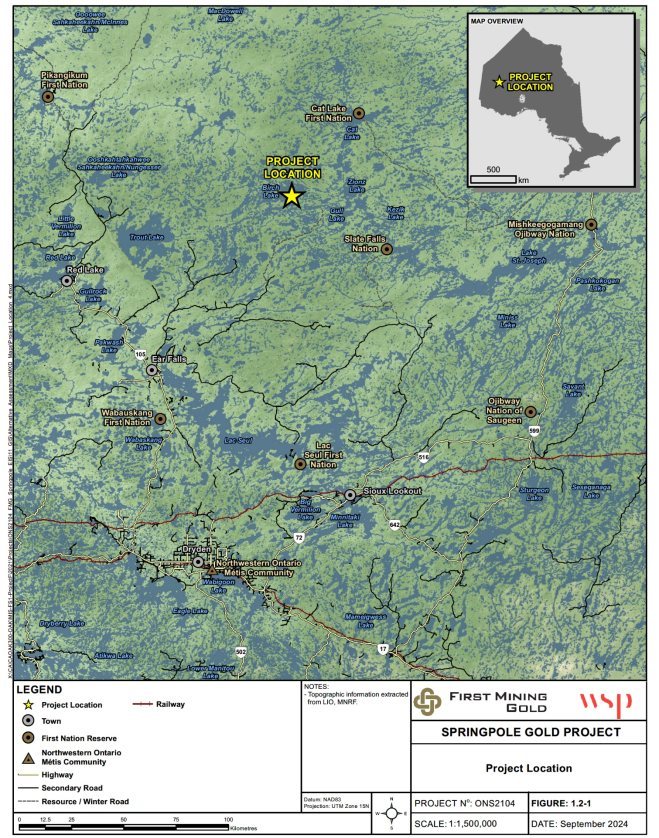
The Designated Project is the construction, operation, decommissioning, and abandonment of an open-pit gold/silver mine and on-site metal mill, located approximately 110 kilometres northeast of Red Lake, Ontario. The Designated Project location is shown in Figure 1.
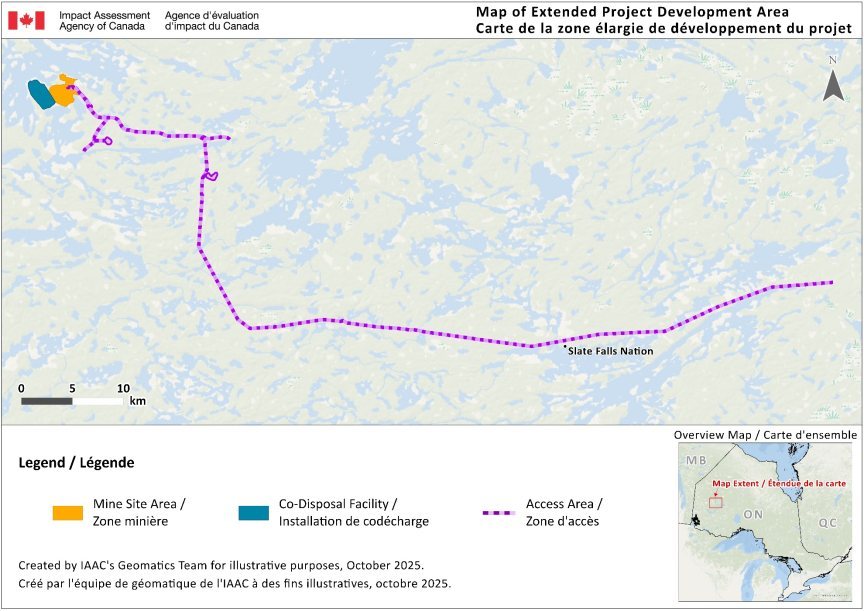
The Designated Project has a production capacity of approximately 23.7 million tonnes of ore per year (approximately 65,000 tonnes per day), with a planned mine life of approximately 10 years. The metal mill would have an ore input capacity of up to approximately 30,000 tonnes per day, with operations expected to align with the mine life. The Project development area, shown in Figure 2 is estimated to cover approximately 2,006 (ha), including the Mine Site Area (~1,528 ha) and Linear Infrastructure (~478 ha).
The Project Development Area is divided into three sections : the Mine Site Area, the Co-Disposal Facility Area and the Mine Access Area.
Mine Site Area
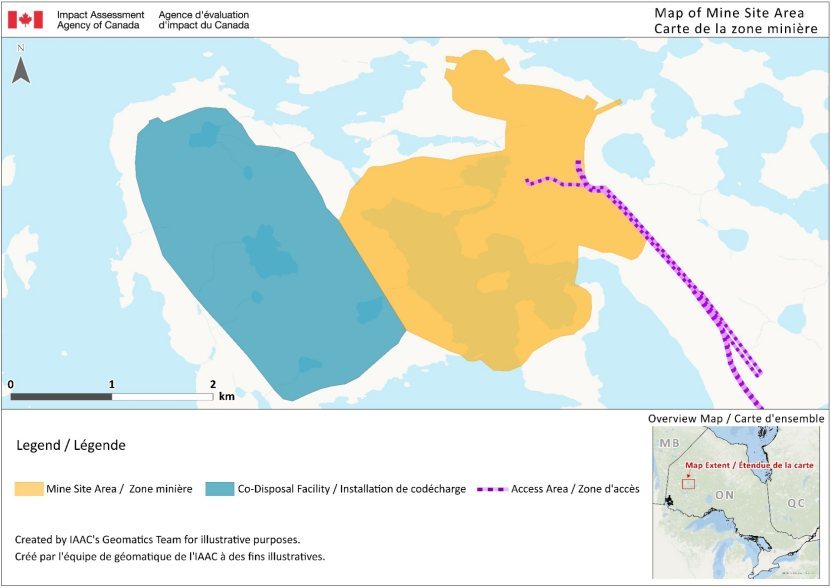
The Mine Site Area, shown on Figure 2 and 3, includes all the following components and associated activities :
- isolation and dewatering of a portion of the north basin of Springpole Lake, with reflooding and restoration of hydraulic connectivity during decommissioning;
- open pit with a minimum 30 metre setback from Birch Lake, located within the dewatered portion of Springpole Lake;
- ore stockpiles with a minimum 120 metre setback from Birch Lake and Springpole Lake;
- surficial soil stockpile. Any remaining soil will be reshaped to a physically stable condition (if needed) and revegetated at the end of decommissioning;
- haul and service roads;
- laydown areas;
- worker accommodation facility (or facilities) and supporting infrastructure, with a total capacity of up to 650 workers during construction and up to 350 workers during operations;
- freshwater intake pipeline for the Effluent Treatment Plant;
- on-site electrical distribution system;
- ore processing facilities;
- tailings management infrastructure, including pipelines and distribution systems;
- administration, mine offices/rescue, warehouse and laboratory;
- vehicle maintenance and wash facilities;
- water management, erosion and sediment control structures, and contact water treatment structures including, ditches and collection ponds;
- fuel storage; and
- sewage treatment.
Co-Disposal Facility Area
The Co-Disposal Facility Area, shown on Figure 2 and 3, includes all the following components and associated activities :
- co-disposal facility for the disposal of tailings and mine rock, with final reclamation and revegetation at decommissioning;
- water management, erosion and sediment control structures, and contact water treatment structures including, ditches and collection ponds with a minimum 120 metre setback from Birch Lake and Springpole Lake;
- haul and service roads;
- laydown areas.
Mine Access Area
The Mine Access Area shown in Figure 2, includes the following components and associated activities :
- Mine Access Road connecting the Mine Site Area to the existing Wenasaga Road;
- airstrip, helipads and supporting infrastructure;
- transmission line connecting the Mine Site Area to the regional electrical grid and supporting infrastructure;
- effluent discharge pipeline connecting the Effluent Treatment Plant to the discharge location in the southeast arm of Springpole Lake;
- borrow pits and associated access roads;
- laydown areas.