
Project 6 - All-Season Road Linking Manto Sipi Cree Nation, Bunibonibee Cree Nation and God's Lake First Nation
Project 6: All-season Road Linking Manto Sipi Cree Nation, Bunibonibee Cree Nation, and God's Lake First Nation: Draft Environmental Assessment Report
Document reference number: 27
November 2025
© His Majesty the King in Right of Canada, as represented by the Minister of Environment and Climate Change, 2025.
This publication may be reproduced for personal or internal use without permission, provided the source is fully acknowledged. However, multiple copy reproduction of this publication in whole or in part for purposes of redistribution requires the prior written permission from the Impact Assessment Agency of Canada, Ottawa, Ontario K1A 0H3, or information@iaac-aeic.gc.ca.
This document has been issued in French under the title: Projet 6 – Route toutes saisons reliant la Nation crie Manto Sipi, la Nation crie Bunibonibee et la Première Nation de God's Lake – Rapport d'évaluation environnementale.
Executive Summary
Manitoba Transportation and Infrastructure (the proponent) is proposing the construction and operation of a 141-kilometre all-season road, located in northern Manitoba on the east side of Lake Winnipeg. The Project 6 – All-season Road Linking Manto Sipi Cree Nation, Bunibonibee Cree Nation, and God's Lake First Nation (the project), designed as a two-lane gravel public highway, would consist of three sections of intersecting road. These road sections would begin at the reserve boundaries of Manto Sipi Cree Nation, Bunibonibee Cree Nation, and God's Lake First Nation. Components of the project would also include two bridge crossings over God's River and Magill Creek, quarries and borrow areas, and other temporary and permanent infrastructure.
The Impact Assessment Agency of Canada (IAAC) is carrying out a federal environmental assessment for the project under the requirements of the Canadian Environmental Assessment Act, 2012 (CEAA 2012). The project is subject to CEAA 2012 as it includes activities described in the following schedule to the Regulations Designating Physical Activities:
Item 25(c): The construction, operation, decommissioning and abandonment of a new all-season public highway that requires a total of 50 km or more of new right of way.
IAAC initiated the environmental assessment process for the project on June 1, 2017, and issued the Environmental Impact Statement (EIS) Guidelines on September 18, 2017. The proponent's EIS and EIS Summary were accepted on May 6, 2019, initiating a technical review during which IAAC requested additional information from the proponent. In July 2022, the proponent requested and received approval from IAAC for a four-year extension to the three-year time limit to provide the information and studies outlined in the EIS Guidelines, extending the time limit to August 28, 2026. The required information and studies were submitted by the proponent on August 27, 2025. The Environmental Assessment Report (EA Report) phase was subsequently commenced on September 29, 2025.
On August 28, 2019, the Impact Assessment Act (IAA) came into force and CEAA 2012 was repealed. In accordance with the transitional provisions of the IAA, the environmental assessment of the proposed project is being continued under CEAA 2012 as if that Act had not been repealed.
The project is subject to a provincial environmental assessment under the Province of Manitoba's The Environment Act. The Environmental Approvals Branch of Manitoba Environment and Climate Change will make a licensing decision for the project at the end of the provincial environmental assessment process.
This EA Report summarizes the assessment conducted by IAAC, including an evaluation of the potential environmental effects of the project within areas of federal jurisdiction. This EA Report also includes IAAC's conclusions on whether the project is likely to cause significant adverse environmental effects after taking into account the implementation of mitigation measures, monitoring, and follow-up programs. IAAC prepared this EA Report in consultation with Environment and Climate Change Canada, Fisheries and Oceans Canada, Indigenous Services Canada, Health Canada, Natural Resources Canada, and Transport Canada, following a technical review of the proponent's EIS. Furthermore, this EA Report was informed by comments submitted throughout the environmental assessment process by Indigenous groups, federal authorities, the proponent, and the public.
IAAC analyzed environmental effects to areas of federal jurisdiction in relation to section 5 of CEAA 2012, including fish and fish habitat, aquatic species as defined in the Species at Risk Act, migratory birds, federal lands, and, with respect to Indigenous Peoples, effects of any change to the environment on health and socio-economic conditions, physical and cultural heritage, the current use of lands and resources for traditional purposes, and any structure, site, or thing that is of historical, archaeological, paleontological, or architectural significance. IAAC also considered effects related to changes to the environment that are directly linked or necessarily incidental to federal decisions that may be required for the project, including:
- authorization(s) under the Fisheries Act (paragraphs 34.4(2)(b) and 35(2)(b)) by Fisheries and Oceans Canada;
- permit(s) under the Migratory Birds Convention Act, 1994 by Environment and Climate Change Canada;
- permit(s) under the Species at Risk Act for effects to species that are listed as Endangered or Threatened on Schedule 1 by Environment and Climate Change Canada;
- licence(s) under the Explosives Act by Natural Resources Canada; and
- permitting under the opt-in provisions of subsection 4(1) of the Canadian Navigable Waters Act for the project's proposed bridge crossings at God's River and Magill Creek.
In assessing the potential environmental effects of the project, IAAC also considered factors, such as effects of potential accidents and malfunctions, effects of the environment on the project, including extreme and periodic weather events, and cumulative effects in conjunction with other past, present, and reasonably foreseeable projects or physical activities.
This EA Report provides an assessment of potential impacts of the project on Aboriginal and Treaty rights, as recognized and affirmed by section 35 of the Constitution Act, 1982, held by First Nations and Métis Peoples, including hunting, trapping, fishing, plant harvesting, and the use of sites and areas of cultural importance for the exercise of rights.
The main residual environmental effects of the project, after considering the implementation of the key mitigation measures identified in this EA Report, in relation to section 5 of CEAA 2012 are:
- effects on fish and fish habitat, including from habitat destruction or alteration, changes to fish passage, and effects to fish health and survival;
- effects on migratory birds, including from habitat loss and alternation, and effects to bird health and mortality;
- effects on the current use of lands and resources for traditional purposes by Indigenous Peoples, including from loss or alteration of access for current use and effects to the availability and quality of lands and resources of importance;
- effects on the health and socio-economic conditions of Indigenous Peoples due to exposure to air and water contaminants by inhalation or ingestion, reduced ability to harvest subsistence and economic resources, and risks to the health and safety of Indigenous Peoples and workers; and
- effects to Indigenous Peoples' physical and cultural heritage and structures, sites, or things of historical, archaeological, paleontological, or architectural significance.
The project may result in residual environmental effects to species at risk that are of cultural importance to Indigenous groups, including from habitat loss, and effects to wildlife health and mortality. The project may impact Aboriginal and Treaty rights, including from loss or alteration of access to sites of traditional and cultural importance, and effects to the availability and quality of lands and resources of importance. The proponent's project planning and design incorporates measures to mitigate potential adverse environmental effects of the project. Mitigation measures include adherence to existing guidelines and regulations, implementation of standard provincial environmental protection procedures and specifications, and project design planning to identify, control, and monitor environmental risks.
IAAC identified key mitigation measures, monitoring, and follow-up programs that would prevent or reduce potential adverse environmental effects to areas within federal jurisdiction, verify the accuracy of the environmental assessment predictions, and verify the effectiveness of mitigation measures. IAAC, in selecting key mitigation measures, monitoring, and follow-up programs, was informed by the proponent's commitments, advice from federal authorities and provincial ministries, and comments from Indigenous groups and the public.
Key mitigation, monitoring, and follow-up measures include: minimizing atmospheric emissions and noise; monitoring and management of project-related changes to groundwater and surface water quantity and quality; erosion and sediment control measures to mitigate increases in sediment concentrations; development of a fish rescue plan and monitoring effects to fish and fish habitat; carrying out project activities in a manner that protects and avoids harming, killing, or disturbing migratory birds, nests, eggs, or habitat that would directly affect migratory birds; and ongoing engagement with Indigenous groups, including with respect to monitoring and access management.
IAAC concludes that, taking into account the implementation of key mitigation measures, monitoring, and follow-up programs, the project is not likely to cause significant adverse environmental effects as defined under CEAA 2012. The Minister of Environment and Climate Change (the Minister) will consider the proposed key mitigation measures in establishing conditions as part of an Environmental Assessment Decision Statement under CEAA 2012 if the project is permitted to proceed. Any conditions established by the Minister would become legally binding on the proponent. In addition, it is IAAC's expectation that all of the proponent's commitments would be implemented in order for the project to be carried out in a careful and precautionary manner.
On this page
- Executive Summary
- List of Tables
- List of Figures
- List of Abbreviations and Acronyms
- Glossary
- 1 Introduction
- 2 Project Overview
- 3 Purpose of and Alternative Means of Carrying out the Project
- 4 Consultation and Engagement Activities
- 5 Existing Ecosystem
- 6 Predicted Changes to the Environment
- 6.1 Atmospheric Environment
- 6.2 Groundwater
- 6.3 Surface Water
- 6.4 Terrestrial Landscape
- 7 Predicted Effects on Valued Components
- 7.1 Fish and Fish Habitat
- 7.2 Migratory Birds
- 7.3 Species at Risk
- 7.4 Indigenous Peoples – Current Use of Lands and Resources for Traditional Purposes, Physical and Cultural Heritage, and Sites of Significance
- 7.5 Indigenous Peoples – Health and Socio-Economic Conditions
- 7.5.1 Effects to Indigenous Peoples' Health
- 7.5.2 Effects to Indigenous Peoples' Socio-economic Conditions
- 7.5.3 Key Mitigation Measures and Monitoring to Avoid Significant Effects and Follow-Up Program Requirements
- 7.6 Federal Lands
- 8 Other Effects Considered
- 8.1 Effects of Accidents and Malfunctions
- 8.2 Effects of the Environment on the Project
- 8.3 Cumulative Environmental Effects
- 9 Impacts to Aboriginal or Treaty Rights
- 10 Conclusions and Recommendations of IAAC
- Appendices
List of Tables
- Table 1: Valued Components Selected by IAAC
- Table 2: Indigenous Groups Comment Opportunities during the Environmental Assessment
- Table 3: Total Habitat Destruction and Alteration at Proposed Watercourse Crossings
- Table 4: Migratory Bird Species at Risk Observed within the RAA
- Table 5: Mammal and Non-Migratory Bird Species at Risk Potentially Affected by the Project
- Table 6: Projects and Physical Activities Included in the Cumulative Effects Assessment
- Table A-1: General Definitions of Criteria Used to Assess Residual Environmental Effects to All Valued Components
- Table A-2: Definitions for Magnitude That Vary by Valued Component Used to Assess Residual Environmental Effects
List of Figures
- Figure 1: Regional Location of the Project
- Figure 2: Local Assessment Areas by Valued Component
- Figure 3: Regional Assessment Areas by Valued Component
- Figure 4: Location of Watercourse Crossings
- Figure 5: Potential Quarry Site Locations
- Figure 6: Route Alignment Alternatives Considered
- Figure 7: Alignment Options Under Consideration for the Road Segment Near Manto Sipi Cree Nation
- Figure 8: Boreal Woodland Caribou and Eastern Migratory Caribou Habitat Ranges in Relation to the Project Footprint, LAA, and RAA
- Figure 9: Location of Treaty Boundaries, Métis Administrative Boundaries, and First Nation Reserve Lands Relative to the Project Location
List of Abbreviations and Acronyms
- ANFO
- Ammonium nitrate and fuel oil
- CAAQS
- Canadian Ambient Air Quality Standards
- CEAA 2012
- Canadian Environmental Assessment Act, 2012
- CO
- Carbon monoxide
- COSEWIC
- Committee on the Status of Endangered Wildlife in Canada
- Current use
- Indigenous Peoples' current use of lands and resources for traditional purposes
- CWQG-PAL
- Canadian Water Quality Guidelines for the Protection of Aquatic Life
- DFO
- Fisheries and Oceans Canada
- EA Report
- Environmental Assessment Report
- EIS
- Environmental Impact Statement
- IAA
- Impact Assessment Act
- IAAC
- Impact Assessment Agency of Canada
- LAA
- Local Assessment Area
- MAAQC
- Manitoba Ambient Air Quality Criteria
- Minister
- Minister of Environment and Climate Change
- MWQSOG
- Manitoba Water Quality Standards, Objectives, and Guidelines
- NOx
- Nitrogen oxides
- PM2.5, PM10
- Particulate matter
- Project
- Project 6 – All-season Road Linking Manto Sipi Cree Nation, Bunibonibee Cree Nation, and God's Lake First Nation
- Proponent
- Manitoba Transportation and Infrastructure
- RAA
- Regional Assessment Area
- ROW
- Right-of-way
- SARA
- Species at Risk Act
- Section 35 rights
- Aboriginal and Treaty rights protected under section 35 of the Constitution Act, 1982
- Sites of significance
- Any structure, site, or thing that is of historical, archaeological, paleontological, or architectural significance to Indigenous Peoples
- SOx
- Sulphur oxides
- VOCs
- Volatile organic compounds
Glossary
- Acid rock drainage
- Some rocks, typically those containing an abundance of sulphide minerals, when exposed to water and air can release water which is more acidic than the natural surrounding environment. Often associated with metal leaching.
- Borrow areas
- Sites where natural materials like soil, gravel, sand, or rock are extracted for use in another project, such as road or embankment construction.
- Contact water
- Surface water or groundwater that has contacted contaminated project components, surfaces, or workings, or interacted with sulphide-bearing rock.
- Critical habitat
- Habitat that is necessary for the survival or recovery of a listed wildlife species and that is identified as the species' critical habitat in the recovery strategy or in an action plan for the species (Species at Risk Act, section 2(1)).
- Deleterious substance
- Any substance that, if added to any water, would degrade or alter, or form part of a process of degradation or alteration of the quality of that water so that it is rendered or is likely to be rendered deleterious to fish or fish habitat or to the use by man or fish that frequent that water, or if by going through some process of degradation, it harms the water quality (Fisheries Act, paragraph 34(1)(a)). A substance is also deleterious if it exceeds a level prescribed by regulation.
- Dewatering
- Removal or draining groundwater or surface water from an area within a construction site by pumping or evaporation.
- Edge effects
- An abrupt transition between two different adjoining ecological communities with respect to the number and type of organisms in the marginal habitat.
- Environmentally sensitive sites
- Represents critical wintering habitat; critical breeding habitat; species fidelity to dens and nests; and/or culturally significant sites.
- Equalization culverts
- Culverts placed to balance water head and elevation on both sides of an embankment and reduce possible water seepage flow.
- Habitat fragmentation
- A process by which large and contiguous habitats are divided into smaller, isolated patches of habitat.
- Heritage resources
- A land or resource (e.g., an artifact, object, or place) that is considered as heritage or any structure, site, or thing distinguished from other lands and resources by the value placed on it.
- Heritage sites
- Sites with potential cultural or heritage value.
- Ice jam
- Generic term referring to the accumulation of ice fragments in a watercourse that restricts flow and causes staging of water levels upstream.
- Metal leaching
- The release of metals from rocks exposed to water and air, which can increase the concentrations of these metals in contact water. Often associated with acid rock drainage.
- Quarry
- A mine established or operated by surface excavation for the purpose of removing consolidated rock material.
- Riprap
- A stone covering used to protect soil or surface bedrock from erosion by water or the elements.
- Runoff
- Surface water that flows overland and into streams, wetlands, or waterbodies, or into drainage systems.
- Species at risk
- Species that are defined federally by the Species at Risk Act and the Committee on the Status of Endangered Wildlife in Canada that are considered rare or at risk of extinction, or that may become threatened or endangered because of a combination of biological characteristics and identified threats.
- Turbidity
- Measure of the lack of clarity or transparency of water caused by biotic and abiotic suspended or dissolved substances. The higher the concentration of these substances in water, the more turbid the water becomes.
- Wetland
- Land saturated with water long enough to promote formation of water altered soils, growth of water-tolerant vegetation, and various kinds of biological activity that is adapted to the wet environment and separated into five classes: fen, bog, marsh, swamp, and shallow open water wetlands. Includes open water areas less than two metres deep with wetland characteristics.
1 Introduction
Manitoba Transportation and Infrastructure (the proponent) is proposing the construction and operation of a 141-kilometre all-season road on provincial Crown land. The Project 6 – All-season Road Linking Manto Sipi Cree Nation, Bunibonibee Cree Nation, and God's Lake First Nation (the project), designed as a two-lane gravel public highway, would consist of three sections of intersecting road located on the east side of Lake Winnipeg, Manitoba. These road sections would begin at the reserve boundaries of Manto Sipi Cree Nation, Bunibonibee Cree Nation, and God's Lake First Nation. The project would also include two bridge crossings over God's River and Magill Creek, culverts, quarries and borrow areas, and other temporary and permanent infrastructure.
An existing on-reserve access road at Bunibonibee Cree Nation would join to the proposed project. On-reserve access roads would be constructed on the Manto Sipi Cree Nation and God's Lake First Nation reserves; these roads are not considered part of the project. The proposed project is one in a series of all-season roads that have been proposed as part of the Province of Manitoba's East Side Transportation Initiative to establish a regional all-season road network on the east side of Lake Winnipeg.
Following construction, the final Project Footprint, including the all-season road, the road right-of-way (ROW), and other permanent infrastructure, would occupy an area of approximately 924 hectares and the project would convey up to 300 vehicles per day. There are currently no plans to decommission the project.
1.1 Environmental Assessment Report
This Environmental Assessment Report (EA Report) summarizes the analysis conducted by the Impact Assessment Agency of Canada (IAAC) in accordance with the Canadian Environmental Assessment Act, 2012 (CEAA 2012) and presents IAAC's conclusions on whether the project is likely to cause significant adverse environmental effects on areas of federal jurisdiction after taking into account proposed key mitigation measures. Following a public comment period on the draft EA Report, IAAC will finalize the EA Report and provide it to the Minister of Environment and Climate Change (the Minister). The Minister will consider the final EA Report when issuing the Environmental Assessment Decision Statement to the proponent under CEAA 2012, if the project is allowed to proceed.
On June 1, 2017, IAAC initiated a screening of a description of the project from the proponent, which included consultation with the public and Indigenous groups, to determine if a federal environmental assessment was required. On July 28, 2017, IAAC commenced the environmental assessment. On September 18, 2017, IAAC finalized and issued the Environmental Impact Statement (EIS) Guidelines to the proponent.
On May 6, 2019, IAAC accepted the proponent's EIS and EIS Summary, and commenced a technical review of the EIS, during which IAAC requested additional information from the proponent. On July 19, 2022, the proponent submitted a request to extend the three-year time limit to provide the information and studies outlined in the EIS Guidelines for the project under CEAA 2012. On August 23, 2022, IAAC approved this request, extending the time limit to provide the required information and studies to August 28, 2026. The proponent submitted the required information and studies on August 27, 2025. On September 29, 2025, IAAC advised the proponent that it had submitted the information and studies required to conduct the environmental assessment of the project, and to prepare the EA Report under CEAA 2012 within the established time limit.
On November 7, 2025, IAAC commenced a 30-day public comment period on this draft EA Report and draft potential conditions.
1.2 Scope of the Environmental Assessment
1.2.1 Environmental Assessment Requirements
On August 28, 2019, the Impact Assessment Act (IAA) came into force and CEAA 2012 was repealed. In accordance with the transitional provisions of the IAA, the environmental assessment of this project is being continued under CEAA 2012 as if that Act had not been repealed.
The project is subject to CEAA 2012 as it would involve activities described in paragraph 25(c) of the Physical Activities Schedule to the Regulations Designating Physical Activities:
Item 25(c): The construction, operation, decommissioning and abandonment of a new all-season public highway that requires a total of 50 km or more of new right of way.
The project is also subject to Manitoba's The Environment Act. IAAC and Manitoba Environment and Climate Change coordinated the federal and provincial environmental assessment processes through acceptance of a single EIS written by the proponent to satisfy both the provincial and federal requirements; information sharing during the technical review of the EIS, where possible.
1.2.2 Factors Considered in the Environmental Assessment
IAAC issued EIS Guidelines, which specify the nature, scope, and extent of information required to support the environmental assessment, and outline environmental effects, factors that must be considered, and valued components. Valued components are environmental and socio-economic features that may be affected by the project and that have been identified to be of concern by the proponent, federal authorities, Indigenous groups, or the public. The EIS Guidelines for the project are available on the Canadian Impact Assessment RegistryFootnote 1.
The environmental assessment considered effects to valued components under federal jurisdiction, pursuant to section 5 of CEAA 2012; environmental components related to these valued components; relevant species at risk, as per subsection 79(2) of the Species at Risk Act (SARA); and species designated by the Committee on the Status of Endangered Wildlife in Canada (COSEWIC). The valued components considered by IAAC for the purposes of this EA Report are presented in Table 1.
|
Valued Component |
IAAC Rationale |
|---|---|
|
Valued components identified pursuant to subsection 5(1) of CEAA 2012 |
|
|
Fish and fish habitat |
Project-related activities may affect fish and fish habitat, including fish species at risk, due to the loss or alteration of habitat, changes to fish passage, and changes to fish health and mortality. Fish and fish habitat are included due to the ecological importance of fish and fish habitat, the legislated protection of fish and fish habitat and species at risk, the cultural and socio-economic importance of fish and fishing, and the high likelihood of project interactions. |
|
Migratory birds |
Project-related activities may affect migratory birds, including migratory bird species at risk, due to sensory disturbance, direct mortality, effects to bird health, effects to surface water quality, and habitat loss or alteration. Migratory birds are included due to their ecological importance, the legislated protection of migratory birds and species at risk, and the high likelihood of project interactions. |
|
Federal lands |
Project-related changes to the environment may affect the reserve lands of Manto Sipi Cree Nation, Bunibonibee Cree Nation, and God's Lake First Nation due to potential changes to surface water; groundwater; vegetation and wetlands; wildlife and their habitat; fish and fish habitat; the atmospheric environment; land and resource use; travel routes; physical and cultural heritage; and health and socio-economic conditions. Federal lands are included due to the legislated protection of federal lands, and the high likelihood of project interactions. |
|
Effects of changes to the environment on Indigenous Peoples – current use of lands and resources for traditional purposes |
Project-related changes to the environment may affect the availability and quality of fish, plant, and wildlife species used by Indigenous Peoples for hunting, trapping, fishing, and gathering. Project-related activities could disturb or reduce access to lands and resources used by Indigenous Peoples for traditional purposes. Indigenous-related valued components are included due to the legislated protection of Indigenous Peoples, their culture, and traditional practices, and the high likelihood of project interactions. |
|
Effects of changes to the environment on Indigenous Peoples – physical and cultural heritage; and any structure, site, or thing that is of historical, archaeological, paleontological, or architectural significance |
Project-related changes to the environment may directly affect or disturb sites, structures, or things of cultural importance to Indigenous Peoples. Indigenous-related valued components are included due to the legislated protection of Indigenous Peoples, their culture, and traditional practices, and the high likelihood of project interactions. |
|
Effects of changes to the environment on Indigenous Peoples – health and socio-economic conditions |
Project-related changes to the environment may affect Indigenous Peoples' health and socio-economic conditions through changes to air quality, noise levels, and water quality; effects to the quality and quantity of and access to country foods; and access to traditional travel routes used for harvesting or use of lands and resources for traditional use activities, recreation, commercial purposes, and sustenance. Indigenous-related valued components are included due to the legislated protection of Indigenous Peoples, their culture, and traditional practices, and the high likelihood of project interactions. |
|
Valued components identified due to their association with factors listed under subsection 5(1) of CEAA 2012 |
|
|
Atmospheric environment |
Project-related activities may affect the atmospheric environment, including the acoustic environment, due to potential changes to air quality, and vibration and noise levels. The atmospheric environment is included due to its ecological importance and interconnectedness with fish and fish habitat, migratory birds, species at risk, Indigenous Peoples, and federal lands. There is a high likelihood of project interactions. |
|
Groundwater |
Project-related activities may affect groundwater and hydrogeology due to potential changes to groundwater quality, quantity, and flow. Groundwater quality and quantity are included due to their ecological importance and interconnectedness with fish and fish habitat, migratory birds, species at risk, Indigenous Peoples, and federal lands. There is a high likelihood of project interactions. |
|
Surface water |
Project-related activities may affect surface water due to potential changes to surface water quality, quantity, and flow. Surface water quality and quantity are included due to their ecological importance and interconnectedness with fish and fish habitat, migratory birds, species at risk, Indigenous Peoples, and federal lands. There is a high likelihood of project interactions. |
|
Terrestrial environment |
Project related activities may affect the terrestrial environment due to potential changes to plant species, communities, and landscapes, and loss or disturbance of wetlands and wetland functions. The terrestrial environment is included due to its ecological importance and interconnectedness with fish and fish habitat, migratory birds, species at risk, Indigenous Peoples, and federal lands. There is a high likelihood of project interactions. |
|
Effects identified pursuant to subsection 79(2) of SARA and species designated by COSEWIC |
|
|
Federally listed species at risk and species of conservation concern |
Project-related activities, such as disturbance of terrestrial habitat and wetlands, effects to air quality, and effects to surface water and groundwater quantity and quality may affect SARA-listed and COSEWIC-listed species and their habitat. SARA requires consideration of listed species when conducting an environmental assessment under CEAA 2012. IAAC also considered species assessed by COSEWIC as Endangered, Threatened, or of Special Concern. |
IAAC also considered the following factors in the environmental assessment, pursuant to subsection 19(1) of CEAA 2012:
- the environmental effects of the project, including the environmental effects of malfunctions or accidents that may occur in connection with the project and any cumulative environmental effects that are likely to result from the project in combination with other physical activities that have been or will be carried out;
- the significance of the effects;
- comments from the public;
- measures that are technically and economically feasible and that would mitigate any significant adverse environmental effects of the project;
- the requirements of the follow-up program in respect of the project;
- the purpose of the project;
- alternative means of carrying out the project that are technically and economically feasible, and the environmental effects of any such alternative means;
- any change to the project that may be caused by the environment; and
- the results of any relevant study conducted by a committee established by the Minister to study the effects of existing or future physical activities carried out in a region.
1.2.3 Methods and Approach
The proponent assessed the project's effects using a structured approach that is consistent with accepted practices for conducting environmental assessments and with IAAC's Operational Policy Statement: Determining Whether a Designated Project is Likely to Cause Significant Adverse Environmental Effects under CEAA 2012Footnote 2. The application of mitigation measures was considered by the proponent in their analysis and the predicted residual environmental effects were characterized based on the following assessment criteria: direction, duration, magnitude, timing, geographic extent, frequency, reversibility, ecological and socio-economic context, and the existence of environmental standards, guidelines, and objectives for assessing those effects. The definitions of these assessment criteria are provided in Appendix A of this EA Report. IAAC considered the proponent's criteria and thresholds when defining these criteria for the purpose of assessing potential environmental effects of the project under CEAA 2012.
IAAC reviewed various sources of information in conducting its analysis, including:
- the EIS and EIS Summary;
- proponent responses to IAAC information requests;
- advice from federal and provincial authorities;
- advice and comments from potentially affected Indigenous groups; and
- comments received from the public.
Federal authorities with specialist information and expert knowledge relevant to the project supported IAAC throughout the environmental assessment process. IAAC requested information from Fisheries and Oceans Canada, Transport Canada, Environment and Climate Change Canada, Health Canada, Natural Resources Canada, and Indigenous Services Canada. Their advice and expertise were incorporated into this EA Report.
The valued components selected by IAAC to support the assessment of potential environmental effects under CEAA 2012 and potential effects on SARA-listed and COSEWIC-listed species are outlined in Table 1. IAAC determined the significance of residual effects of the construction and operation phases of the project on areas of federal jurisdiction (Chapter 7) by taking into account mitigation measures, monitoring, and follow-up programs. IAAC also considered the effects of accidents and malfunctions that may occur in connection with the project (Chapter 8.1), effects of the environment on the project (Chapter 8.2), and cumulative environmental effects (Chapter 8.3).
IAAC's analysis, including where IAAC incorporated information received from Indigenous groups, the public, and federal and provincial authorities, is provided throughout this EA Report.
2 Project Overview
2.1 Project Location and Temporal and Spatial Boundaries
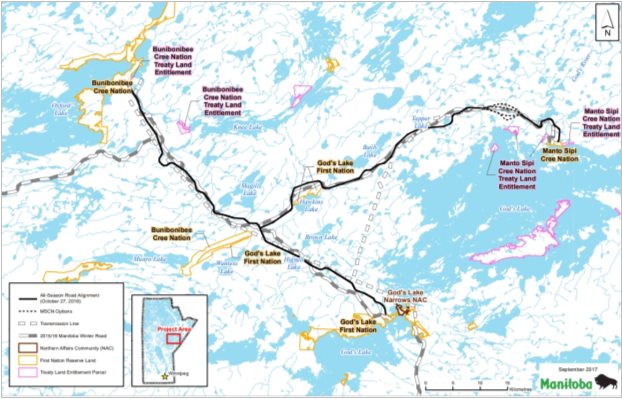
The project would be located in northeastern Manitoba, approximately 550 kilometres north of Winnipeg (Figure 1). The project would be located entirely on provincial Crown land and directly adjacent to the reserve lands of Manto Sipi Cree Nation, Bunibonibee Cree Nation, and God's Lake First Nation, which are located at the terminus of each of the three road segments that comprise the project.
Source: Project 6 – All-season Road, Environmental Impact Statement (April 2019).
Figure Description
The three road sections comprising the project would intersect near Magill Lake, and branch out northeast towards the Manto Sipi Cree Nation reserve, northwest towards the Bunibonibee Cree Nation reserve, and southeast towards the God's Lake First Nation reserve.
Spatial and temporal boundaries of an environmental assessment are established to define the area and timeframe within which a project may interact with the environment and cause environmental effects. The spatial and temporal boundaries vary among valued components, depending on the nature of the potential project interaction with the environment.
2.1.1 Spatial Boundaries
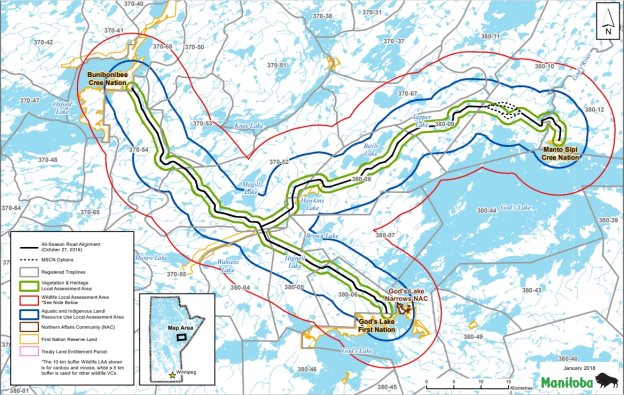
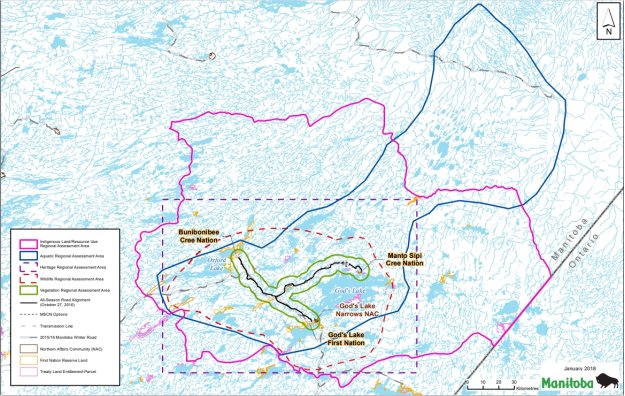
The proponent defined spatial boundaries as the geographic extent over which project-related activities and their potential environmental effects to valued components may occur. The proponent defined three types of spatial boundaries for the environmental assessment: Project Footprint, Local Assessment Area (LAA), and Regional Assessment Area (RAA). Figures 2 and 3 provide a visual representation of the proponent's LAAs and RAAs for each valued component; the spatial extent of the Project Footprint is the same for all valued components.
Proponent's Project Footprint: includes the immediate area within which temporary and permanent project components and activities may occur, including the all-season road, 100-metre ROW along its length, temporary access routes, construction camps, borrow areas, and quarries. The Project Footprint is the anticipated area of direct physical disturbance associated with construction and operation of the project.
Proponent's LAA: includes the area extending beyond the Project Footprint within which measurable direct project-related environmental effects are expected to occur. The LAA is specific to each valued component and includes the geographic extent of effects on the given valued component, in addition to the Project Footprint.
Proponent's RAA: includes the area beyond the LAA within which most potential indirect and cumulative environmental effects are expected to occur. The RAA is specific to each valued component and encompasses the Project Footprint and the LAA for that valued component.
Source: Project 6 – All-season Road, Environmental Impact Statement (April 2019).
Figure Description
The Vegetation and Heritage Resources LAA includes the area within a two-kilometre radius of the Project Footprint; the Indigenous Land and Resource Use LAA, Aquatic LAA, and Wildlife (other than ungulates) LAA includes the area within a ten-kilometre radius of the Project Footprint and Hawkins Lake, Bayly Lake, Hignell Lake, and a portion Magill Lake where the three road sections intersect; and the Wildlife (ungulates) LAA includes the area within a 20-kilometre radius of the Project Footprint and the reserves of Manto Sipi Cree Nation, Bunibonibee Cree Nation, and God's Lake First Nation.
Source: Project 6 – All-season Road, Environmental Impact Statement (April 2019).
Figure Description
The Vegetation RAA includes the area within a ten-kilometre radius of the Project Footprint and partially includes the Manto Sipi Cree Nation, Bunibonibee Cree Nation, and God's Lake First Nation reserves. The Wildlife RAA encompasses the Project Footprint, God's Lake, and portions of Knee Lake and Oxford Lake. The Heritage Resources RAA encompasses the Wildlife RAA, Knee Lake, Oxford Lake, and includes Bolten Lake to the south of the project. The Aquatic RAA encompasses areas upstream and downstream of the LAA connected to watercourses affected by the project, and headwater areas of streams and downstream receiving waterbodies, such as the Hayes River and God's Lake. The Indigenous Land and Resource Use RAA includes the traditional territories of Manto Sipi Cree Nation, Bunibonibee Cree Nation, and God's Lake First Nation, extending to the Manitoba-Ontario border.
2.1.2 Temporal Boundaries
The proponent defined temporal boundaries based on the timing and duration of project activities that could cause environmental effects, including cumulative effects. For all valued components, the proponent defined the temporal boundaries as:
- Construction: estimated to begin in 2030 and would continue for approximately eight years; and
- Operation: immediately following construction and would continue in perpetuity; also includes ongoing and seasonal maintenance activities.
There are no specific plans to decommission the project as it is intended to operate in perpetuity.
2.2 Project Components
The project's components are described below and depicted in Figures 4 and 5.
Existing Infrastructure
The project would be located on mostly undeveloped land, with the exception of existing infrastructure within the RAA which includes winter road corridors extending from Provincial Trunk Highway 6 and Provincial Road 373, and 138-kilovolt transmission lines that service Manto Sipi Cree Nation, Bunibonibee Cree Nation, God's Lake First Nation, and the God's Lake Narrows Northern Affairs Community. On-reserve community infrastructure consists of water treatment plants, landfills, and on-reserve gravel road networks. Once completed, the proposed project would replace the existing winter road segment linking the Manto Sipi Cree Nation, Bunibonibee Cree Nation, God's Lake First Nation reserves, and the winter roads would be decommissioned.
All-season Road
The all-season road would include 141 kilometres of two-lane gravel road, including a new ROW along the entirety of the road length. The ROW would be up to 100 metres wide to maintain sight lines for safety. The all-season road would include an 8.4-metre-wide road top, and the design speed would be 90 kilometres per hour or less depending on natural landscape features. The road would be modified at key access points, such as trapline and community access points (e.g., portages), to include gradual slopes and cleared areas to ensure visibility for oncoming traffic, and to allow snowmobile and all-terrain vehicle crossings.
The project alignment would closely follow the existing winter road corridor, except for occasional deviations of up to three kilometres to avoid unfavorable terrain conditions. Construction of the road and ROW would require clearing of approximately 830 hectares of provincial Crown land.
Watercourse Crossings
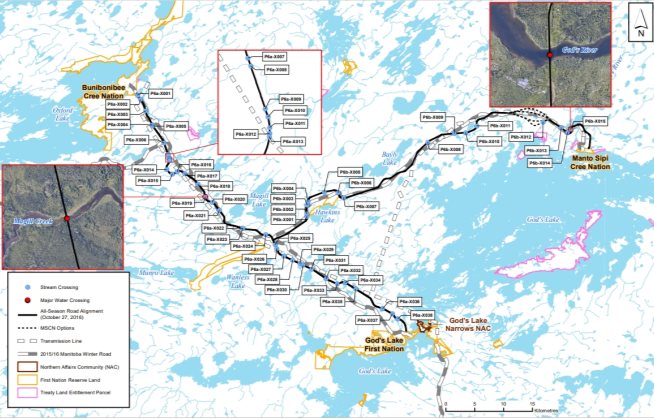
The project includes the construction of crossings at fish-bearing and non-fish-bearing watercourses (Figure 4). This includes a potential replacement or upgrade of the existing Acrow bridge at God's River, construction of a new two-span bridge at Magill Creek, and installation of culverts at 51 stream crossings. Single or multiple round culverts would be used in 23 fish-bearing streams and small diameter culverts with a minimum size of 900 millimetres would be used at 28 non-fish-bearing watercourse crossings. An additional 429 equalization culverts would be installed along the road alignment to maintain hydraulic connectivity.
Source: Project 6 – All-season Road, Environmental Impact Statement (April 2019).
Figure Description
Bridges over major watercourses are included at Magill Creek and God's River, located southeast of the Bunibonibee Cree Nation reserve and northwest of the Manto Sipi Cree Nation reserve, respectively. The location of the 51 proposed culverts at fish-bearing and non-fish-bearing watercourses are also depicted along the entirety of the all-season road length.
Quarries and Borrow Areas
New rock quarries and borrow areas would be established near the road alignment to provide materials for construction and maintenance of the road. These areas would supply rock fill, crushed rock, clay, and granular materials for bridge abutments, culvert crossings, temporary access routes, construction laydown areas, and construction camps. Approximately 384 hectares of provincial Crown land would be required for these quarries and borrow areas during construction.
While the final locations of the 19 quarries and borrow areas required for the project have not been selected, 62 potential quarry locations are being considered (Figure 5). The final locations of quarries and borrow areas would be selected based on their proximity to the road alignment; the potential for acid rock drainage and metal leaching following a site assessment; and avoidance of heritage resources, and sensitive areas, species, or features. A 150-metre buffer would be maintained between the road alignment and borrow areas to minimize environmental disturbance. Up to six quarry locations, occupying approximately 60 hectares of land, would remain open during operation.
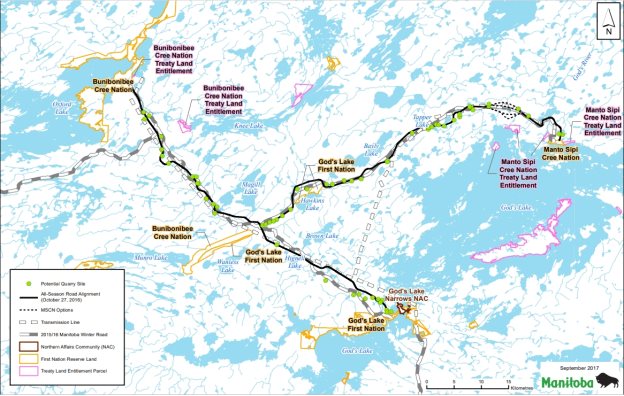
Source: Project 6 – All-season Road, Environmental Impact Statement (April 2019).
Figure Description
Potential quarry site locations are depicted along the entirety of the road alignment; all potential locations are within 500 metres of the centerline of the road alignment. Major water features, First Nation reserve lands, including the Manto Sipi Cree Nation, Bunibonibee Cree Nation, and God's Lake First Nation reserves, Treaty Land Entitlement areas, and the God's Lake Narrows Northern Affairs Community are also depicted.
Temporary Construction Laydown Areas
During construction, a maximum of 15 temporary construction laydown areas would be established to store construction vehicles, machinery, materials, and other supplies necessary for the project. Laydown areas would be constructed within the Project Footprint, would require clearing of approximately 86 hectares of land, and would be sited to minimize the amount of clearing required and overall effects to the environment.
Temporary Construction Camps
Temporary construction camps would be established near the ROW to house project construction crews. A maximum of six camps, covering approximately 96 hectares, would be constructed with each camp accommodating around 40 personnel. Security measures, including fencing and site security, would be implemented, as necessary. Diesel generators would provide electricity for construction camps, with a potential connection to the existing transmission line in the area. Potable water would be trucked in from nearby First Nation reserves; alternatively, potable water may be sourced from on-site groundwater wells. The camps would also contain sanitary and solid waste containment facilities for storage prior to waste disposal and treatment.
Temporary Access Routes
Temporary access routes would be established for quarries, borrow areas, laydown areas, and construction camps during construction. These routes would vary from rough trails to cleared, graded, and graveled service roads. Approximately 13 kilometres of temporary access routes would be developed, resulting in a disturbance footprint of approximately 39 hectares.
Construction-related traffic would be limited to the project's ROW, existing winter roads, and temporary access routes. Existing trails and travel routes adjacent to the project would be unaffected unless necessary for construction and maintenance activities. Public access to temporary routes would be blocked when not in use.
Water Management Infrastructure
Water management infrastructure would be required during project construction to control, collect, and discharge surface and groundwater from project components. Pumps would be used to remove collected water and would discharge onto geofabric, straw bales, or other alternatives to dissipate energy. The discharge point for seepage, runoff, or pumped water from any excavation would be at least 30 metres away from watercourses.
Cofferdams would be installed for erosion protection and sediment control during bridge and culvert construction. In fish-bearing waters, fish rescues would be conducted, and flow would be maintained around isolated work areas through temporary diversions or pumps. Silt curtains would be deployed downstream of granular cofferdams, where required, to control sedimentation.
Waste Disposal
Solid, liquid, and hazardous wastes (i.e., solid non-hazardous waste, kitchen wastes, sewage, grey water, contaminated soil) from the project would be managed in accordance with Manitoba's The Environment Act and The Dangerous Goods Handling and Transportation Act. If contaminated soil from accidental spills is discovered, it would be assessed and removed to approved treatment sites. Waste management plans would be developed by the contractor and domestic solid waste would be transported to the nearest landfill. Wastewater would be collected and hauled to existing treatment plants on the closest First Nation reserve. Waste petroleum products (i.e., lubricants, oils, greases) would be collected and stored in designated areas and containers until they can be properly disposed of or recycled by licensed waste companies.
Facilities for the Storage of Explosives
During construction, blasting activities would be conducted at quarries, as required for road and bridge construction. Blasting would be conducted on an infrequent basis; therefore, a permanent facility for explosives storage would not be required. Explosives and initiation systems would be stored in temporary, independent magazines near blasting sites and would meet the requirements of the Explosives Regulation pursuant to The Explosives Act. Furthermore, the siting of the magazines would meet the requirements of the Operation of Mines Regulation pursuant to Manitoba's The Workplace Safety and Health Act. Should the project require explosives manufacturing, all legislative requirements, and commitments, including those associated with Manitoba's Environmental Protection Procedures and Environmental Protection Specifications, would be adhered to.
2.3 Project Activities and Timing
Construction (Eight Years)
The project would be constructed in segments, beginning at the Bunibonibee Cree Nation reserve and extending to the south and east. ROW clearing for each road segment would be completed during the winter months, where feasible, to facilitate machinery access and minimize potential adverse environmental effects. Vegetation and organic materials would be cleared from a 60-metre-wide portion of the ROW, prior to grading. Organic materials stripped from the ground surface would be stockpiled or bermed on road shoulders for use in reclamation of temporary infrastructure following construction. Timber suitable for use would be salvaged; non-salvageable material would be stockpiled, burned, or buried.
Quarries and borrow areas would be cleared of vegetation and prepared for use. Rock fill and granular materials would be excavated, crushed, sorted, and stockpiled. Temporary crossing structures may be required within the 60-metre cleared ROW; existing roads and cut lines would be used to access temporary crossings, where feasible.
Construction of the roadbed would include topsoil stripping, unsuitable soil removal, installation of geotechnical materials where appropriate, rock and granular material placement and compaction, and trimming and shaping. Concrete batch plants would be used for bridge abutments, piers, and decking at the watercourse crossings at Magill Creek and God's River.
Culvert installation would also occur during construction and would include installing silt fencing, turbidity curtains, or cofferdams to isolate the work area, excavating the stream bed, laying geotextile material; installing the culvert; placing and compacting granular fill and road topping; installation and maintenance of erosion control measures; and restoration of vegetation following construction.
Construction would occur progressively, followed by removal and reclamation of any temporary components, including revegetation with native vegetation.
Operation (Indefinite)
Operation of the proposed project would include ongoing and seasonal road maintenance activities, including culvert steaming and cleaning to maintain water passage. Reclaimed areas where temporary infrastructure was located would be inspected periodically to monitor reclamation and revegetation success.
Up to six quarries would be operated beyond the construction phase to supply road materials for ongoing maintenance of the project.
3 Purpose of and Alternative Means of Carrying out the Project
3.1 Purpose of Project
The purpose of the project is to link the communities of Manto Sipi Cree Nation, Bunibonibee Cree Nation, God's Lake First Nation, and the God's Lake Narrows Northern Affairs Community with a more reliable and permanent all-season road to enable the transfer of people and goods.
3.2 Alternative Means of Carrying Out the Project
CEAA 2012 requires that environmental assessments of designated projects take into account alternative means of carrying out the physical activity that are technically and economically feasible, as well as consider the effects of any such alternative means. IAAC's Operational Policy Statement: Addressing "Purpose of" and "Alternative Means" under CEAA 2012 sets out the general requirements and approach to address the alternative means of carrying out the designated project.Footnote 3
The proponent assessed alternative means of carrying out the following aspects of the project:
- transportation modes;
- all-season road alignment;
- watercourse crossings, including culverts;
- borrow areas and quarries; and
- temporary construction camps and laydown areas.
Input from Indigenous groups, including Indigenous knowledge and project-specific traditional land use information, was considered by the proponent in the alternative means assessment and with respect to project design and siting.
3.2.1 Proponent's Alternative Means Assessment
Transportation Modes
The transportation modes that were considered by the proponent included rail, hovercraft, airships (dirigibles), ferries, improved winter roads, and an all-season road.
Although rail was a comparable alternative to the all-season road option from an economic perspective, construction of a railway would require additional connections to existing rail lines, which restricted user flexibility and increased costs. Hovercrafts were limited in suitability due to potential fen and bog degradation, environmental damage from multiple routes being used, and the risk of damaging ice surfaces during winter, causing hazards for snowmobilers. Airships (dirigibles) would require a large load to be economically feasible and would be sensitive to inclement weather. Ferries provided an option for summer months but would require an ice bridge during the winter, creating safety issues related to ice breaks and environmental degradation.
While improved winter road access did present a viable alternative, it was concluded that the all-season road network is the preferred option as it would provide greater long-term reliability for safe transportation of people and goods in all seasons and weather conditions.
All-season Road Alignment
A preliminary alignment option was proposed by the Province of Manitoba in 2010 based on aerial photo analysis. The proponent considered several alternative alignment options between 2012 and 2016 based on input received during community engagement and project design studies (Figure 6). The route selection criteria used by the proponent included:
- technical considerations, such as travel distance, terrain conditions, availability of construction materials, and other construction constraints and limitations;
- potential effects on species at risk, environmentally sensitive features, aquatic habitat, and habitat fragmentation;
- potential positive and negative effects on current use, culturally sensitive resources, community infrastructure, community well-being, and community knowledge and interests; and
- capital and maintenance costs.
The final preferred alignment chosen would avoid important traditional and heritage resource use areas, use suitable terrain for ease of construction and access to road construction resources, and minimize the length of access roads, the quantity of materials required for construction, the duration of construction, and environmental disturbances.
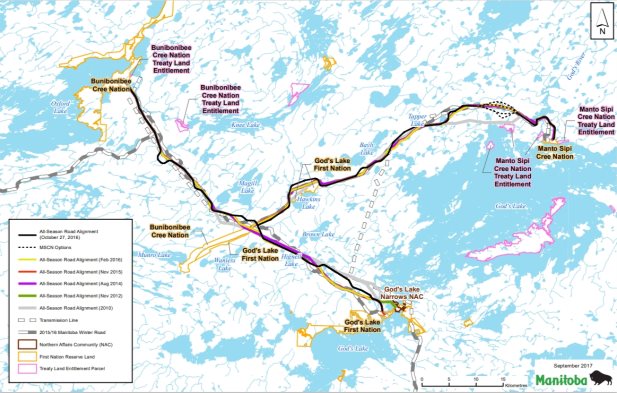
Source: Project 6 – All-season Road, Environmental Impact Statement (April 2019).
Figure Description
The figure displays the overlapping six all-season road alignment alternatives that were proposed between 2012 and 2016, overlaid onto the 2015-2016 winter road alignment, existing transmission lines, First Nation reserve lands, Treaty Land Entitlement areas, and the God's Lake Narrows Northern Affairs Community. God's Lake covers the largest area on the east side of the project, separating Manto Sipi Cree Nation in the north from God's Lake First Nation and the God's Lake Narrows Northern Affairs Community located at the narrows of the God's Lake southern basin, and Bunibonibee Cree Nation is located to the east, adjacent to Oxford Lake in the upper - northwest region. The three separate segments of the project intersect near Wanless Lake, Magill Lake, Hawkins Lake, Brown Lake, and Hignell Lake, approximately 200 kilometres from Lake Winnipeg.
With respect to the eight-kilometre section of road near the Manto Sipi Cree Nation reserve, while the final alignment option has not been selected, four options were considered by Manto Sipi Cree Nation (Figure 7). Options one and two would likely not be suitable due to inadequate terrain and lack of road building materials. Option four would present challenges due to rugged terrain that would require a large amount of road building materials. Option three was recommended to Manto Sipi Cree Nation by the proponent due to its short length, the availability of adequate construction material sources near the alignment, and a relatively smooth horizontal and vertical alignment for ease of construction.
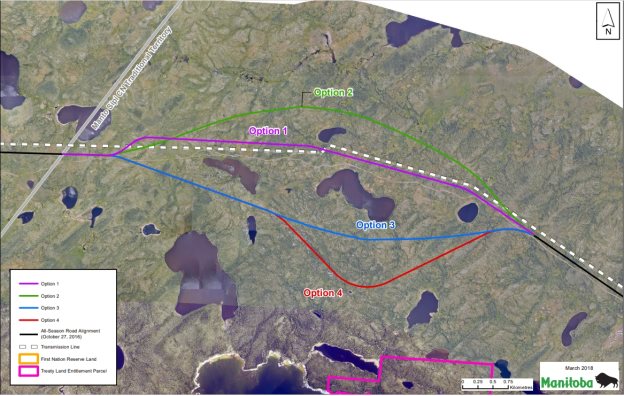
Source: Project 6 – All-Season Road, Environmental Impact Statement (April 2019).
Figure Description
Four options for an eight-kilometre stretch of the proposed all-season road alignment near the Manto Sipi Cree Nation reserve are depicted. A transmission line follows the all-season road alignment and is plotted crossing the gap between the alignment options. Option 1 follows the existing transmission line. Option 2 curves north of the transmission line through an area that appears to have minimal waterbodies. Option 3 curves south of the transmission line and stretches between waterbodies in the area. Option 4 follows Option 3 for part of its length, but curves sharply south near the centre.
Watercourse Crossings
Three options were considered for the bridge crossing at God's River: using the existing Acrow bridge, upgrading or widening the existing bridge, or replacing the existing bridge with a two-span bridge with one in-water pier. While the preferred option for this crossing has not been finalized, it would be chosen based on the availability of funding, channel structure, hydraulics, the ability to maintain navigability, and the presence of fish and fish habitat.
One option was considered for the proposed crossing at Magill Creek: a two-span bridge with one in-water pier. Alternative bridge locations were considered along Magill Creek; the preferred location was selected based on shore-to-shore distance, approach conditions, riparian characteristics, watercourse substrates, hydrology and channel hydraulics, footprint area, the ability to maintain navigability, bridge design standards, traditional knowledge, and heritage resource impact assessments.
Potential culvert locations were identified based on the proximity of the proposed road alignment to streams and the characteristics of those streams, including wetted width, navigability, and riparian conditions. Culverts would be required at approximately 51 locations.
During the detailed design phase of construction, additional factors would be weighed to determine the specifics of culvert size and design, such as potential effects on fish habitat, hydraulic functions, and geotechnical investigations. Crossing type and design may change based on this analysis.
Borrow Areas and Quarries
The proponent identified 62 potential borrow area and quarry sites (Figure 5). Of these, 19 sites would be selected prior to construction, based on the suitability of rock and aggregate materials, degree of roadbed preparation required, proximity to the proposed road alignment, proximity to bridge and other construction sites, proximity to waterbodies, and travel distances required for equipment and workers. Additional considerations may include proximity to known environmentally important or sensitive locations, the potential for loss of habitat for furbearers and migratory birds, the potential for acid rock drainage, and the objective to minimize potential adverse effects to the environment overall. Potential quarry and borrow site locations would be further discussed with members of nearby Indigenous groups at design workshops and community meetings.
Temporary Construction Camps and Laydown Areas
While the final locations for construction camps and laydown areas have not been selected, these components would be sited within the proposed ROW. The preferred locations for temporary construction camps and laydown areas would be selected based on travel distances for equipment and workers, availability of suitable level sites, extent of site preparation required, proximity to the road alignment and other construction sites, proximity to known environmentally important or sensitive locations, and ongoing input from local Indigenous groups.
3.2.2 Views Expressed
God's Lake First Nation, Manto Sipi Cree Nation, and the Manitoba Métis Federation noted concerns regarding the proponent's watercourse crossing designs due to the methods for collecting baseline data at watercourse crossings, the lack of baseline geomorphological and hydrological data, and the assessment of effects to surface water.
A summary of comments provided by Indigenous groups, along with proponent and IAAC responses, is included in Appendix B of this EA Report.
3.2.3 IAAC Analysis and Conclusions
IAAC is of the view that the proponent adequately considered the cost-effectiveness, technical feasibility, reliability, potential environmental effects, and feedback from federal authorities, the public, and Indigenous groups with respect to the identified alternative means of carrying out the project.
IAAC acknowledges that concerns remain regarding the proponent's methods for evaluating and selecting watercourse crossing sites and designs, given the limited information available on surface water drainage patterns in the area. IAAC also recognizes that uncertainty remains regarding the location of quarries, borrow areas, and temporary construction camps, given that final site selection has not occurred. IAAC understands that the proponent considered the potential effects of all potential quarry, borrow area, and temporary construction camp locations in its assessment of potential environmental effects. IAAC also understands that the proponent committed to conducting a data validity review prior to construction, which may include additional baseline data collection and field surveys to inform existing conditions and support the development of a follow-up and monitoring program.
IAAC understands that the proponent committed to ongoing engagement with Indigenous groups regarding the project, its potential effects, and follow-up and monitoring programs. Further details regarding the proponent's plans for future engagement activities are available in Chapter 4 (Consultation and Engagement Activities) and Appendix C. IAAC highlights the importance of ongoing engagement and consultation with Indigenous groups to ensure that potential adverse environmental effects of the project are identified and addressed, and to ensure that Indigenous knowledge is appropriately considered.
IAAC is satisfied that the proponent sufficiently assessed the technically and economically feasible alternative means of carrying out the project and their environmental effects under CEAA 2012.
4 Consultation and Engagement Activities
4.1 Crown Consultation with Indigenous Peoples
The Crown has a duty to consult Indigenous Peoples in Canada and to accommodate, where appropriate, when its proposed conduct might adversely impact Aboriginal or Treaty rights protected under section 35 of the Constitution Act, 1982Footnote 4 (section 35 rights). Consultation with Indigenous Peoples is also undertaken more broadly to aid good governance, sound policy development, and decision-making. The Minister's significance decision pursuant to subsection 52(1) of CEAA 2012 is considered Crown conduct that could give rise to the common law duty to consult and, where appropriate, accommodate with respect to potential adverse impacts on section 35 rights.
For the purposes of the federal environmental assessment, IAAC served as Crown Consultation Coordinator to facilitate a whole-of-government approach to consultation. Indigenous groups that were invited to participate in consultation included those identified as having an interest in the project by reason of the potential for the project to adversely impact section 35 rights.
IAAC is committed to advancing reconciliation by working towards implementing the standards set out in the United Nations Declaration on the Rights of Indigenous Peoples (the Declaration). On June 21, 2021, the United Nations Declaration on the Rights of Indigenous Peoples Act received Royal Assent. This Act provides a road map for the government and Indigenous Peoples to work together to fully implement the Declaration. Consultation efforts for the project have been consistent with the Crown's commitment to implement the Declaration by recognizing and upholding the rights of Indigenous Peoples and ensuring there is effective and meaningful participation of Indigenous Peoples throughout the environmental assessment process. To fulfill the Crown consultation obligations, IAAC conducted Indigenous consultation in an integrated manner with the environmental assessment process. IAAC provided opportunities throughout the environmental assessment for dialogue with Indigenous groups about their concerns through phone calls, correspondence, and in-person and virtual meetings. IAAC provided regular updates to inform Indigenous groups of key developments and to solicit feedback on environmental assessment documents.
4.1.1 Consultation Led by IAAC
In addition to the federal government's broader obligations, CEAA 2012 requires consideration of the effects of changes to the environment on Indigenous Peoples' health and socio-economic conditions, physical and cultural heritage, current use of lands and resources for traditional purposes, and on structures, sites, or things of historical, archaeological, paleontological, or architectural significance. Analysis of potential effects to Indigenous groups is presented in Chapters 7.4, 7.5, and 7.6. An assessment of potential impacts on asserted or established Aboriginal and Treaty rights is discussed in Chapter 9.
Indigenous groups that were invited to participate in consultation activities include those with an interest in the project due to proximity, traditional land use, and the extent of potential adverse impacts on potential or established Aboriginal or Treaty rights. Overall, IAAC identified ten Indigenous groups whose section 35 rights may be impacted by the project, including:
- Bunibonibee Cree Nation;
- Garden Hill First Nation;
- God's Lake First Nation;
- Manto Sipi Cree Nation;
- Norway House Cree Nation;
- Pimicikamak Okimawin (Cross Lake First Nation);
- Red Sucker Lake First Nation;
- St. Theresa Point First Nation;
- Wasagamack First Nation; and
- Manitoba Métis Federation.
IAAC supported the participation of Indigenous groups in the environmental assessment process through its Participant Funding Program. Funds were made available to reimburse eligible expenses of participating Indigenous groups. Eight of the identified Indigenous groups applied for and were allocated a total funding amount of $489,288.70 through this program.
IAAC provided Indigenous groups with opportunities to learn about the project, discuss concerns about the project's potential environmental effects and potential impacts to section 35 rights, and discuss possible mitigation and accommodation measures, as appropriate. This information contributed to the Crown's understanding of the project's potential adverse impacts on section 35 rights, Treaty rights, and the effectiveness of measures proposed to avoid or minimize those impacts. IAAC integrated the Crown's consultation and engagement activities throughout the environmental assessment process and invited Indigenous groups to review and provide written comments during formal comment periods on the environmental assessment documents listed in Table 2. Indigenous groups will also be provided an opportunity to review and provide comments on the draft EA Report and draft potential conditions.
|
Subject of Consultation |
Dates |
|---|---|
|
Summary of Project Description |
June 13, 2017 to July 4, 2017 |
|
Draft EIS Guidelines |
July 28, 2017 to August 28, 2017 |
|
EIS Summary and EIS |
May 6, 2019 to June 6, 2019 |
|
EIS Technical Review |
May 6, 2019 to September 29, 2025 |
|
Draft EA Report and draft potential conditions |
November 7, 2025 to December 8, 2025 |
IAAC met with and considered comments from Indigenous groups during the review of the EIS and the EIS Summary when identifying and communicating information requirements to the proponent. Indigenous groups were provided opportunities to review and comment on additional information provided by the proponent throughout the EIS technical review.
IAAC met with individual Indigenous groups during the public comment period on the summary of the EIS and throughout the EIS technical review. IAAC listened to and documented their views on how the project may adversely impact their asserted or established Aboriginal or Treaty rights, and heard their suggestions for how these impacts could be avoided, mitigated, or accommodated.
IAAC will also consider and integrate comments received from Indigenous groups on the draft EA Report and draft potential conditions. IAAC will offer to meet with Indigenous groups to discuss the draft EA Report to support their review.
Appendix B contains a summary of comments received by IAAC from Indigenous groups, along with responses from the proponent and IAAC. A subset of comments is also discussed in the context of individual valued components throughout Chapters 6, 7, 8, and 9.
4.2 Proponent Indigenous Engagement Activities
The proponent engaged with all ten Indigenous groups identified by IAAC for consultation, along with the God's Lake Narrows Northern Affairs Community located in Manitoba. Engagement methods included in person and virtual meetings, phone calls, emails, written letters, and reports provided by the proponent. The proponent stated that they would continue to provide information and to solicit feedback from Indigenous groups on the project, mitigation measures, monitoring, and follow-up programs.
Pre-project engagement and consultation began in 2000 with the establishment of the East Side Planning Initiative and the East Side Round Table, which consisted of First Nations, Métis, local communities, and environmental, industry, and recreational organizations, to develop a broad area plan and an all-season road network feasibility study for the east side of Lake Winnipeg. In 2008, the proponent commissioned the Large Area Transportation Network Study to identify a preferred all-season road network. As a part of the study, the proponent conducted engagement and consultation activities with Indigenous groups from 2009 to 2011. The proponent also conducted engagement and consultation activities from 2010 to 2016 to gather more detailed information for the selection of the project's road alignment.
The proponent's project-specific engagement with Manto Sipi Cree Nation, Bunibonibee Cree Nation, and God's Lake First Nation began in 2016. The project was submitted to IAAC and began the federal environmental assessment process on July 28, 2017. The proponent's engagement activities expanded in 2018 following direction provided by IAAC in the Guidelines for the Preparation of an Environmental Impact Statement for the project, to include the following additional Indigenous groups:
- Garden Hill First Nation;
- Norway House Cree Nation;
- Pimicikamak Okimawin (Cross Lake First Nation);
- Red Sucker Lake First Nation;
- St. Theresa Point First Nation;
- Wasagamack First Nation; and
- Manitoba Métis Federation.
Key concerns raised by Indigenous groups during proponent engagement included:
- the level of consultation conducted with the Manitoba Métis Federation to solicit information about Métis values, rights, interests, and land use, which is necessary for a comprehensive environmental assessment;
- the level of engagement with First Nations in the area;
- effects to the current use of lands and resources for traditional purposes, including fishing, gathering, harvesting, hunting, and trapping;
- effects to physical and cultural heritage and sites of significance; and
- effects to Indigenous Peoples' health and socio-economic conditions, including commercial harvesting.
4.3 Public Participation
4.3.1 Public Participation Led by IAAC
To date, IAAC has provided multiple opportunities for the public to participate in the environmental assessment process, which includes formal comment periods on the Summary of the Project Description, draft EIS Guidelines, EIS Summary and EIS, and the draft EA Report and draft potential conditions. Notices of opportunities to participate were posted on the project's Canadian Impact Assessment Registry website and advertised through local media.
IAAC made funding available through its Participant Funding Program to support the public in reviewing and providing comments. To date, no requests for funding from public stakeholders have been received in relation to the project.
IAAC received one submission from a member of the public during the environmental assessment process pertaining to alternative means of carrying out the project. This represents some of the issues, concerns, and views that were expressed and considered throughout the environmental assessment process.
4.3.2 Public Participation Led by the Proponent
Pre-project engagement with the public as part of the broader East Side Road Planning Initiative began in 2000 through the East Side Round Table. Project-specific public engagement commenced in May 2017. In May and November 2017, the proponent held two open houses in Winnipeg with 23 attendees and 14 attendees, respectively. Following these open houses and throughout the environmental assessment process, the proponent also provided project information through community presentations, newsletters, comment sheets, and maps, and continued conversations with interested stakeholders through letters, questionnaires, and one-on-one meetings.
Key issues raised by the public during proponent engagement include:
- the need for the road to be constructed earlier than proposed;
- effects to the current use of lands and resources for traditional purposes by Indigenous Peoples;
- the potential for the project to result in increased substance abuse due to open access;
- effects to wildlife and wildlife habitat within the RAA;
- effects to the environment, including climate change and permafrost;
- effects to surface water and groundwater, including watercourse crossings; and
- the need for follow-up and monitoring of effects to valued components after construction of the project.
5 Existing Ecosystem
CEAA 2012 defines the environment as the components of the earth, including the land, water, and air, all organic and inorganic matter and living organisms, and the interacting natural systems that include these components. This chapter summarizes information on the existing ecosystem presented by the proponent.
5.1 Biophysical Environment
The project would be located in the Boreal Shield Ecozone, Hayes River Upland Ecoregion, High Boreal Ecoclimatic Region, and the Ecodistricts of God's River and the Knee Lake, which are generally comprised of forested and wetland habitats. The proponent identified 12 plant species of cultural importance to Indigenous Peoples, including three species of medicinal plants, and 14 plant species of conservation concernFootnote 5 that have the potential to occur within the RAA.
Forested and wetland areas present in the Project Footprint, LAA, and RAA provide habitat for a diverse range of wildlife species, including migratory birds, species of traditional and cultural importance to Indigenous Peoples, and species of conservation concern, including caribou (Rangifer tarandus caribou), wolverine (Gulo gulo), and little brown myotis (Myotis lucifugus).
Two different ecotypes of caribou may be present in the RAA: the eastern migratory population (Penn Island Caribou) and boreal woodland caribou (Norway House). The Project Footprint overlaps with the Manitoba North Range, an area delineated federallyFootnote 6 as containing habitat for boreal woodland caribou, and the Molson Management Unit, a provincially designatedFootnote 7 geographic unit used to facilitate the management of boreal woodland caribou ranges.
The project would be located within the Hayes River watershed, which includes God's River, Hayes River, God's Lake, and Oxford Lake. Surface water from the Hayes River drainage basin and watershed generally flows northeast, through Oxford Lake and Knee Lake, ultimately discharging into Hudson Bay. Extensive wetland systems, such as bogs and fens, are linked to the local rivers and creeks in the Hayes River watershed through small drainage paths and serve as natural water reservoirs.
Permafrost is known to be present in the area of the project, which can restrict the movement of groundwater due to its influence on infiltration, runoff, groundwater storage, and flow. Waterbodies within the Project Footprint were characterized as slightly acidic with relatively high alkalinity, low dissolved oxygen levels, relatively low nutrient concentrations, low productivity, and high clarity. Ammonia, nitrate, phosphorus, and nitrite concentrations, and pH levels were generally found to be within provincial and federal guidelines.
Groundwater supplies in the region are available within the upper 60 to 150 metres of bedrock. Overall, groundwater quality is relatively uniform throughout the Project Footprint, meeting federal and provincial drinking water quality standards.
The proponent indicated that as many as 32 fish species may occur within the RAA, including lake sturgeon (Acipenser fulvescens) which is considered a species at risk. The Aquatic LAA includes a range of ephemeral, intermittent, and perennial watercourses that provide a variety of low to high quality fish habitat. Magill Creek is comprised largely of fine sediments with boulders and instream vegetation, suitable for spawning, rearing, feeding, and overwintering for northern pike (Esox lucius) and forage fish, such as fathead minnow (Pimephales promelas). Gravel and cobbles provide suitable spawning and rearing habitat for longnose sucker (Catostomus catostomus), white sucker (Catostomus commersoni), and walleye (Sander vitreus). Substrates within God's River consist largely of coarse material and sand, which provides suitable foraging, rearing, and spawning habitat for a range of species, including northern pike, longnose sucker, white sucker, walleye, and brook trout (Salvelinus fontinalis).
Generally, the remaining rivers and lakes within the Project Footprint are less than one metre in depth, which may be used as spawning and nursery habitat by larger fish species and forage species. Wetlands within the LAA, though capable of hosting smaller fish species able to tolerate low oxygen levels, are typically anoxic over the winter and generally disconnected from fish bearing waters.
5.2 Human Environment
The project would be located in a remote, sparsely populated region, where traditional and resource-use activities (e.g., hunting, fishing, trapping, and gathering); recreation and tourism (e.g., hunting, trapping, fishing, hiking, camping, and snowmobiling); and some mining activities are the primary land uses. The RAA falls within Manitoba Game Hunting Area 3A, and there are eight lodges and outfitters that operate in the RAA. Commercial trapping, guiding, and tourism are the major sources of income for people living in this region. Wildlife species commercially trapped within the RAA include marten and other furbearers. Air emissions are limited to local and transport vehicles on the existing winter road, air traffic, emissions from forest fires, and other human activities, such as the use of wood stoves and open fires.
The project would be located on provincial Crown lands within the territory of Treaty 5, the traditional territories of many First Nations and Métis Peoples, and the Manitoba Métis Federation's Thompson Region. The reserve lands of Manto Sipi Cree Nation, Bunibonibee Cree Nation, and God's Lake First Nation are located directly adjacent to the three endpoints of the road. Treaty Land Entitlement areas of Manto Sipi Cree Nation, Bunibonibee Cree Nation, and God's Lake First Nation are also located within the RAA, with Manto Sipi Cree Nation's being the closest at approximately 660 metres from the Project Footprint. The God's Lake Narrows Northern Affairs Community would be located approximately three kilometres from the end of the southeastern leg of the project.
Through the proponent's Indigenous engagement program, Manto Sipi Cree Nation, Bunibonibee Cree Nation, and God's Lake First Nation indicated that their citizens continue to use the RAA to support traditional and cultural activities, including hunting, trapping, fishing, camping, recreation, ceremonies, and plant gathering for food and medicinal uses. These Nations also identified important trails and travel routes; hunting, fishing, plant gathering, trapping, and cultural use sites; and archaeological sites within the LAA and RAA, including some associated with the existing winter road, Oxford Lake, God's Lake, God's River, Knee Lake, and other major watercourses.
Two registered trapline districts, Oxford House and God's Lake, are located partially within the LAA and ten registered traplines intersect the Project Footprint. These traplines are registered to members of Manto Sipi Cree Nation, Bunibonibee Cree Nation, and God's Lake First Nation, who have exclusive opportunity to harvest furbearers. Traplines are used to exercise traditional practices, including hunting, fishing, gathering, and ceremonial practices.
As there is no existing all-season road connection to the broader provincial road network within the RAA, access to and within the RAA is primarily facilitated through air travel (year-round) and winter roads (seasonal). Thompson, located approximately 186 kilometres from the Bunibonibee Cree Nation reserve by air, is the closest city to the Project Footprint.
There are no known national historic sites, provincial parks, designated protected areas, or other lands protected under the Manitoba Protected Areas Initiative within the RAA. A small portion of the Project Footprint falls within the Knee Lake Ecodistrict, which is an Area of Special InterestFootnote 8 and a candidate for protection under the Manitoba Protected Areas Initiative. The Hayes River is a designated Heritage River under the Canadian Heritage Rivers System and a portion of the Middle Track and Hayes River designated canoe route passes through the Indigenous RAA.
Twelve previously unrecorded heritage sites were identified within the LAA during a Heritage Resources Impact Assessment conducted for the project, including two historic portages: one leading from the west side of God's Lake to Bayly Lake, and another near the God's River rapids. Two pre-contact archaeological sites were also identified within the project's ROW.
6 Predicted Changes to the Environment
6.1 Atmospheric Environment
IAAC summarized the proponent's assessment of changes to the atmospheric environment with input from federal authorities and Indigenous groups. This summary supports the analysis of effects on fish and fish habitat (Chapter 7.1), migratory birds (Chapter 7.2), species at risk (Chapter 7.3), Indigenous Peoples' current use of lands and resources for traditional purposes, physical and cultural heritage, and sites of significance (Chapter 7.4), Indigenous Peoples' health and socio-economic conditions (Chapter 7.5), and federal lands (Chapter 7.6).
IAAC is of the view that the proponent adequately considered potential effects of the project on the atmospheric environment and that the proponent's proposed mitigation measures, monitoring, and follow-up programs (Appendix C) are appropriate to address potential project effects to the atmospheric environment. IAAC's conclusions are based on an analysis of the proponent's assessment, including the proponent's proposed mitigation, monitoring, and follow-up measures, and the views expressed by federal authorities, Indigenous groups, and the public.
6.1.1 Proponent's Assessment of Environmental Effects
Air Quality
Construction, operation, and maintenance activities associated with the project, including clearing of the ROW, vehicle and equipment operation, road use, aggregate stockpiling, roadbed construction and repair, hauling materials, blasting, rock crushing, and burning of brush piles, have the potential to generate fugitive dust emissions, total suspended particulates, and particulate matter (PM2.5 and PM10). Operation of equipment and blasting during construction, and use of the road by public and commercial vehicles during operation could also result in elevated emissions of carbon monoxide (CO), sulphur oxides (SOx), nitrogen oxides (NOx), diesel particulates, volatile organic compounds (VOCs), and ammonium nitrate and fuel oil (ANFO).
While the proponent did not directly model project-related air emissions, it was predicted that increased fugitive dust and particulate matter concentrations from project activities would be limited to the portions of the Project Footprint undergoing active construction and maintenance, or active quarrying, as particulates typically settle rapidly upon cessation of activities that produce them. During operation, any potential increase in particulate matter concentrations would vary by season, being more likely to occur during summer and fall months when the road is dry and not frozen, and during periods of higher vehicle traffic volumes.
During construction and operation, concentrations of SOx, NOx, diesel particulates, and VOCs were predicted to exceed the Manitoba Ambient Air Quality Criteria (MAAQC) and Canadian Ambient Air Quality Standards (CAAQS) limits. However, the proponent anticipated that these exceedances would be limited to the Project Footprint; any project-related increases in air contaminant concentrations in the LAA and RAA would be unlikely to exceed air quality guidelines, given the lack of other emissions sources in the region. Exceedances of MAAQC and CAAQS limits were not predicted at sensitive receptor locations on the Manto Sipi Cree Nation, Bunibonibee Cree Nation, or God's Lake First Nation reserves.
The proponent predicted that, following the implementation of mitigation measures, residual project effects to air quality would be low in magnitude, readily reversible, sporadic, long-term, and limited to the Project Footprint. Effects resulting from public and commercial vehicle emissions would be long-term, frequent, and regular.
Light, Noise, and Vibration Levels
The proponent stated that there would be no lighting required during construction or operation of the project; therefore, no effects to light levels within the Project Footprint or LAA were anticipated.
Project activities during all phases, including blasting, drilling, rock crushing, vehicle traffic, and vehicle and equipment use, could result in elevated noise and vibration levels, with drilling and rock crushing resulting in the highest noise level increases. While the proponent did not directly model project-related noise increases, based on similar road projects in the area, noise levels above baseline conditions were not predicted to occur beyond 300 metres of project construction activities or beyond 500 metres of blasting locations. With the exception of drilling, the proponent anticipated that project-related noise increases during construction and operation would be below limits set out in the Canadian Centre for Occupational Health and Safety's Noise - Occupational Exposure Limits in Canada and Health Canada's Guidance on Evaluating Human Health Effects in Impact Assessment: Noise at a distance of approximately 50 metres from the project, which is less than the distance to the nearest known human residence. Project-related increases in vibration levels were not predicted to extend beyond the Project Footprint.
The proponent predicted that, following the implementation of mitigation measures, project-related changes to noise and vibration levels during all phases would be low in magnitude, long-term, regular and frequent, readily reversible, and may extend into the LAA.
6.1.2 Views Expressed
Manto Sipi Cree Nation, the Manitoba Métis Federation, and Pimicikamak Okimawin expressed concerns regarding the potential for particulate matter, dust, and other air contaminants to migrate to nearby reserve lands causing adverse effects to Indigenous Peoples' health and requested that the proponent develop a mitigation plan for each potentially affected Indigenous reserve.
Manto Sipi Cree Nation and Health Canada noted that, given the lack of air quality baseline data in the RAA, there is a high level of uncertainty with respect to potential project effects on human health. They recommended that the proponent collect air quality baseline data for the Project Footprint and LAA prior to construction for all contaminants of potential concern, and develop a follow-up and monitoring program for the project to ensure that there are no exceedances of air quality guidelines; this data should be made publicly available. Health Canada also expressed concerns regarding predicted project-related exceedances of CAAQS limits for NO2 and PM2.5, given that these are non-threshold contaminants which can cause adverse human health effects even at low concentrations, and recommended that the proponent develop additional mitigation measures to reduce NO2 and PM2.5 concentrations to the extent possible.
Health Canada noted concerns regarding the level of uncertainty with respect to the proponent's assessment of project-related effects to noise levels, and therefore human health, and noted that high nighttime noise levels and construction noise could occur at nearby receptor locations, including Indigenous receptors. Health Canada and Manto Sipi Cree Nation recommended that the proponent collect baseline lighting, vibration, and ambient noise data prior to construction, and develop a noise follow-up and monitoring plan. Health Canada also recommended that the proponent develop and implement a protocol to collect and resolve noise complaints when peak noise generating activities associated with the project are anticipated.
A summary of the comments provided by Indigenous groups, along with proponent and IAAC responses, is included in Appendix B of this EA Report.
6.1.3 IAAC Analysis and Conclusions
IAAC is of the view that the proponent adequately characterized potential project effects to the atmospheric environment, including effects to air quality and noise, light, and vibration levels. IAAC recognizes that the project may result in exceedances of the MAAQC and CAAQS limits for NOx, CO, SOx, PM2.5, PM10, and total suspended particulates during construction and operation, and that uncertainty remains regarding the accuracy of the proponent's baseline data with respect to air quality. IAAC understands that the proponent committed to conducting a data validity review prior to construction, which may include additional baseline data collection and field surveys to inform existing conditions. IAAC agrees with Manto Sipi Cree Nation and Health Canada that the proponent should develop an air quality follow-up and monitoring program to verify the results of the environmental assessment, verify the effectiveness of mitigation measures, and inform the need for the implementation of contingency measures.
IAAC acknowledges that concerns remain regarding potential effects to human health as a result of project-related dust and particulate matter emissions. IAAC understands that the proponent committed to implementing dust and particulate matter control and suppression procedures, including the use of non-chemical dust suppressants, to mitigate project-related dust emissions. IAAC agrees with Health Canada's recommendation that the proponent implement additional mitigation measures to reduce NO2 and PM2.5 emissions to the extent possible to be protective of human health.
With respect to project-related effects to noise and vibration levels, IAAC acknowledges that uncertainty remains regarding the extent and magnitude of project effects at key receptor locations. IAAC understands that the proponent committed to conducting a data validity review prior to construction, which may include additional baseline data collection and field surveys to inform existing conditions. IAAC recommends that the proponent develop a noise and vibration follow-up and monitoring program to verify the results of the environmental assessment, verify the effectiveness of mitigation measures, and inform the need for the implementation of contingency measures, taking into account Health Canada's Guidance on Evaluating Human Health Effects in Impact Assessment: Noise. IAAC also agrees with Health Canada's recommendation that the proponent develop and implement a procedure to accept and resolve complaints regarding project-related noise.
IAAC highlights the importance of continued engagement with Indigenous groups regarding the development and implementation of mitigation measures, monitoring, and follow-up programs with respect to the atmospheric environment to ensure potential effects to Indigenous Peoples' health and Indigenous knowledge are adequately considered.
IAAC is of the view that potential effects of the project to the atmospheric environment would be adequately addressed, taking into account the implementation of the mitigation, follow-up, and monitoring measures proposed by the proponent (Appendix C) and the key mitigation measures described below.
Key Mitigation Measures and Monitoring to Avoid Significant Effects and Follow-Up Program Requirements
IAAC considers the following mitigation measures, monitoring, and follow-up programs to be necessary to ensure that there are no significant adverse environmental effects to fish and fish habitat, migratory birds, and Indigenous Peoples as a result of changes to the atmospheric environment. The following key mitigation measures are based on mitigation measures, monitoring, and follow-up programs proposed by the proponent, expert advice from federal authorities, and comments received from Indigenous groups.
Mitigation Measures
- During construction and operation, apply non-chemical dust suppressants, including water, that have the least potential for adverse environmental effects during dry periods when dust generation is expected or is occurring, such as periods of drought and high winds, to control fugitive dust emissions.
Follow-up and Monitoring
- Develop a follow-up program, prior to construction and in consultation with relevant federal and provincial authorities and Indigenous groups, regarding project-related effects to air quality, which will include:
- prior to construction, verification of baseline air quality data for the Project Footprint and LAA, including for total suspended particulates, PM2.5, PM10, CO, SOx, NOx, VOCs, and ANFO, taking into account Health Canada's Guidance for Evaluating Human Health Effects in Impact Assessment: Air Quality, to inform follow-up and monitoring related to air quality;
- continuous monitoring of ambient total suspended particulates, CO, SOx, VOCs, ANFO, PM10, NOx, and PM2.5 concentrations during construction and for at least the first two years of operation. For monitoring locations, include areas upwind and downwind of the Project Footprint and any other locations identified in consultation with Indigenous groups and relevant federal and provincial authorities; and
- if contaminant concentrations exceed CAAQS or MAAQC limits, development of additional mitigation measures in consultation with Health Canada, other relevant federal and provincial authorities, and Indigenous groups, to reduce project-related emissions.
- Develop a follow-up program, prior to construction and in consultation with relevant federal and provincial authorities and Indigenous groups, regarding project-related increases in noise and vibration levels, which will include:
- prior to construction, verification of baseline noise and vibration levels within the Project Footprint and LAA, taking into account Health Canada's Guidance on Evaluating Human Health Effects in Impact Assessment: Noise;
- during construction, continuous monitoring of noise and vibration levels at key receptor locations within the Project Footprint and LAA where effects to the health of wildlife (i.e., migratory birds, fish, and species of cultural and traditional importance to Indigenous Peoples) and Indigenous Peoples may occur, taking into account Health Canada's Guidance on Evaluating Human Health Effects in Impact Assessment: Noise;
- if noise and vibration levels exceed thresholds identified in Health Canada's Guidance on Evaluating Human Health Effects in Impact Assessment: Noise, development of additional mitigation measures, in consultation with Health Canada and Indigenous groups, to reduce noise and vibration levels; and
- development of a public complaints protocol to receive and address noise or vibration complaints in a timely manner. Information on this protocol and how to file a complaint will be made publicly available online.
Additional mitigation measures, monitoring, and follow-up programs applicable to project-related effects to the atmospheric environment can be found in the following chapters of this EA Report: Indigenous Peoples – Health and Socio-economic Conditions (Chapter 7.5).
6.2 Groundwater
IAAC summarized the proponent's assessment of changes to groundwater and hydrogeology. This summary supports the analysis of potential project effects to fish and fish habitat (Chapter 7.1), migratory birds (Chapter 7.2), species at risk (Chapter 7.3), Indigenous Peoples' current use of lands and resources for traditional purposes, physical and cultural heritage, and sites of significance (Chapter 7.4), Indigenous Peoples' health and socio-economic conditions (Chapter 7.5), and federal lands (Chapter 7.6).
IAAC is of the view that the proponent adequately considered potential effects of the project on groundwater quality and hydrogeology, and that the proponent's proposed mitigation measures, monitoring, and follow-up programs (Appendix C) are appropriate to address potential project effects to groundwater. IAAC's conclusions are based on an analysis of the proponent's assessment, including the proponent's proposed mitigation, monitoring, and follow-up measures, and the views expressed by federal authorities, Indigenous groups, and the public.
6.2.1 Proponent's Assessment of Environmental Effects
Changes in Groundwater Quantity
Changes in groundwater quantity and flow could occur during construction and operation in localized areas within the Project Footprint that are immediately surrounding excavated quarries and borrow areas, particularly if dewatering is required. However, the proponent estimated that the reduction in groundwater levels in areas surrounding quarries and borrow areas would be temporary and would result in a change of less than 15 percent relative to baseline conditions. The proponent also did not anticipate changes to groundwater-surface water interactions, given the hydrogeology of the region. During construction, potable water for construction camps may be sourced from groundwater resources if it cannot be sourced from on-reserve water treatment plants. However, the proponent indicated that withdrawals, if required, would only occur during construction and all appropriate provincial approvals and permits would be acquired prior to construction.
The proponent anticipated that, with the implementation of mitigation measures, effects to groundwater quantity and flow during construction and operation would be negligible to low in magnitude, reversible in the short-term, sporadically occurring, and would be limited to the Project Footprint.
Groundwater Quality
The project may adversely affect groundwater quality during construction and operation as a result of acid rock drainage and metal leaching from excavation of quarries and borrow areas, and weathering of crushed rock used for road construction, should this material be potentially acid generating. Should acidic leachate infiltrate into groundwater through porous soil materials, it could acidify groundwater resources and increase concentrations of heavy metals, such as iron, zinc, nickel, copper, lead, arsenic, aluminum, and manganese. However, with the implementation of mitigation measures, including avoiding sites with high acid rock drainage potential and, where avoidance is not possible, use of engineered covers, the proponent predicted that contaminant concentrations would remain below limits established in the Canadian Water Quality Guidelines for the Protection of Aquatic Life (CWQG-PAL) and Manitoba Water Quality Standards, Objectives, and Guidelines (MWQSOG).
The proponent predicted that, with the implementation of mitigation measures, residual effects to groundwater quality from the project would be negligible to low in magnitude, reversible over a long period, sporadically occurring throughout construction and infrequently occurring throughout operation, would extend to the LAA, and would occur throughout the life of the project.
6.2.2 Views Expressed
Natural Resources Canada noted concerns regarding potential project effects on groundwater and the need for the implementation of appropriate mitigation measures, follow-up, and monitoring programs.
6.2.3 IAAC Analysis and Conclusions
IAAC is of the view that the proponent adequately characterized potential project effects on groundwater quantity and quality. Given the limited pathways of potential project effects to groundwater and the mitigation measures proposed by the proponent, IAAC is of the view that project effects to groundwater would likely be limited. IAAC understands that the proponent committed to conducting a review of data validity prior to construction, which may include collection of additional baseline information and field surveys to inform their understanding of existing conditions and support the development of a follow-up and monitoring program. IAAC highlights the importance of a follow-up and monitoring program with respect to groundwater to verify the results of the environmental assessment, verify the effectiveness of mitigation measures, and inform the need for the implementation of contingency measures.
IAAC is of the view that potential effects of the project on groundwater quantity and quality would be adequately addressed, taking into account the implementation of the mitigation, follow-up, and monitoring measures proposed by the proponent (Appendix C) and the key mitigation measures described below.
Key Mitigation Measures and Monitoring to Avoid Significant Effects and Follow-Up Program Requirements
IAAC considers the following mitigation measures, monitoring, and follow-up programs to be necessary to ensure that there are no significant adverse effects to areas within federal jurisdiction, including fish and fish habitat, migratory birds, and Indigenous Peoples, as a result of changes to groundwater quantity and quality. The following key mitigation measures are based on mitigation measures, monitoring, and follow-up programs proposed by the proponent, expert advice from federal authorities, and comments received from Indigenous groups.
Mitigation Measures
- Collect and manage contact water and seepage, including groundwater that discharges into quarries and borrow areas, during construction and the period of operation during which project-related quarries and/or borrow areas are active. Treat contact water and seepage to meet the CWQG-PAL and MWQSOG limits prior to discharge into the receiving environment.
Follow-up and Monitoring
- Develop a follow-up program, prior to construction and in consultation with Indigenous groups and relevant federal and provincial authorities, to provide a framework for monitoring project-related changes to groundwater quantity and quality, verify the effectiveness of mitigation measures implemented to protect groundwater quantity and quality, verify the results of the environmental assessment, and inform adaptive management decisions. Implement the groundwater follow-up program during construction and the period of operation during which project-related quarries and borrow areas remain active, and include:
- monitoring of groundwater quality in locations that may be affected by quarries or borrow areas within the Project Footprint for all parameters that may adversely affect fish and fish habitat, including acidity (pH), sulphates, and heavy metals, including aluminum, arsenic, copper, iron, lead, manganese, nickel, and zinc;
- monitoring of groundwater elevation at monitoring locations on a seasonal basis; and
- contingency measures that will be implemented should monitoring results demonstrate unanticipated effects attributable to the project, taking into account limits established in the CWQG-PAL or the MWQSOG, whichever is most protective of fish and fish habitat.
Additional mitigation measures, monitoring, and follow-up programs applicable to project-related effects to groundwater can be found in the following chapters of this EA Report: Surface Water (Chapter 6.3), Indigenous Peoples – Current Use of Lands and Resources for Traditional Purposes, Physical and Cultural Heritage, and Sites of Significance (Chapter 7.4), Indigenous Peoples – Health and Socio-economic Conditions (Chapter 7.5), Federal Lands (Chapter 7.6), and Effects of Accidents and Malfunctions (Chapter 8.1).
6.3 Surface Water
IAAC summarized the proponent's assessment of project-related changes to surface water quantity and quality. This summary supports the analysis of effects to fish and fish habitat (Chapter 7.1), migratory birds (Chapter 7.2), species at risk (Chapter 7.3), Indigenous Peoples' current use of lands and resources for traditional purposes, physical and cultural heritage, and sites of significance (Chapter 7.4), Indigenous Peoples' health and socio-economic conditions (Chapter 7.5), and federal lands (Chapter 7.6).
IAAC is of the view that the proponent adequately considered potential effects of the project on surface water and that the proponent's proposed mitigation measures, monitoring, and follow-up programs (Appendix C) are appropriate to address potential project effects to surface water. IAAC's conclusions are based on an analysis of the proponent's assessment, including the proponent's proposed mitigation, monitoring, and follow-up measures, and the views expressed by federal authorities, Indigenous groups, and the public.
6.3.1 Proponent's Assessment of Environmental Effects
Changes to Surface Water Quantity
The project may cause alterations to surface water quantity, drainage, and flows during construction and operation as a result of site preparation activities and infrastructure installation, including the construction of bridges at God's River and Magill Creek and culvert installations at stream crossings. Any required in-water works to construct watercourse crossings under unfrozen conditions may require the temporary installation of cofferdams. These activities may result in changes to surface water drainage patterns by concentrating flow at certain points, and could result in localized flooding, soil erosion, channel and bank alterations, and siltation of watercourses. The development of quarries, borrow areas, and temporary access roads may also disrupt surface water drainage patterns, resulting in increased or decreased flows in nearby watercourses. However, the proponent was of the view that the project would not alter flow patterns to a sufficient degree to affect existing winter thaw and ice flow patterns, given the mitigation measures proposed and that watercourse crossings would be designed to accommodate 1-in-50 year flood events.
The proponent predicted that, following the implementation of mitigation measures, residual effects to surface water quantity, drainage, and flows during construction and operation would be negligible to low in magnitude, infrequent, reversible over the long-term, and limited to the LAA.
Changes to Surface Water Quality
Erosion and Sedimentation
The project may result in increased erosion and sedimentation during construction through installation of watercourse crossings; quarry and borrow area excavation; construction of temporary access roads; vegetation removal within the ROW; and operation of heavy equipment near waterbodies and watercourses. Operation of heavy equipment within the Project Footprint could also result in soil compaction and reduced infiltration, which could increase surface runoff, erosion, and sediment transport to nearby waterbodies. An increase in suspended sediment concentrations in waterbodies and watercourses, including at Magill Creek, God's River, and various unnamed tributaries within the Project Footprint and LAA, could result in exceedances of MWQSOG and CWQG-PAL limits, which may adversely affect fish and other aquatic life. However, the proponent anticipated that suspended sediment concentrations would not increase appreciably in waterbodies that did not require the installation of watercourse crossings, following the implementation of mitigation measures, such as the use of setbacks and vegetated buffers.
During operation, maintenance activities, such as grading, road repair, and debris removal from culverts, could result in temporary increases in suspended sediment concentrations in waterbodies and watercourses within the Project Footprint and LAA. However, the proponent predicted that these increases would be minor and suspended sediment concentrations would likely decrease with increasing distance from the Project Footprint through dilution downstream. Further, as most watercourses within the Project Footprint are low-gradient channels and are densely vegetated, any project-related sediment inputs would be largely localized to the Project Footprint.
The proponent predicted that, following the implementation of mitigation measures, residual effects to surface water quality due to erosion and sedimentation during construction and operation would be medium-term in duration, sporadically occurring, readily reversible, occurring within the Project Footprint, and of negligible to low magnitude.
Acid Rock Drainage and Metal Leaching
During construction and operation, blasting and excavation of quarries and borrow areas may affect surface water quality through the generation of acid rock drainage and metal leaching. Although materials within the Project Footprint have not been directly tested to confirm their acid generating potential, the proponent noted that the Project Footprint and LAA may contain acid generating materials based on field studies conducted for past activities in the region. Leachate from acid generating materials could acidify surface water and mobilize heavy metals, potentially increasing concentrations of dissolved heavy metals, such as iron, arsenic, manganese, and copper. However, with the implementation of mitigation measures, including avoidance of quarry and borrow areas with high acid generating potential and collection of runoff from sites that may result in acid rock drainage, the proponent predicted that there would be little to no potential for adverse effects.
The proponent predicted that, following the implementation of mitigation measures, residual effects to surface water quality due to acid rock drainage and metal leaching during construction and operation would not occur.
6.3.2 Views Expressed
Environment and Climate Change Canada, Natural Resources Canada, God's Lake First Nation, and the Manitoba Métis Federation expressed concerns that potential project-related effects to surface water quality and the aquatic environment from acid rock drainage and metal leaching may be underestimated. Concerns were also noted regarding the baseline water quality sampling program undertaken by the proponent, which did not include sampling across seasonal conditions.
Environment and Climate Change Canada, Health Canada, Manto Sipi Cree Nation, Bunibonibee Cree Nation, and the Manitoba Métis Federation expressed concerns regarding the potential for nitrate concentrations in surface waterbodies to increase as a result of the use of explosives and highlighted the need for mitigation measures to address these effects and a follow-up and monitoring program that includes sampling downstream watercourses during blasting activities.
Health Canada noted concerns regarding the potential for sediments or other harmful substances from project activities to be transported to downstream receiving waterbodies.
The Manitoba Métis Federation and Norway House Cree Nation expressed concerns regarding potential alterations to flow regimes and increased erosion, sedimentation, and ice scour as a result of the installation of watercourse crossings. God's Lake First Nation and Manto Sipi Cree Nation expressed concerns that project infrastructure and the disturbance of natural drainage systems may cause flooding and adverse effects on adjacent wildlife habitat.
A summary of the comments provided by Indigenous groups, along with proponent and IAAC responses, is included in Appendix B of this EA Report.
6.3.3 IAAC Analysis and Conclusions
IAAC is of the view that the proponent adequately characterized potential project effects to surface water quality and quantity. IAAC acknowledges that the project may cause residual effects to surface water quality and quantity throughout the lifetime of the project.
IAAC acknowledges that concerns remain regarding the quality of baseline data and predictive modeling used to inform the proponent's assessment of project effects. IAAC understands that the proponent committed to providing a baseline water quality data for drinking water sources within the RAA, and to conducting a review of data validity prior to construction, which may include additional baseline data collection and field surveys to inform existing conditions and support the development of follow-up and monitoring programs with respect to surface water quality and quantity.
IAAC acknowledges the concerns raised regarding potential increases in nitrate and sediment concentrations in surface waterbodies within and downstream of the Project Footprint. IAAC understands that the proponent will comply with provincial and federal regulations related to the use of explosives to limit the potential for the release of nitrates into surface water, including Fisheries and Oceans Canada's Guidelines for the Use of Explosives in or Near Canadian Fisheries Waters. IAAC also understands that the proponent committed to avoiding the use of ammonium nitrate explosives in or near watercourses and developing an Explosives and Blasting Management Plan. IAAC also understands that the proponent committed to implementing measures to mitigate project-related increases in suspended sediment concentrations, including hand-clearing vegetation within 30 metres of waterbodies and implementing suspended sediment monitoring upstream and downstream of in-water works. IAAC is of the view that these mitigation measures would adequately address potential effects to surface water quality as a result of the use of explosives, and erosion and sedimentation.
IAAC acknowledges that concerns remain regarding the potential for acid rock drainage and metal leaching from quarries and borrow areas to adversely affect surface water quality. IAAC understands that the proponent committed to conducting a field sampling program prior to construction to evaluate the acid generating potential of all potential quarries, borrow areas, and blasting sites, and avoiding development of sites with high acid generating potential. Where avoidance is not possible, the proponent committed to implementing additional mitigation measures, including covering any acid generating materials with non-acid generating materials; remediating quarries and borrow areas with alkaline materials to neutralize acidic leachate; and collecting, testing, and treating contact water from quarries and borrow areas prior to discharge to the surrounding environment. IAAC highlights the importance of the development and implementation of a follow-up and monitoring program with respect to acid rock drainage and metal leaching to verify the results of the environmental assessment, verify the effectiveness of mitigation measures, and inform the need for the implementation of contingency measures.
IAAC highlights the importance of continued engagement with Indigenous groups regarding the development and implementation of mitigation measures, monitoring, and follow-up programs with respect to surface water quality and quantity, including the establishment of water quality benchmarks and adaptive management triggers, to ensure that Indigenous land and resource use practices and Indigenous knowledge are adequately considered.
IAAC is of the view that potential project effects to surface water quality and quantity would be adequately addressed, taking into account the implementation of the mitigation, follow-up, and monitoring measures proposed by the proponent (Appendix C) and the key mitigation measures described below.
Key Mitigation Measures and Monitoring to Avoid Significant Effects and Follow-Up Program Requirements
IAAC considers the following mitigation measures, monitoring, and follow-up programs to be necessary to ensure that there are no significant adverse environmental effects to fish and fish habitat, migratory birds, and Indigenous Peoples, as a result of project effects to surface water quality and quantity. The following key mitigation measures are based on mitigation measures, monitoring, and follow-up programs proposed by the proponent, expert advice from federal authorities, and comments received from Indigenous groups.
Mitigation Measures
- Implement sediment and erosion control measures during construction and operation, including:
- stabilize all erodible areas and conduct any dewatering gradually, using appropriate energy dissipation controls;
- where project activities on land will occur within 30 metres of the 1-in-2 year ordinary high-water mark of a waterbody, maintain an undisturbed vegetated buffer zone and avoid the use of heavy equipment, except where there are in-stream structures;
- install temporary clear span bridges to accommodate expected high-water flows above the ordinary high-water mark;
- isolate in-water activities from receiving fish-bearing watercourses to mitigate the intensity, spatial scale, and duration of sedimentation, taking into account Fisheries and Oceans Canada's Interim standard: in-water site isolation; and
- install appropriate structures to reduce scouring and sedimentation in aquatic areas intended to receive concentrated drainage, such as water ditch checks, blocks, riprap, and silt fencing.
- Avoid the use of ammonium nitrate explosives in or near fish-bearing watercourses or watercourses with known use of Indigenous Peoples as a drinking water source.
- Prior to construction, characterize the acid generating potential of all proposed quarries and borrow areas, including through geochemical testing. Avoid sites that are found to have a moderate or high acid generating potential.
- Where the use or development of potentially acid generating materials or sites cannot be avoided, implement the following mitigation measures during construction and any period during operation where quarries or borrow areas are active:
- cover all acid generating materials with non-acid generating materials as soon as feasible, in a time frame determined by a qualified individual;
- remediate quarries and borrow areas that are no longer required for construction or operation with alkaline materials applied to the cut surfaces or to removed aggregate, based on appropriate acid-base accounting and in a manner determined by a qualified individual; and
- collect and treat runoff from these areas to ensure contaminant levels do not exceed the limits set out in the MWQSOG and CWQG-PAL prior to discharge to the receiving environment.
- Where the use or development of potentially acid generating materials or sites cannot be avoided, implement the following mitigation measures during construction and any period during operation where quarries or borrow areas are active:
Follow-up and Monitoring
- Develop a follow-up program, prior to construction and in consultation with Indigenous groups and relevant federal and provincial authorities, that will be implemented during all phases and will provide a framework for monitoring potential changes in surface water quantity and quality to support aquatic life; verifying the results of the environmental assessment and the effectiveness of mitigation measures; and informing the need for the implementation of contingency measures to protect surface water quantity and quality. Use this follow-up program to monitor the following parameters at a minimum: instantaneous flows; total suspended solids; electrical conductivity; pH levels; and concentrations of sulphates, nitrates, and heavy metals, including aluminum, arsenic, copper, iron, lead, manganese, nickel, and zinc. Include a description of:
- monitoring locations, including upstream and downstream locations, at a minimum for watercourse crossings for Magill Creek, God's River, and various unnamed tributaries associated with the Hayes River, Michikanes Lake, Knee Lake, Laird Lake, Hawkings Lake, Wanless Lake, Hignell Lake, God's Lake, Opaskaykow Lake, Bayley Kale, and Tapper Lake;
- analytical parameters to be monitored and monitoring frequency;
- thresholds that will trigger the implementation of contingency measures; and
- contingency measures that will be implemented to address potential project effects to surface water quality and quantity.
- Should monitoring results indicate that project-related total suspended solids concentrations exceed the limits established in the MWQSOG and CWQG-PAL, cease all activities until effective mitigation measures are implemented, as determined by a qualified professional and when two consecutive samples indicate a return to acceptable levels. Where an isolated work area is being dewatered and total suspended solids concentrations exceed guidelines, include mitigation measures such as diverting waters to splash pads or settling ponds prior to release or diverting discharged water to a terrestrial area where it will not run directly into a watercourse, at the direction of a trained and qualified individual.
- Develop a follow-up program, prior to construction and in consultation with Indigenous groups and relevant federal and provincial authorities, to monitor quarries, borrow areas, and blasting sites that may be potentially acid generating for signs of acid rock drainage and metal leaching, and to verify the effectiveness of proposed mitigation measures. Describe contingency measures that will be implemented to address acid rock drainage and metal leaching and the thresholds that will trigger their implementation.
- Provide opportunities and training for Indigenous groups to participate in follow-up and monitoring programs, including monitoring activities and development of adaptive management triggers, thresholds, and actions.
Additional mitigation measures, monitoring, and follow-up programs applicable to project-related effects to surface water quality and quantity can be found in the following chapters of this EA Report: Groundwater (Chapter 6.2), Fish and Fish Habitat (Chapter 7.1), Indigenous Peoples – Current Use of Lands and Resources for Traditional Purposes, Physical and Cultural Heritage, and Sites of Significance (Chapter 7.4), Indigenous Peoples – Health and Socio-economic Conditions (Chapter 7.5), Federal Lands (Chapter 7.6), Effects of Accidents and Malfunctions (Chapter 8.1), and Effects of the Environment on the Project (Chapter 8.2).
6.4 Terrestrial Landscape
IAAC summarized the proponent's assessment of changes to the terrestrial landscape, including vegetation and wetlands. This summary supports the analysis of effects to fish and fish habitat (Chapter 7.1), migratory birds (Chapter 7.2), species at risk (Chapter 7.3), Indigenous Peoples' current use of lands and resources for traditional purposes, physical and cultural heritage, and sites of significance (Chapter 7.4), Indigenous Peoples' health and socio-economic conditions (Chapter 7.5), and federal lands (Chapter 7.6).
IAAC is of the view that the proponent adequately considered potential effects of the project on the terrestrial landscape and that the proponent's proposed mitigation measures, monitoring, and follow-up programs (Appendix C) are appropriate to address potential project effects to the terrestrial landscape. IAAC's conclusions are based on an analysis of the proponent's assessment, including the proponent's proposed mitigation, monitoring, and follow-up measures, and views expressed by federal authorities, Indigenous groups, and the public.
6.4.1 Proponent's Assessment of Environmental Effects
Changes to Plant Species, Communities, and Landscapes
Project activities during construction and operation, including vegetation clearing and construction of project components, could result in changes to plant species composition, diversity, and structure, including plant species of cultural importance to Indigenous groups, through the direct loss and fragmentation of native upland habitat and old-growth forests, and edge effects. The proponent predicted that a total of 29.2 square kilometres of native vegetation would be cleared within the Project Footprint during construction.
Construction and maintenance activities could also result in the introduction and spread of non-native or invasive plant species along roads and watercourses within the Project Footprint, which may adversely affect native plant communities through increased competition, displacement, disruption of flower and seed production, and changes in community composition. However, as no non-native or invasive plant species were observed during field surveys for the project and given the mitigation measures proposed, the proponent was of the view that potential effects to native plant communities would be minimal.
Throughout construction and operation, dust generation from construction activities, vehicle and equipment transportation, blasting, and aggregate removal from quarries could result in the loss or impairment of native plant species within the Project Footprint by covering plant surfaces, hindering photosynthesis, and decreasing productivity. However, as the project is intended to service a small population and given the mitigation measures proposed, the proponent was of the view that dust generation would be minimal.
The use of herbicides during construction and operation to control vegetation within the Project Footprint could also negatively affect native plant species by causing stress and possible mortality of vegetation that may be important for wildlife or traditional uses. However, given the mitigation measures proposed, the proponent was of the view that effects on vegetation would be minimal.
The proponent predicted that, following the implementation of mitigation measures, residual effects to plant species, communities, and landscapes would be negligible to low in magnitude, long-term in duration, limited to the Project Footprint, reversible over a long period, and would persist throughout the life of the project.
Changes in Wetland Area and Functions
The proponent predicted that vegetation clearing during construction would result in the direct loss of wetlands within the Project Footprint. Indirect effects to wetlands may also occur due to project-related changes to surface water or groundwater flow patterns, water levels, and nutrient and mineral inputs. This may result in the loss of or changes to wetland plant communities and functions, including plant species composition, nutrient cycling, and transport. The proponent estimated that approximately 3.6 square kilometres of wetland vegetation within the Project Footprint would be affected by project activities, with bog-fen complexes experiencing the largest proportion of effects. However, wetlands potentially affected by the project were considered common in the area.
The proponent predicted that, following the implementation of mitigation measures, residual effects to wetlands during construction and operation would be adverse, moderate in magnitude, long-term in duration, infrequent, reversible over a long period, and limited to the Project Footprint.
6.4.2 Views Expressed
The Manitoba Métis Federation noted concerns that the proponent's assessment did not consider residual effects associated with permanent and irreversible wetland removal that would be required for road construction, quarry and borrow area development, and other associated infrastructure. The Manitoba Métis Federation and Manto Sipi Cree Nation requested that the proponent offset wetland losses and restore any wetlands that are damaged or disturbed during construction, as these areas are important for supporting traditional use and cultural activities.
The Manitoba Métis Federation expressed concerns regarding the proponent's proposed revegetation plan, particularly the level of uncertainty regarding follow-up and monitoring, reporting requirements, and the composition of native seed mixes to be used. They noted the importance of consulting Indigenous groups regarding the composition of native seed mixes to ensure plant species of cultural importance are included.
The Manitoba Métis Federation noted concerns regarding potential project effects and cumulative effects to old-growth forests, as the project may facilitate additional development, such as logging or industrial development, that may further disturb these areas. It was requested that the use of herbicides be prohibited within or near old-growth forests to mitigate potential effects.
Manto Sipi Cree Nation and the Manitoba Métis Federation expressed concerns regarding the potential introduction and spread of non-native and invasive plant species as a result of project activities, and the need for mitigation measures to address this potential effect. Manto Sipi Cree Nation also raised concerns regarding the use of herbicides within the Project Footprint and requested that the proponent take measures to ensure that only undesirable plants are affected by herbicide use.
God's Lake First Nation expressed concerns that road embankments and altered surface drainage as a result of the project may cause flooding, which may adversely affect terrestrial habitat.
A summary of the comments provided by Indigenous groups, along with proponent and IAAC responses, is included in Appendix B of this EA Report.
6.4.3 IAAC Analysis and Conclusions
IAAC is of the view that the proponent adequately characterized potential project effects to the terrestrial landscape. IAAC recognizes that the project would result in the direct loss of terrestrial habitat, and the direct and indirect loss of wetlands and wetland functions within the Project Footprint. IAAC understands that effects to terrestrial vegetation and wetlands would be partially reversible following construction through reclamation; however, some effects would be irreversible given the permanent nature of the project. IAAC understands that the proponent committed to reclaiming the winter road following construction of the project to mitigate project effects on terrestrial vegetation and wetlands, and promote natural re-establishment of vegetation.
IAAC acknowledges that concerns remain with respect to potential project effects to terrestrial vegetation and wetlands, including species of cultural importance to Indigenous groups and sensitive wetland sites, and baseline data used to inform the assessment of effects. IAAC understands that the proponent committed to conducting a review of data validity prior to construction, which may include additional baseline data collection and field surveys to inform existing conditions. IAAC recommends that the proponent develop and implement a follow-up and monitoring program with respect to vegetation and wetlands to verify the results of the environmental assessment, verify the effectiveness of mitigation measures, and inform the need for the implementation of contingency measures. IAAC highlights the importance of continued engagement with Indigenous groups to ensure that any additional concerns and Indigenous knowledge are adequately considered.
IAAC acknowledges the concerns raised by the Manitoba Métis Federation with respect to reclamation and revegetation, and agrees with the recommendation that the proponent engage with Indigenous groups during the development of revegetation plans for the project to ensure that plant species of importance to Indigenous groups be included in these plans. IAAC also acknowledges the concerns raised regarding potential effects to native plant species and habitat, including old-growth forests, as a result of the introduction and spread of non-native and invasive plant species, herbicide use, and flooding. IAAC is of the view that the mitigation measures proposed by the proponent (Appendix C) and the key mitigation measures proposed in Chapter 6.3 (Surface Water) are appropriate to mitigate these potential effects.
IAAC is of the view that potential project effects to the terrestrial landscape would be adequately addressed, taking into account the implementation of the mitigation, follow-up, and monitoring measures proposed by the proponent (Appendix C) and the key mitigation measures described below.
Key Mitigation Measures and Monitoring to Avoid Significant Effects and Follow-Up Program Requirements
IAAC considers the following mitigation measures, monitoring, and follow-up programs to be necessary to ensure that there are no significant adverse environmental effects to fish and fish habitat, migratory birds, and Indigenous Peoples, as a result of changes to the terrestrial landscape. The following key mitigation measures are based on mitigation measures, monitoring, and follow-up programs proposed by the proponent, expert advice from federal authorities, and comments received from Indigenous groups.
Mitigation Measures
- Consult with Indigenous groups during the development of revegetation plans for the project to ensure that Indigenous knowledge is considered in the selection of plant species. To the extent possible, include plant species of importance to Indigenous groups identified through consultation.
- During construction and maintenance activities, inspect and clean all project vehicles, machinery, and construction equipment prior to entering the Project Footprint to ensure that no soil or vegetative debris of invasive or non-native plant species is attached.
- Take measures to ensure that herbicides are applied to only undesirable plant species, including the provision of training to employees applying herbicides and by avoiding application during windy conditions.
Follow-up and Monitoring
- Develop a follow-up and monitoring program, prior to construction and in consultation with Indigenous groups and relevant federal and provincial authorities, that will be implemented during the entirety of the construction phase and when maintenance activities are taking place, and will provide a framework for monitoring project effects to wetlands and plant species of cultural importance to Indigenous groups within the Project Footprint and LAA. Consult with Indigenous groups to identify the location of wetland sites and plant species of cultural importance within or near the Project Footprint that may be affected by the project, to inform this program.
Additional mitigation, monitoring, and follow-up measures applicable to the terrestrial landscape can be found in the following chapters of this EA Report: Atmospheric Environment (Chapter 6.1), Groundwater (Chapter 6.2), Surface Water (Chapter 6.3), Fish and Fish Habitat (Chapter 7.1), Migratory Birds (Chapter 7.2), Species at Risk (Chapter 7.3), and Indigenous Peoples – Current Use of Lands and Resources for Traditional Purposes, Physical and Cultural Heritage, and Sites of Significance (Chapter 7.4).
7 Predicted Effects on Valued Components
7.1 Fish and Fish Habitat
The project could cause residual effects to fish and fish habitat, as defined in the Fisheries Act, and fish species at risk through fish habitat disruption, destruction, and alteration, changes to fish passage, and effects to fish health and survival.
IAAC is of the view that the project is not likely to cause significant adverse effects on fish and fish habitat, including fish species at risk, after taking into account the implementation of key mitigation measures, monitoring, and follow-up programs. IAAC's conclusions are based on an analysis of the proponent's assessment, including the proponent's proposed mitigation, monitoring, and follow-up measures (Appendix C), and the views expressed by federal authorities, Indigenous groups, and the public.
7.1.1 Proponent's Assessment of Environmental Effects
Changes to Fish Habitat
Project activities during construction, including the installation of temporary crossings, bridge approaches, line of sight requirements, placement of permanent crossing structures below the high-water mark, and placement of riprap along watercourse channels and banks, could result in the destruction or alteration of riparian and in-stream fish habitat. In total, approximately 1,170 square metres and 4,536 square metres of fish habitat would be permanently altered or destroyed, respectively, as a result of the project (Table 3). The proponent predicted that this net loss of the productive capacity of fish habitat could result in measurable adverse changes to local fish communities and populations within the Project Footprint. However, should fish habitat offsetting be required as part of any required Fisheries Act authorizations for the project, the proponent predicted that fish habitat losses may be reversible over a long period.
The project could also facilitate the introduction and spread of aquatic invasive species (e.g., spiny water flea, zebra mussels, rainbow smelt) during construction and operation through the movement of contaminated equipment or increased access to the Project Footprint that would be facilitated by the project. The spread of aquatic invasive species could result in irreversible fish habitat alteration through the modification of habitat and reduction of local diversity. However, the proponent predicted that, with the implementation of mitigation measures, such as equipment cleaning protocols and transporting equipment during winter, the likelihood of adverse effects would be negligible.
|
Watercourse |
Destruction (m²) |
Alteration (m²) |
|---|---|---|
|
Various unnamed tributaries |
4191 |
840 |
|
Magill Creek and unnamed tributaries |
99 |
330 |
|
God's River and unnamed tributaries |
246 |
0 |
|
Total Area |
4,536 |
1,170 |
Table Description
The table lists the predicted total area in square metres of fish habitat that may be altered or destroyed for the 25 fish-bearing watercourses intersected by the Project Footprint, including God's River, Magill Creek, and 23 unnamed tributaries. The amount of fish habitat that may be destroyed or altered by the project totals 4,536 square metres and 1,170 square metres, respectively. Fish habitat is anticipated to be destroyed or altered at all watercourse crossings except God's River.
Following the implementation of mitigation measures, the proponent predicted that project-related destruction and alteration of fish habitat would be moderate in magnitude, reversible over a long period, infrequent, limited to the Project Footprint, and would persist for the life of the project. Effects resulting from the potential introduction and spread of aquatic invasive species were predicted to be low in magnitude, irreversible, infrequent, limited to the Project Footprint, and short-term in duration.
Fish Passage
The proponent predicted that the project could cause changes in fish passage during construction and operation at watercourses presented in Table 3, due to installation of temporary and permanent watercourse crossing structures, such as culverts, and in-water works. These project components could block migratory corridors used to access spawning habitats and constrict surface water flows, resulting in higher water velocities that could restrict fish passage. The proponent committed to mitigating project effects to fish passage, including by adhering to Manitoba Restricted Activity Timing Windows for the Protection of Fish and Fish Habitat when project activities are to be conducted near or within fish-bearing waterbodies; conducting project activities in accordance with Fisheries and Oceans Canada's Measures to Protect Fish and Fish Habitat; conducting regular maintenance of culverts and other watercourse crossings to limit potential blockages or reductions in flow; and adhering to fish passage criteria outlined in the Manitoba Stream Crossing Guidelines for the Protection of Fish and Fish Habitat, Fisheries and Oceans Canada's Fish Swimming Performance User Guide, and the Swim Performance Online Tool.
Following the implementation of mitigation measures, the proponent predicted that project effects to fish passage would be negligible to low in magnitude, reversible, infrequent, limited to the Project Footprint, and would persist for the life of the project.
Fish Health and Survival
The project could result in adverse effects to the health and survival of fish during construction and operation as a result of the use of explosives, erosion and sedimentation, and increased fishing pressure. The use of explosives can generate compressive shock waves that could cause mortality and injury to fish in nearby watercourses by rupturing swim bladders and vital organs. Vibrations from blasting activities could also damage incubating eggs and reduce the productive capacity of fish habitat. However, with the implementation of mitigation measures, such as scheduling blasting activities outside of restricted activity timing windows, the proponent predicted that effects to fish at the population level would be negligible.
Predicted project-related increases in total suspended solids concentrations in watercourses within the LAA during construction and operation could adversely affect fish health and survival through a reduction in suitable spawning habitats, spawning success, primary productivity, and habitat quality for some fish species. Large sediment influxes could also bury aquatic invertebrates, reducing species abundance and potentially eliminating important food sources for some fish species.
Increased access to the Project Footprint by project personnel and the public could result in increased fishing pressure, and therefore adverse effects on fish populations, particularly if fishing occurs during critical life stages for fish. However, the proponent predicted that effects would be negligible following the implementation of mitigation measures, such as locating the road alignment and temporary access roads away from sensitive fish habitat to minimize access to these areas.
Following the implementation of mitigation measures, the proponent predicted that project effects to fish health and survival would be low in magnitude, short- to long-term in duration, reversible, infrequent to sporadic, and limited to the Project Footprint.
Fish Species at Risk
One fish species at risk, lake sturgeon, designated as Special Concern by COSEWIC, may be present in God's River, God's Lake, Hayes River, and Oxford Lake. As the proposed watercourse crossing at God's River overlaps with foraging habitat for lake sturgeon, the project may result in adverse effects to fish habitat, and the health and survival of this species through effects to water quality, blasting activities, increased fishing pressure, changes to fish passage, and the destruction or alteration of habitat. The magnitude of effects to lake sturgeon would depend on the final watercourse crossing design selected. However, the proponent predicted that, following the implementation of mitigation measures, residual effects to lake sturgeon would be minor, given the limited number of locations where effects may occur in comparison to the amount of habitat available in the area of the project, the reversibility of effects, and the limited potential for in-water effects.
Proponent Conclusions
The proponent concluded that residual effects to fish habitat, fish health and survival, fish passage, and fish species at risk would not be significant, following the implementation of mitigation measures. Any residual net loss of the productive capacity of fish or fish habitat affecting local fish communities and populations, including fish species at risk, as a result of the project were not predicted to be of sufficient magnitude, frequency, or duration to result in measurable effects at the population level.
7.1.2 Views Expressed
Fisheries and Oceans Canada, Norway House Cree Nation, and Bunibonibee Cree Nation noted concerns regarding potential effects to fish and fish habitat, including fish passage, from construction activities, such as the construction of watercourse crossings, fish rescues, and the construction, use, and decommissioning of cofferdams, should they be required. Concerns were also noted regarding effects to fish should emergency debris removal be required during restricted activity timing windows for fish.
The Manitoba Métis Federation expressed concerns regarding the amount and extent of fish habitat that would be altered or destroyed within the LAA and RAA as a result of the project, and the proponent's conclusions of non-significance. Concerns were also noted that the project could facilitate the spread of aquatic invasive species during construction and operation, which could result in the destruction or alteration of fish habitat.
Pimicikamak Okimawin and the Manitoba Métis Federation noted concerns regarding the proponent's methodology for characterizing fish-bearing watercourses, including the lack of field-based studies undertaken to confirm aerial and remote survey data. Manto Sipi Cree Nation and the Manitoba Métis Federation expressed concerns regarding the limited field sampling and seasonal baseline data collected by the proponent to inform fish abundance, distribution, and movement patterns outside of the Project Footprint, and how this could influence the effectiveness of watercourse crossing designs, and proposed mitigation measures, monitoring, and follow-up programs for fish and fish habitat.
God's Lake First Nation, Manto Sipi Cree Nation, and the Manitoba Métis Federation noted concerns regarding the proponent's proposed measures to mitigate potential blockages or reductions in fish passage, and potential effects to fish as a result of changes in geomorphology, local flows, and ice scour.
Manto Sipi Cree Nation expressed concerns about potential adverse effects to fish and fishing sites as a result of blasting activities.
A summary of the comments provided by Indigenous groups, along with proponent and IAAC responses, is included in Appendix B of this EA Report.
7.1.3 IAAC Analysis and Conclusions
Changes to Fish Habitat
IAAC acknowledges that the project may result in the permanent disruption, destruction, or alteration of fish habitat within the Project Footprint and that concerns remain regarding the lack of field-based studies conducted by the proponent to confirm the presence of fish and fish habitat in watercourses that may be affected by the project. IAAC understands that the proponent committed to conducting a data validity review prior to construction, which may include additional baseline data collection and field surveys to inform existing conditions and support the development of a follow-up and monitoring program with respect to fish and fish habitat. IAAC also understands that the proponent committed to developing a fish habitat offsetting plan, if required, in consultation with Fisheries and Oceans Canada, prior to construction of watercourse crossings, and obtain any other appropriate regulatory approvals, where required. IAAC is therefore of the view that project-related changes to fish habitat would be adequately addressed, and unlikely to result in changes to fish abundance and distribution within the Project Footprint and LAA. IAAC highlights the importance of continued engagement with Indigenous groups during the development and implementation of a fish habitat offsetting plan and a fish and fish habitat follow-up and monitoring program for the project to ensure that their views and Indigenous knowledge are considered.
IAAC acknowledges that concerns remain regarding the potential introduction and spread of aquatic invasive species during construction and operation. IAAC is of the view that the proponent's proposed mitigation measures, including equipment cleaning protocols and transporting equipment during winter, are appropriate to address the potential introduction and spread of aquatic invasive species. IAAC highlights the importance of the development and implementation of a follow-up and monitoring program to verify the effectiveness of mitigation measures, monitor for the introduction and spread of aquatic invasive species, and inform the need for the implementation of contingency measures.
Fish Passage
IAAC acknowledges that the project could result in changes to fish passage during construction and operation. IAAC is of the view that, with the use of Fisheries and Oceans Canada's Swim Performance Online Tool and the implementation of mitigation measures, including conducting regular debris removal and culvert maintenance outside of restricted activity windows for fish, residual effects to fish passage as a result of project activities would be adequately addressed. Should debris removal be required during restricted activity windows for fish, IAAC recommends that the proponent develop a protocol, including mitigation measures, that would be implemented to avoid potential adverse effects to fish and fish habitat. IAAC also highlights the importance of the development and implementation of a follow-up and monitoring program for fish and fish habitat prior to construction to verify the results of the environmental assessment, verify the effectiveness of mitigation measures, and inform the need for the implementation of contingency measures.
Fish Health and Survival
IAAC acknowledges that the project may result in effects to fish health and survival as a result of blasting activities. IAAC is of the view that the proponent's proposed mitigation measures (Appendix C) and adherence to Fisheries and Oceans Canada's Guidelines for Use of Explosives In or Near Canadian Fisheries Waters are appropriate to address these effects. IAAC recommends that the proponent develop and implement an Explosives and Blasting Management Plan, in consultation with Indigenous groups and relevant federal and provincial authorities, to inform the management of blasting materials and mitigation of potential project effects to fish and fish habitat.
IAAC recognizes that the project may result in adverse effects to fish health and survival as a result of increased fishing pressure. IAAC is of the view that the proponent's proposed mitigation measures, including restricting off-road access to sensitive fish habitat and decommissioning of temporary access roads, would adequately address potential residual effects to fish from these activities. Compliance with provincial fishing regulations would also aid in preventing adverse effects to fish associated with potential overfishing.
IAAC acknowledges that concerns remain regarding potential project effects to fish and fish habitat as a result of changes to in-stream geomorphology at watercourse crossings and the installation of project components, such as culverts, bridges, and associated road fill and abutments. IAAC understands that, where possible, the proponent committed to designing crossings at fish-bearing watercourses in compliance with the Fisheries Act. Where this is not possible, IAAC understands that the proponent will obtain appropriate permits pursuant to the Fisheries Act and will review watercourse crossing designs in consultation with Fisheries and Oceans Canada.
IAAC acknowledges that concerns remain regarding the proponent's methodology for collecting baseline data to inform the assessment of effects to fish and fish habitat. While field sampling was not conducted at all watercourses that may intersect the project, IAAC is of the view that the proponent adequately applied the precautionary principle when characterizing fish-bearing watercourses. Further, should fish be identified at watercourses previously classified as non-fish-bearing during construction, appropriate measures to avoid harm to fish and fish habitat, including compliance with any requirements under the Fisheries Act, will be implemented. IAAC also understands that the proponent committed to conducting a data validity review prior to construction, which may include additional field surveys and collection of baseline information to inform the development of follow-up and monitoring programs.
IAAC acknowledges that concerns remain regarding potential project effects to fish as a result of fish rescues that may be required during cofferdam construction, use, or decommissioning, and how these effects would be mitigated. IAAC recommends that the proponent develop a plan for undertaking fish rescues, in consultation with Indigenous groups, Fisheries and Oceans Canada, and any other relevant federal or provincial authorities. This should include proposed mitigation and monitoring measures to address adverse effects to fish, including, at a minimum, conducting project activities outside of sensitive timing windows for fish present within potentially affected watercourses, in accordance with Manitoba Restricted Activity Timing Windows for the Protection of Fish and Fish Habitat.
Fish Species at Risk
IAAC acknowledges that the project may affect lake sturgeon and its habitat, and that uncertainty exists regarding the abundance and distribution of lake sturgeon and its habitat within the Project Footprint and LAA, which may affect the certainty of conclusions with respect to project effects. IAAC understands that the proponent committed to implementing species-specific mitigation measures for lake sturgeon and that mitigation measures proposed to address effects to fish and fish habitat overall would also address effects to lake sturgeon. IAAC also understands that the proponent committed to conducting a data validity review prior to construction, which may include additional baseline field studies that would inform the development of an aquatic monitoring and follow-up program. IAAC recommends that the proponent include a component in this follow-up and monitoring program to verify the presence, distribution, and abundance of lake sturgeon, and inform the need for the implementation of contingency measures.
Conclusions
IAAC is of the view that the project is not likely to cause significant adverse effects to fish and fish habitat, including fish species at risk, taking into account the implementation of the mitigation, follow-up, and monitoring measures proposed by the proponent (Appendix C) and the key mitigation measures described below.
Key Mitigation Measures and Monitoring to Avoid Significant Effects and Follow-Up Program Requirements
IAAC considers the following mitigation measures, monitoring, and follow-up programs to be necessary to ensure that there are no significant adverse environmental effects to fish and fish habitat, including fish species at risk. The following key mitigation measures are based on mitigation measures, monitoring, and follow-up programs proposed by the proponent, expert advice from federal authorities, and comments received from Indigenous groups.
Mitigation Measures
- Transport all construction equipment to the project site from its site of origin during the winter months and implement appropriate cleaning protocols to mitigate the potential spread of aquatic invasive species.
- Review all temporary and permanent watercourse crossing structure designs with Fisheries and Oceans Canada prior to construction. Design and plan all temporary and permanent crossing structures following relevant Fisheries and Oceans Canada standards and codes of practice including the Fish Swimming Performance User Guide, the Swim Performance Online Tool, Code of practice: clear span bridges, and Code of Practice: culvert maintenance.
- Develop, prior to construction and in consultation with relevant federal and provincial authorities and Indigenous groups, an Explosives and Blasting Management Plan that adheres to provisions outlined in Fisheries and Oceans Canada's Guidelines for Use of Explosives In or Near Canadian Fisheries Waters.
- Develop a plan for undertaking fish rescue, following Fisheries and Oceans Canada's Interim Standard for In-Water Site Isolation, that includes mitigation measures and a follow-up and monitoring program, in consultation with Fisheries and Oceans Canada and Indigenous groups, to address potential adverse effects to fish health and survival. Conduct fish rescues prior to any dewatering activities, including at locations where in-water works may be required. Determine the interest of Indigenous groups in participating in fish rescue and relocation programs, and identify opportunities for Indigenous groups to participate during all project phases.
Follow-up and Monitoring
- Develop a follow-up program, prior to construction and in consultation with Indigenous groups and relevant federal and provincial authorities, to monitor changes in fish abundance and fish movement at all fish-bearing watercourses that may be affected by project activities, including those presented in Table 3, to verify the results of the environmental assessment, verify the effectiveness of mitigation measures, and inform the need for the implementation of contingency measures. Implement the follow-up program during construction and the first five years of operation, and include provisions for the following:
- verify for the presence of lake sturgeon and other fish species in streams, watercourses, and waterbodies that may be affected by the project, including those listed in Table 3, prior to construction;
- develop a list of fish species to be monitored in consultation with Fisheries and Oceans Canada, Indigenous groups, and other relevant federal and provincial authorities and, at a minimum, include lake sturgeon; and
- a follow-up program to assess the effectiveness of all the elements of the fish habitat offsetting plan, ensure the achievement of offsetting objectives, and deploy corrective actions adapted to the results of the follow-up program.
Additional mitigation measures, monitoring, and follow-up programs applicable to project-related effects to fish and fish habitat can be found the following chapters of this EA Report: Groundwater (Chapter 6.2), Surface Water (Chapter 6.3), Indigenous Peoples – Current Use of Lands and Resources for Traditional Purposes, Physical and Cultural Heritage, and Sites of Significance (Chapter 7.4), Indigenous Peoples – Health and Socio-economic Conditions (Chapter 7.5), Effects of Accidents and Malfunctions (Chapter 8.1), and Effects of the Environment on the Project (Chapter 8.2).
7.2 Migratory Birds
The project could cause residual adverse effects on migratory birds and their eggs, nests, and habitat, as defined in the Migratory Birds Convention Act, 1994, and migratory bird species at risk listed under Schedule 1 of SARA or assessed as Endangered, Threatened, or of Special Concern by COSEWIC, through habitat loss or alteration, changes in mortality risk, and changes in health.
IAAC is of the view that the project is not likely to cause significant adverse effects on migratory birds or migratory bird species at risk, after taking into account the implementation of key mitigation measures, monitoring, and follow-up programs. IAAC's conclusions are based on an analysis of the proponent's assessment, including the proponent's proposed mitigation, monitoring, and follow-up measures (Appendix C), and the views expressed by federal authorities, Indigenous groups, and the public.
7.2.1 Proponent's Assessment of Environmental Effects
The proponent identified an estimated total of 170 migratory bird species that may occur in the RAA, including various waterfowl, waterbirds, raptors, and forest birds. Of these species, eight are listed under Schedule 1 of SARA and were observed in the RAA during baseline studies (Table 4).
|
Species |
Status |
||||
|---|---|---|---|---|---|
|
Common Name |
Scientific Name |
Observed or Potential Location |
SARA (Schedule 1) |
COSEWIC |
SARA Recovery Strategy |
|
Bank swallow |
Riparia riparia |
RAA |
Threatened |
Threatened |
Yes (2022) |
|
Barn swallow |
Hirundo rustica |
RAA |
Threatened |
Threatened¹ |
No |
|
Canada warbler |
Cardellina canadensis |
RAA |
Threatened |
Threatened¹ |
Yes (2016) |
|
Common nighthawk |
Chordeiles minor |
RAA |
Threatened¹ |
Threatened¹ |
Yes (2016) |
|
Eastern wood-pewee |
Contopus virens |
RAA |
Special Concern |
Special Concern |
No |
|
Horned grebe |
Podiceps auritus |
RAA |
Special Concern² |
Special Concern |
No |
|
Olive-sided flycatcher |
Contopus cooperi |
LAA, RAA |
Threatened¹ |
Threatened¹ |
Yes (2016) |
|
Yellow rail |
Coturnicops noveboracensis |
RAA |
Special Concern |
Special Concern |
No |
¹ Since submission of the EIS (2019), this species' status has been updated to Special Concern (2025).
² Since submission of the EIS (2019), this species has been removed from Schedule 1 of SARA (2025).
Changes in Habitat
The proponent predicted that project activities during construction and operation, such as site clearing and installation of watercourse crossings, could result in the direct removal of at least 1,469 hectares of migratory bird habitat within the Project Footprint, including coniferous forest, riparian, and wetland habitat and nesting sites. These activities may also result in edge effects and habitat alteration and fragmentation, which may adversely affect migratory birds, including species at risk.
Project activities during construction and operation, such as vehicle and equipment operation and blasting, could also result in indirect effects to migratory bird habitat through increased noise and vibration levels, and associated sensory disturbance, habitat displacement, or habitat abandonment. The proponent noted that elevated noise and vibration levels may particularly affect the use of wetlands, other waterbodies, and forested habitat by migratory birds if project activities were to occur during breeding and nesting periods. However, following the implementation of mitigation measures, such as avoiding blasting and vegetation clearing during critical breeding and nesting periods, the proponent predicted that adverse effects would be minimal and unlikely to result in measurable changes at the population level.
Following the implementation of mitigation measures, the proponent predicted that residual effects to migratory birds, including species at risk, as a result of direct and indirect changes to their habitat would be adverse, low in magnitude, limited to the Project Footprint, infrequent, reversible in the long-term, and would occur throughout the life of the project.
Changes in Mortality Risk
The project may result in an increased risk of mortality for migratory birds, including species at risk, during construction and operation as a result of collisions with vehicles and equipment, powerlines, and buildings. As the project would result in an increase in road traffic throughout the year versus seasonally under baseline conditions with the winter road network, there would also be an increased potential that collisions would occur during critical life stages, such as breeding and nesting periods. However, given the low density of roads in the LAA and RAA, anticipated low traffic volumes overall within the Project Footprint, and the lack of suitable habitat for migratory birds in the Project Footprint, the proponent predicted that an increased risk of mortality for individual migratory birds as a result of the project would not have a measurable effect at the population level.
The project could also result in increased hunting pressure on migratory birds, such as waterfowl, resulting from an increased number of project personnel during construction and increased access to the Project Footprint and LAA that would be facilitated by the project during operation. This could result in increased individual mortality that could result in effects at the population level, particularly if increased hunting pressure were to coincide with critical life stages, such as nesting or breeding periods. However, given the mitigation measures proposed, including restricting hunting and firearms use by project personnel and contractors, and provincial hunting regulations in place in the area, the proponent was of the view that changes at the population level would be unlikely to occur.
Blasting activities may also result in the loss of nests and/or eggs of migratory birds due to vibrations and shock waves. However, with the implementation of mitigation measures, the proponent was of the view that effects to migratory birds associated with blasting activities would be minimal.
Following the implementation of mitigation measures, the proponent predicted that residual effects to migratory birds, including species at risk, as a result of changes in mortality risk would be limited to the Project Footprint, infrequent, reversible in the long-term, would occur throughout the life of the project, and would likely occur at the individual level.
Changes in Health
Project activities may result in changes to the health of migratory birds, including species at risk during construction and operation as a result of increased noise and vibration levels, and increased contaminant concentrations in the atmosphere and surface water. Increased noise and vibration levels could lead to sensory disturbances, disorientation, collisions, increased stress levels, or increased energy expenditure that could cause harm to exposed individuals, including behavioural and fitness changes. Stress-related effects in particular could adversely affect maternal care, mating behaviors, and reproductive success, potentially leading to long-term population declines. Increased concentrations of heavy metals in waterbodies frequented by migratory birds for foraging, nesting, or other purposes could also cause adverse effects to their health, as these contaminants may accumulate in tissues, affecting immune function and reproductive success. However, with the implementation of mitigation measures to address project-related increases in noise, vibration, and contaminant levels, the proponent predicted that effects would be unlikely to occur at the population level.
Project-related increases in dust emissions could result in changes to the quality and availability of vegetation, and insects that rely on this vegetation. Migratory bird species that rely on insects as a food source, such as barn swallow, eastern wood-pewee, and common nighthawk, may be particularly affected by a reduced availability of certain insects. Further, migratory bird species at risk, such as Canada warbler and olive-sided flycatcher, which utilize dense forest understory and edge habitats, may be indirectly affected by increased dust emissions through the loss of foraging and nesting habitat, which may reduce their overall fitness. However, as dust levels were expected to remain low given the limited traffic volume associated with the project and proposed mitigation measures, the proponent was of the view that effects would be unlikely to occur at the population level.
Following the implementation of mitigation measures, the proponent predicted that residual effects to migratory birds, including species at risk, as a result of changes in their health would be limited to the Project Footprint, continuous, reversible in the long-term, would occur throughout the life of the project, and would likely occur at the individual level.
Proponent Conclusions
The proponent concluded that, following the implementation of mitigation measures, residual effects on migratory birds, including species at risk, as a result of changes to their habitat, mortality risk, and health would not be significant, given that residual effects were not expected to measurably affect migratory bird populations within the RAA.
7.2.2 Views Expressed
Environment and Climate Change Canada recommended that setback distances be established around migratory bird nests in the vicinity of project activities until the young have permanently left the nest. Setback distances should be species-specific, tailored to the level of the disturbance and the landscape context, and take into consideration Environment and Climate Change Canada's Guidelines to Avoid Harm to Migratory Birds, the Petroleum Industry Activity Guidelines for Wildlife Species at Risk in the Prairie and Northern Region, and advice from Environment and Climate Change Canada for species not listed in these documents.
Environment and Climate Change Canada noted concerns with respect to the use of preconstruction surveys or nest sweeps to verify the presence of active nests of migratory birds, given the difficulty of finding nests in complex habitat and the risks of disturbing the nesting birds, It was recommended that the proponent avoid vegetation clearing during the breeding bird season to mitigate effects to migratory birds and their nests and young, and only conduct preconstruction surveys or nest searches where appropriate, as determined by a qualified individual and using appropriate methodology.
Manto Sipi Cree Nation and the Manitoba Métis Federation noted concerns that Indigenous knowledge regarding migratory waterfowl, forest birds, and culturally significant species was not considered in the proponent's assessment of effects. This, along with the lack of information on the methodology used to collect Indigenous knowledge, could affect the accuracy of the assessment. Concerns were also noted that information presented in the EIS regarding migratory birds may become outdated, given the proposed construction timelines.
Pimicikamak Okimawin, Manto Sipi Cree Nation, God's Lake First Nation, and Bunibonibee Cree Nation noted concerns regarding potential effects to migratory bird nests; it was recommended that the proponent conduct bird nest surveys every year of the construction phase to account for the fact that bird nests may not be reused from year to year and locations may change.
The Manitoba Métis Federation and God's Lake First Nation expressed concerns regarding potential effects to migratory birds, should project activities be conducted during critical lifecycle periods for migratory birds, and the lack of information on criteria that would be used to determine when clearing would be allowed near nests, rookeries, or other sensitive wildlife areas. The Manitoba Métis Federation requested that they be consulted regarding this criteria.
The Manitoba Métis Federation noted the importance of a robust follow-up and monitoring program for migratory birds to ensure the accuracy of the environmental assessment and the effectiveness of mitigation measures.
A summary of the comments provided by Indigenous groups, along with proponent and IAAC responses, is included in Appendix B of this EA Report.
7.2.3 IAAC Analysis and Conclusions
IAAC is of the view that the proponent adequately characterized potential project effects to the habitat, mortality risk, and health of migratory birds, including species at risk. IAAC acknowledges that the project may result in direct and indirect losses or changes to migratory bird habitat. IAAC is of the view that the proponent's proposed mitigation, follow-up, and monitoring measures (Appendix C) and the key mitigation measures identified in Chapter 6.1 (Atmospheric Environment) of this EA Report will adequately address potential direct and indirect effects to migratory bird habitat. IAAC highlights the importance of the development and implementation of a follow-up and monitoring program for migratory birds to verify the results of the environmental assessment, verify the effectiveness of mitigation measures, and inform the need for the implementation of contingency measures.
IAAC acknowledges that the project may increase mortality risk for migratory birds, including from collisions and increased hunting pressure, and may result in adverse changes to migratory bird health from atmospheric emissions and increased contaminant concentrations in the environment. IAAC understands that the proponent committed to implementing mitigation measures to address potential project effects to migratory bird mortality rates, including enforcing speed limits for construction vehicles and limiting hunting and firearms use by project personnel and contractors. Compliance with provincial hunting regulations would also aid in preventing adverse effects to migratory birds associated with potential overhunting. IAAC is of the view that the proponent's proposed mitigation, follow-up, and monitoring measures and the key mitigation measures identified in Chapter 6.1 (Atmospheric Environment), Chapter 6.2 (Groundwater), and Chapter 6.3 (Surface Water) of this EA Report to mitigate increased atmospheric emissions and contaminant concentrations in the environment would also address potential project effects to migratory bird health.
IAAC acknowledges that concerns remain regarding potential effects to migratory bird nests as a result of project activities. IAAC agrees with Environment and Climate Change Canada's recommendation that the proponent avoid vegetation clearing during the breeding bird season and that setbacks be established around migratory bird nests in the vicinity of project activities until the young have permanently left the nest. IAAC acknowledges the concerns expressed by Environment and Climate Change Canada and Indigenous groups regarding preconstruction surveys and nest searches. IAAC recommends that the proponent engage with Indigenous groups and Environment and Climate Change Canada prior to construction to determine the need for preconstruction surveys and nest searches and, if required, appropriate methodology for conducting these activities.
IAAC acknowledges that uncertainty remains regarding potential effects to migratory birds, should project activities be conducted during critical lifecycle periods, and regarding the criteria that would be used to allow clearing near sensitive habitat features. IAAC understands that the proponent committed to implementing mitigation measures to avoid project activities, such as vegetation clearing and blasting, in close proximity to sensitive wildlife habitat during critical lifecycle periods. The proponent also committed to maintaining a 100-metre buffer around sensitive wildlife areas when selecting final quarry sites. Provisions within existing legislation , including the Migratory Birds Convention Act, 1994, would also aid in protecting migratory birds, their nests, and their eggs.
IAAC highlights the importance of continued engagement with Indigenous groups and their involvement in follow-up and monitoring programs to ensure that Indigenous knowledge is considered, including in the identification of migratory bird species of importance to Indigenous groups that may be present within the Project Footprint.
IAAC is of the view that the project is not likely to cause significant adverse effects on migratory birds, including species at risk, taking into account the implementation of the mitigation, follow-up, and monitoring measures proposed by the proponent (Appendix C) and the key mitigation measures described below. IAAC is also of the view that the mitigation measures proposed are consistent with the goals, objectives, and activities of recovery strategies, action plans, and management plans for migratory bird species at risk, and meet IAAC's section 79 obligations under SARA.
Key Mitigation Measures and Monitoring to Avoid Significant Effects and Follow-Up Program Requirements
IAAC considers the following mitigation measures, monitoring, and follow-up programs to be necessary to ensure that there are no significant adverse effects to migratory birds and for meeting IAAC's section 79 obligations under SARA. The following key mitigation measures are based on mitigation measures, monitoring, and follow-up programs proposed by the proponent, expert advice from federal authorities, and comments received from Indigenous groups.
Mitigation Measures
- All activities associated with the project will be executed in a manner that protects migratory birds and avoids injuring, killing, or harassing migratory birds; destroying, taking, or disturbing their eggs; or damaging, destroying, removing, or disturbing their nests, while taking into account Environment and Climate Change Canada's Guidelines to Avoid Harm to Migratory Birds. Vegetation clearing, including tree clearing, will be conducted in accordance with the Migratory Birds Regulations.
- Prior to initiating any project activities, determine the presence, or likely presence, of migratory bird nest(s) protected under the Migratory Birds Convention Act, 1994 and its regulations, and residences protected under SARA that may be adversely affected by the project. Under the direction of a qualified individual, determine setback distances around these nests or residences and avoid conducting project activities within these areas.
- Restrict hunting and the use of firearms by non-local project personnel.
Follow-up and Monitoring
- Prior to construction, develop a follow-up program, in consultation with relevant federal and provincial authorities and Indigenous groups, to verify the accuracy of the environmental assessment, verify the effectiveness of mitigation measures related to avoiding harm to migratory birds and migratory bird species at risk, their eggs, and nests, and to inform the need for the implementation of contingency measures. The follow-up program will be implemented during the construction phase and during maintenance activities that may adversely affect migratory birds.
Additional mitigation measures, monitoring, and follow-up programs applicable to project-related effects to migratory birds, including migratory bird species at risk, can be found in the following chapters of this EA Report: Atmospheric Environment (Chapter 6.1), Groundwater (Chapter 6.2), Surface Water (Chapter 6.3), Terrestrial Landscape (Chapter 6.4), Species at Risk (Chapter 7.3), Indigenous Peoples – Current Use of Lands and Resources for Traditional Purposes, Physical and Cultural Heritage, and Sites of Significance (Chapter 7.4), and Effects of Accidents and Malfunctions (Chapter 8.1).
7.3 Species at Risk
Subsection 79(2) of SARA requires IAAC to identify any adverse effects of the project on wildlife species listed in Schedule 1 and associated critical habitat. IAAC must ensure that measures are taken to avoid or lessen those effects and to monitor them, and measures must be consistent with any applicable recovery strategy and action plans.
For the purpose of the environmental assessment, IAAC defined "species at risk" as species listed in Schedule 1 of SARA or assessed as Endangered, Threatened, or of Special Concern by COSEWIC. IAAC focused the analysis in this chapter on potential effects of the project on species at risk that are not fish or migratory birds, as these effects are discussed in Chapter 7.1 (Fish and Fish Habitat) and Chapter 7.2 (Migratory Birds), respectively.
IAAC is of the view that the proponent adequately considered potential project effects on species at risk and that the proponent's proposed mitigation, monitoring, and follow-up measures (Appendix C) and the key mitigation measures identified by IAAC are appropriate to address potential project effects to species at risk. IAAC's conclusions are based on an analysis of the proponent's assessment, including the proponent's proposed mitigation, monitoring, and follow-up measures, and the views expressed by federal authorities, Indigenous groups, and the public.
7.3.1 Proponent's Assessment of Environmental Effects
The proponent identified six mammal and non-migratory bird species at risk potentially occurring in the LAA or RAA, and that may be affected by the project (Table 5). Of these species, boreal woodland caribou, eastern migratory caribou, and wolverine were identified as species of cultural and traditional importance to Indigenous Peoples.
|
Species |
Status |
||||
|---|---|---|---|---|---|
|
Common Name |
Scientific Name |
Observed or Potential Location |
SARA (Schedule 1) |
COSEWIC |
SARA Recovery Strategy |
|
Mammals |
|||||
|
Boreal woodland caribou |
Rangifer tarandus caribou |
RAA |
Threatened |
Threatened |
Yes (2012) |
|
Eastern migratory caribou |
Rangifer tarandus caribou |
RAA, LAA |
No Status |
Endangered |
No |
|
Little brown myotis |
Myotis lucifugus |
RAA |
Endangered |
Endangered |
Yes (2015) |
|
Wolverine |
Gulo gulo |
RAA |
Special Concern |
Special Concern |
No |
|
Non-Migratory Birds |
|||||
|
Rusty blackbird |
Euphagus carolinus |
RAA |
Special Concern |
Special Concern |
No |
|
Short-eared owl |
Asio flammeus |
RAA |
Special Concern¹ |
Special Concern¹ |
No |
|
Peregrine falcon |
Falco pereginus |
RAA |
Special Concern² |
Special Concern² |
No |
¹ Since submission of the EIS (2019), this species has been removed from Schedule 1 of SARA and is assessed as Not as Risk by COSEWIC (2025).
² Since submission of the EIS (2019), this species has been reassessed by COSEWIC as Threatened and is under consideration for status change under SARA Schedule 1 (2025).
Change in Habitat
The proponent predicted that project activities during construction and operation, including vegetation clearing, the construction of temporary access roads and work camps, and quarry and borrow pit development, could lead to the direct loss or alteration of species at risk habitat. The Project Footprint, LAA, and RAA occur within the periphery of boreal woodland and eastern migratory caribou ranges and habitat (Figure 8). Approximately 594 square kilometres and 102 square kilometres of high-quality winter caribou habitat overlaps with the RAA and LAA, respectively. Under baseline conditions, the eastern migratory and boreal woodland caribou ranges contain 23 percent and 28 percent total disturbed habitat, respectively; project activities would result in an increase in disturbed habitat of 0.005 percent within the eastern migratory caribou range and a decrease in disturbed habitat of 0.01 percent in the boreal woodland caribou range. As these values are below Environment and Climate Change Canada's sustainability threshold of 65 percent undisturbed (35 percent disturbed) habitat for boreal caribou, the amount of project-related habitat disturbance was considered minor.
Project-related increases in noise and vibration levels could also result in indirect effects to the availability and usage of caribou habitat, through avoidance and displacement, and effects to caribou movement patterns. However, given the low population of caribou and low density of roads and other disturbances within the RAA, and the distance travelled by caribou within their ranges, indirect effects to caribou habitat and effects to movement patterns were predicted to be limited. Further, the amount of caribou habitat that may be affected through sensory disturbance was considered small relative to habitat availability within the RAA.
Vegetation clearing, particularly clearing of forested habitat, and sensory disturbances were also predicted to adversely affect wolverine habitat availability. However, given that the proponent would avoid conducting project activities during critical life stages for wolverine, the limited extent of habitat that would be disturbed, and the limited number of observations and track sightings within the RAA during field studies, the proponent predicted that effects to wolverine would likely be limited and would be unlikely to result in effects at the population level.
Project activities during construction could also disrupt nurseries and summer roosting colonies for little brown bat, particularly if project activities were to occur during critical life stages. However, the proponent predicted that the amount of habitat lost would be minor compared to the total available habitat in the Project Footprint. Further, no winter roosting, hibernacula, or other critical habitat of little brown bat were recorded in the RAA during baseline studies.
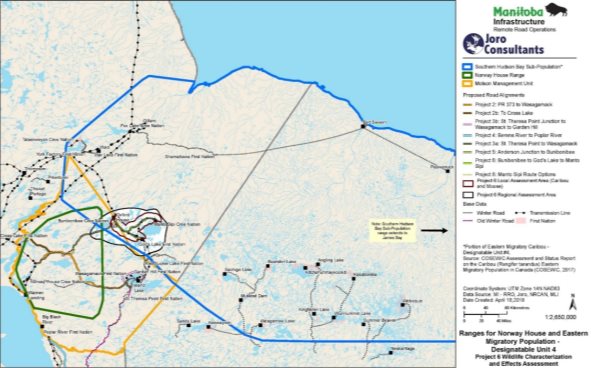
Source: Project 6 – All-Season Road Environmental Impact Statement (April 2019).
Figure Description
The eastern migratory caribou range extends across northeastern Manitoba along the Hudson Bay coastline to northwestern Ontario and includes most of the Wildlife RAA. The boreal woodland caribou range is largely located to the west side of the Wildlife RAA, although a small portion of the eastern extent of this range overlaps with the RAA. The northeastern extent of the Molson Management Unit (part of the boreal woodland caribou range) crosses through the Project Footprint, LAA, and Wildlife RAA.
Change in Mortality Risk
The project could result in increased mortality risk for species at risk as a result of increased hunting and trapping pressure, vehicle collisions, and predation. As caribou serve as a seasonal source of food for local Indigenous Peoples, caribou are already hunted near the existing winter road throughout fall and winter. Indigenous groups indicated that wolverine is also occasionally harvested by local trappers. The project could facilitate increased access to the Project Footprint and LAA year-round, which could increase hunting and trapping pressure, and potentially result in a decrease in population levels for caribou and wolverine. However, following the implementation of mitigation measures, including prohibiting project contractors and personnel from hunting, trapping, and possessing firearms, the proponent was of the view that the project would not result in a measurable effect on caribou and wolverine populations.
Increased traffic during construction and operation could lead to increased vehicle collisions with species at risk, including caribou, wolverine, and little brown bat. Further, as the project would facilitate year-round road traffic, collisions could occur during critical life stages (e.g., denning, rearing, calving, and breeding periods), which could exacerbate effects. However, as traffic densities would likely be low during operation given the remote nature of the road, and given the mitigation measures proposed to limit collisions, such as enforcing speed limits for project vehicles, the proponent predicted that the risk of collisions with species at risk would be minimal. Further, given the location of the project at the periphery of caribou ranges and the low density of caribou in the RAA, the risk of vehicular collisions with caribou would be further reduced.
The project may also facilitate increased predation of species at risk, particularly caribou, through an increase in linear features, such as the road, which are often used by wolves for easier movement and access to new areas. However, the proponent predicted that an increase in predation rates would not result in a measurable change in caribou population levels, given that wolves may use anthropogenic features less than natural features, and considering the implementation of mitigation measures, such as the decommissioning and reclamation of temporary access roads and winter road access points after construction is completed.
Change in Health
The project may result in changes to the health and fitness of species at risk during construction and operation due to the potential introduction and spread of diseases, increased stress, and increased contaminant concentrations in the environment. Movement of construction equipment and traffic sourced from areas where white-nose syndrome and chronic wasting disease are prevalent may facilitate their introduction and spread throughout the area of the project, potentially adversely affecting little brown bat and caribou, respectively. However, as no hibernacula or critical habitat for little brown bat were identified in the Project Footprint or LAA during field studies, and given that project activities would not involve entering caves or disturbing places where bats might roost, the proponent was of the view that the likelihood of the introduction and spread of white-nosed syndrome would be very low. Further, while chronic wasting disease is a concern, the proponent indicated that the chronic wasting disease zone is not near the proposed project area; therefore, the likelihood of the introduction and spread of this disease would be very low.
Project activities during construction and operation could also increase stress levels for species at risk through habitat fragmentation, sensory disturbance, and increased predator access, which could lead to higher energy expenditure, changes to migration patterns and mating behaviours, and adverse effects on reproductive success and maternal care. However, with the implementation of mitigation measures to address project-related increases in noise and vibration levels, the proponent predicted that effects would be unlikely to occur at the population level.
Project-related dust emissions could also indirectly affect species at risk, such as caribou, through changes to vegetation communities relied upon by these species as a food source. Dust accumulation on vegetation may limit photosynthesis, and reduce the availability and quality of lichen and other vegetation that serve as important forage for caribou, particularly during winter. However, as dust levels were expected to remain low, given the limited traffic volume associated with the project and proposed mitigation measures, the proponent was of the view that effects would be unlikely to occur at the population level.
Proponent's Conclusions
The proponent concluded that, following the implementation of mitigation measures, residual effects to species at risk would be minor, infrequent, irreversible, long-term, would occur within the LAA, and would occur throughout the life of the project. Residual project effects were not expected to threaten the long-term persistence or viability of species at risk.
7.3.2 Views Expressed
Environment and Climate Change Canada noted concerns regarding the proponent`s methodology for calculating the extent of project-related caribou habitat disturbance, which may influence the accuracy of the effects assessment. Further, while Environment and Climate Change Canada concluded that the risk to boreal woodland caribou from the project was likely low in magnitude, it was emphasized that any loss of boreal woodland caribou critical habitat represents a risk to the species and its ability to recover. Therefore, the implementation of mitigation measures to reduce habitat disturbance to the extent possible, including offsetting caribou habitat losses, would be necessary to minimize effects.
Environment and Climate Change Canada noted that, while eastern migratory caribou are not currently listed under Schedule 1 of SARA, should their status change prior to or during construction of the project, additional mitigation measures may be required to mitigate effects, including effects to any critical habitat that may be identified.
Bunibonibee Cree Nation, God's Lake First Nation, Pimicikamak Okimawin, and Manto Sipi Cree Nation expressed concerns regarding potential project effects on caribou and the lack of mitigation measures proposed to address project effects. The importance of a robust follow-up and monitoring program to verify the results of the environmental assessment, verify the effectiveness of mitigation measures, and inform the need for contingency measures was also highlighted.
Pimicikamak Okimawin, Manto Sipi Cree Nation, and Environment and Climate Change Canada expressed concerns about potential project effects to wolverine and requested that mitigation measures be implemented to address adverse effects to denning sites, if found during construction, including the establishment of buffers around denning sites to avoid disturbance.
The Manitoba Métis Federation, Manto Sipi Cree Nation, and Pimicikamak Okimawin expressed concerns that the proponent`s assessment did not consider potential project effects to all species at risk with the potential to occur in the area.
A summary of the comments provided by Indigenous groups, along with proponent and IAAC responses, is included in Appendix B of this EA Report.
7.3.3 IAAC Analysis and Conclusions
IAAC is of the view that the proponent adequately characterized potential project effects to species at risk. IAAC acknowledges that the project could result in adverse effects to the habitat and movement patterns of species at risk. IAAC understands that the proponent committed to conducting pre-construction surveys, and construction and post-construction monitoring for the presence of wildlife and wildlife habitat, including species at risk, and potential interactions with the project. Should individuals or potential habitat features of species at risk be discovered within the Project Footprint, IAAC encourages the proponent to implement mitigation measures to protect identified habitat features, prevent mortality of any individuals detected, and prevent measurable changes to movement patterns.
IAAC recognizes that caribou is a species of cultural and traditional importance to Indigenous Peoples and that concerns remain regarding potential effects to caribou and their habitat. IAAC understands that boreal woodland caribou are managed provincially under Manitoba's Endangered Species and Ecosystems Act. IAAC agrees with Environment and Climate Change Canada that, should eastern migratory caribou be listed under Schedule 1 of SARA before or during construction of the project, the proponent should be prepared to apply appropriate mitigation measures. IAAC acknowledges the concerns raised by Environment and Climate Change Canada regarding project-related effects to caribou habitat. Given the minimal amount of habitat likely present within the Project Footprint and LAA, the limited number of individuals detected during baseline field studies, and the proponent's proposed mitigation measures to address effects to caribou, including restricting project activities during critical lifecycle periods, IAAC is of the view that project-related effects to caribou would be unlikely to threaten the long-term persistence or viability of this species. IAAC encourages the proponent to engage with the Province of Manitoba, Environment and Climate Change Canada, and Indigenous groups to determine appropriate mitigation measures to address project effects to caribou.
IAAC recognizes that wolverine is a species of cultural and traditional importance to Indigenous Peoples and that concerns remain regarding potential project effects to wolverine denning sites. IAAC understands that the proponent committed to implementing mitigation measures specific to wolverine, such as identifying the location of natal and maternal denning sites prior to construction and avoiding these areas to the extent possible. IAAC encourages the proponent to engage with the Province of Manitoba, Environment and Climate Change, and Indigenous groups to determine appropriate mitigation measures to address project effects to wolverine, including denning sites.
IAAC understands that the species at risk listed in Table 5 are also managed by the Province of Manitoba under Manitoba's Endangered Species and Ecosystems Act. IAAC is satisfied that provincial mechanisms in place to protect species at risk and the mitigation, monitoring, and follow-up measures proposed by the proponent (Appendix C) will avoid or lessen project-related effects to species at risk. IAAC is also of the view that key mitigation measures identified in Chapter 6.1 (Atmospheric Environment), Chapter 6.2 (Groundwater), Chapter 6.3 (Surface Water), Chapter 6.4 (Terrestrial Landscape), Chapter 7.1 (Fish and Fish Habitat), Chapter 7.2 (Migratory Birds), and Chapter 7.4 (Indigenous Peoples - Current Use of Lands and Resources for Traditional Purposes, Physical and Cultural Heritage, and Sites of Significance) would also mitigate effects to species at risk.
IAAC is of the view that the project is unlikely to result in population-level effects to the abundance and distribution of species at risk, or threaten the long-term persistence or viability of species at risk as a result of effects to their habitat, mortality risk, and health. IAAC is of the view that the mitigation measures proposed are consistent with the goals, objectives, and activities of recovery strategies, action plans, and management plans for species at risk, and meet IAAC's section 79 obligations under SARA.
Key Mitigation Measures and Monitoring to Avoid Significant Effects and Follow-Up Program Requirements
Additional mitigation measures, monitoring, and follow-up programs applicable to project-related effects to species at risk can be found in the following chapters of this EA Report: Atmospheric Environment (Chapter 6.1), Groundwater (Chapter 6.2), Surface Water (Chapter 6.3), Terrestrial Landscape (Chapter 6.4), Fish and Fish Habitat (Chapter 7.1), Migratory Birds (Chapter 7.2), and Indigenous Peoples – Current Use of Lands and Resources for Traditional Purposes, Physical and Cultural Heritage, and Sites of Significance (Chapter 7.4).
7.4 Indigenous Peoples – Current Use of Lands and Resources for Traditional Purposes, Physical and Cultural Heritage, and Sites of Significance
The project could cause residual effects to Indigenous Peoples' current use of lands and resources for traditional purposes (current use), physical and cultural heritage, and any structure, site, or thing that is of historical, archaeological, paleontological, or architectural significance (sites of significance) through changes to access to lands and resources of importance for current use, changes to the availability and quality of resources, and disturbance or loss of physical and cultural heritage and sites of significance.
IAAC is of the view that the project is not likely to cause significant adverse effects on current use, physical and cultural heritage, and sites of significance, after taking into account the implementation of key mitigation measures, monitoring, and follow-up programs. IAAC's conclusions are based on an analysis of the proponent's assessment, including the proponent's proposed mitigation measures, monitoring, and follow-up programs (Appendix C), and the views expressed by federal authorities, Indigenous groups, and the public.
7.4.1 Current Use of Lands and Resources for Traditional Purposes
7.4.1.1 Proponent's Assessment of Effects
Access for Current Use
Through engagement activities with the proponent, members of Bunibonibee Cree Nation, God's Lake First Nation, and Manto Sipi Cree Nation identified travel routes, trails, and Registered Traplines that exist within the Indigenous Land and Resource Use LAA and RAA, which provide access to lands and resources of importance for current use activities. The proponent predicted that the project would intersect ten all-terrain vehicle and snowmobile routes, one walking route, one waterway used for boat travel, and one harvesting route, which could limit or prevent access to these areas by Indigenous Peoples. The proponent predicted that effects to access to travel routes would be greatest during construction; the degree to which the project would reduce access would change throughout construction as different segments of the road are built. However, the proponent anticipated that Indigenous groups would be able to easily adapt to the effects of the project and maintain pre-project current use activities by using alternate travel routes made available by the proponent within the LAA and RAA.
Following construction, the proponent predicted that the project could also result in positive effects to current use by increasing access and reliability of access to currently isolated fishing, harvesting, and hunting areas, which could result in an increased availability of resources for use by Indigenous groups. This would likely benefit Bunibonibee Cree Nation, God's Lake First Nation, and Manto Sipi Cree Nation to the highest degree, given their proximity to the project.
The proponent predicted that, following the implementation of mitigation measures, residual project effects on access for current use would be long-term in duration, low in magnitude, infrequent, reversible, and would extend into the LAA.
Availability and Quality of Resources for Current Use
The project could adversely affect the availability and quality of plant, wildlife, and fish species, and their habitat, that support the traditional and cultural practices of Indigenous Peoples, such as plant gathering, hunting, trapping, and fishing. Several species of cultural importance were identified by Indigenous groups and the proponent within the LAA and RAA, including plants used for food and medicines, furbearers and ungulates, migratory and non-migratory birds, and fish. Potential residual project effects to vegetation and wetlands, fish and fish habitat, migratory birds, and species at risk, as well as proposed key mitigation measures, monitoring, and follow-up programs, are described in Chapter 6.4 (Terrestrial Landscape), Chapter 7.1 (Fish and Fish Habitat), Chapter 7.2 (Migratory Birds), and Chapter 7.3 (Species at Risk) of this EA Report.
Potential project effects to wetlands, plants, and wildlife species of importance to Indigenous groups during construction and operation include the direct or indirect loss or disturbance of plant species and wetland areas, wildlife habitat loss and alteration, increased wildlife displacement and mortality risk, and effects to wildlife health. Project effects on fish and fish habitat during construction and operation include fish habitat destruction or alteration, effects to fish passage, and effects to fish health and survival. These effects could adversely affect the availability and quality of resources of importance for current use, lead to a reduction in the quantity of plants, fish, and wildlife available for use, and lead to changes in the locations in which plants, fish, and wildlife are available. Measurable or perceived effects on the quality of resources may also deter use of species of cultural importance by Indigenous Peoples due to potential risk of contamination. The displacement of wildlife and fish could also lead to the need for Indigenous Peoples to travel farther to access resources. These effects on current use would be exacerbated should the effects coincide with important periods of use. However, the proponent anticipated that Indigenous groups would be able to adapt to project-related changes to the availability and quality of plants, fish, and wildlife, and maintain pre-project current use activities with some adjustments and support.
The proponent predicted that, following the implementation of mitigation measures, residual project effects on the availability and quality of resources of importance for current use would be long-term in duration, low in magnitude, limited to the Project Footprint for vegetation and to the LAA for wildlife and fish, sporadic, and reversible over a short period for vegetation and over a long period for wildlife and fish.
Proponent Conclusions
The proponent predicted that, following the implementation of mitigation measures, residual project effects on current use would not be significant as Indigenous groups would be able to adapt to the effects of the project and maintain pre-project current use activities with some adjustments. The project could also provide benefits to Bunibonibee Cree Nation, God's Lake First Nation, and Manto Sipi Cree Nation by facilitating new or easier access to lands and resources of importance for current use.
7.4.1.2 Views Expressed
Bunibonibee Cree Nation, Garden Hill First Nation, the Manitoba Métis Federation, Manto Sipi Cree Nation, and St. Theresa Point First Nation raised concerns regarding potential adverse project effects on current use activities, and the proponent's assessment and identification of lands, resources, and activities of importance for current use. Manto Sipi Cree Nation indicated that areas of importance for current use must be identified and mapped prior to construction to minimize effects.
Manto Sipi Cree Nation noted concerns regarding the lack of information provided by the proponent regarding potential adverse project effects to Indigenous Peoples' connection with the land and nature, and an associated loss of traditions, and mitigation measures to address these effects.
Bunibonibee Cree Nation, Garden Hill First Nation, God's Lake First Nation, Manto Sipi Cree Nation, Norway House Cree Nation, and Pimicikamak Okimawin expressed concerns regarding potential project effects to lands and resources of importance for current use, including lakes, wetlands, fish, furbearers, medicinal plants, and wildlife, and resulting effects on current use activities and patterns of use, including the need for Indigenous Peoples' to travel farther to engage in these activities. The Manitoba Métis Federation and Manto Sipi Cree Nation recommended that the proponent work with Indigenous groups to manage, mitigate, and monitor effects on lands and resources of importance for current use, such as through the implementation of Indigenous monitoring.
Bunibonibee Cree Nation, God's Lake First Nation, and Manto Sipi Cree Nation raised concerns regarding potential project effects on navigation and the need to protect existing travel routes. Manto Sipi Cree Nation recommended that a communication plan be developed, in consultation with Indigenous groups, to inform Indigenous groups about when and where project activities that could affect navigation and current use will occur.
Bunibonibee Cree Nation, Garden Hill First Nation, God's Lake First Nation, Manto Sipi Cree Nation, and Norway House Cree Nation noted concerns regarding potential project effects to traplines, given that portions of the road alignment would intersect with these areas. Concerns were also noted regarding the use of provincial trapline boundaries for the assessment, and the limited assessment of effects undertaken by the proponent.
God's Lake First Nation, Manto Sipi Cree Nation, Norway House Cree Nation, and Pimicikamak Okimawin expressed concerns regarding increased access and increased resource use by non-community members and project personnel, and resulting effects on their ability to practice current use activities as a result of the project.
A summary of the comments provided by Indigenous groups, along with proponent and IAAC responses, is included in Appendix B of this EA Report.
7.4.1.3 IAAC Analysis and Conclusions for Current Use
IAAC is of the view that the proponent adequately characterized potential residual project effects to current use. IAAC acknowledges that construction and operation of the project could result in adverse effects on Indigenous Peoples' access to, and the availability and quality of resources of importance for current use. IAAC is of the view that the proponent's proposed mitigation, follow-up, and monitoring measures, including identifying and mapping harvesting areas prior to construction, halting work if active traps are discovered along traplines, providing regular construction progress updates to Indigenous groups, and notifying Indigenous groups during construction of any access restrictions and temporary alternate access routes, are appropriate to address potential project effects to current use. Mitigation measures that IAAC views as key for preventing significant adverse effects to lands and resources of importance for current use are described in Chapter 6.4 (Terrestrial Landscape), Chapter 7.1 (Fish and Fish Habitat), and Chapter 7.2 (Migratory Birds) of this EA Report.
IAAC recognizes that concerns remain regarding potential project effects to Indigenous Peoples' connection with the land and any associated loss of traditions. IAAC highlights the importance of ongoing engagement with Indigenous groups throughout the life of the project to identify, manage, mitigate, and monitor project effects to lands and resources of cultural and traditional importance to Indigenous groups, including traplines, that may be affected by the project, and associated effects to Indigenous Peoples' connection with the land.
IAAC recognizes that concerns remain regarding potential adverse effects on current use as a result of increased access to and use of lands and resources by non-local individuals. IAAC understands that the proponent proposed mitigation measures to address potential effects resulting from increased access to the area by non-local individuals, including prohibiting contractors and project personnel from hunting or trapping within the Project Footprint, and is of the view that these measures would adequately address these effects. IAAC is of the view that measures to reduce fishing pressure, such as limiting general vehicular access to watercourses adjacent to or intersecting the Project Footprint, would also reduce adverse residual effects to current use. Compliance with provincial hunting and fishing regulations would also aid in preventing adverse effects associated with potential overfishing or overhunting.
IAAC is of the view that the project is not likely to cause significant adverse effects on current use, taking into account the implementation of mitigation measures, monitoring, and follow-up programs proposed by the proponent (Appendix C) and the key mitigation measures described in Section 7.4.3 of this chapter.
7.4.2 Physical and Cultural Heritage, and Sites of Significance
7.4.2.1 Proponent's Assessment of Effects
The project could result in adverse effects on Indigenous Peoples' physical and cultural heritage and sites of significance, including the disturbance or loss of archaeological, cultural, heritage, and sacred resources and sites, as a result of construction activities (e.g., site clearing and excavation) and increased access to the Project Footprint. Other project activities were not predicted to result in adverse effects as these activities would be limited to previously disturbed areas. The proponent indicated that there are 79 heritage sites located within the Heritage Resources RAA, including campsites, a fishing/hunting site, historical sites, pictograph sites, and sites with isolated finds, identified through provincial Heritage Resource Impact Assessments. Of these sites, four sites of significance were identified within the Project Footprint and may overlap with project activities. While additional sites of significance were identified by Indigenous groups within the RAA during engagement activities, none of these sites were located within the Project Footprint and therefore would not be directly disturbed by project activities. With the implementation of mitigation measures, including establishing buffers and access controls for known sites of significance and development of an artifact recovery program, the proponent concluded that effects to physical and cultural heritage and sites of significance would be unlikely.
Proponent Conclusions
The proponent predicted that, following the implementation of mitigation measures, residual effects to Indigenous Peoples' physical and cultural heritage and sites of significance would be short- to long-term in duration (i.e., for construction activities and increased access, respectively), moderate in magnitude, limited to the Project Footprint, sporadic for construction activities and infrequent for increased access, and reversible over a long period. Residual project effects on physical and cultural heritage and sites of significance were predicted to not be significant, as Indigenous groups would be able to moderately adapt to project effects to physical and cultural heritage and sites of significance, and maintain pre-project activities with some adjustments and support.
7.4.2.2 Views Expressed
God's Lake First Nation, the Manitoba Métis Federation, and Manto Sipi Cree Nation noted concerns regarding the lack of consultation with Indigenous groups on the location of archaeological, cultural, and historical resources and sites of significance that may be affected by the project. God's Lake First Nation and Manto Sipi Cree Nation recommended that measures be implemented to locate and preserve knowledge regarding sites of significance.
The Manitoba Métis Federation recommended that a chance find protocol be developed with Indigenous groups and implemented in the event of chance finds of physical and cultural heritage resources and sites of significance. God's Lake First Nation, the Manitoba Métis Federation, and Manto Sipi Cree Nation noted the importance of Indigenous engagement regarding processes and protocols related to the proper identification of artifacts and sites of significance, the notification of Indigenous groups regarding artifact or site discovery, and the development and implementation of mitigation measures, including stopping construction, allowing for ceremonies, and collection of artifacts. God's Lake First Nation also raised concerns regarding the removal of artifacts from the community and the need for local preservation.
God's Lake First Nation, the Manitoba Métis Federation, and Manto Sipi Cree Nation recommended that Indigenous monitors be present during project construction to identify any physical and cultural heritage resources and sites of significance to Indigenous groups.
A summary of the comments provided by Indigenous groups, along with proponent and IAAC responses, is included in Appendix B of this EA Report.
7.4.2.3 IAAC Analysis and Conclusions for Physical and Cultural Heritage and Sites of Significance
IAAC is of the view that the proponent adequately characterized potential residual project effects to Indigenous Peoples' physical and cultural heritage and sites of significance. IAAC acknowledges that disturbance or loss of physical and cultural heritage resources and sites of significance may occur as a result of the project, and that some effects may be irreversible. IAAC understands that the proponent committed to implementing mitigation measures to prevent or limit adverse effects to physical and cultural heritage resources and sites of significance, including the development of an artifact recovery program, implementation of protection measures for known sites of significance (e.g., maintaining no work buffers and access controls), identification and mapping of areas of cultural importance to Indigenous groups prior to construction, and providing opportunities for Indigenous groups to conduct ceremonies and other cultural activities prior to construction in the vicinity of sites of significance. IAAC is of the view that these mitigation measures are appropriate to address potential project effects. IAAC also understands that the proponent would be required to comply with Manitoba's The Heritage Resources Act, which includes provisions for the identification and protection of resources and sites of importance.
IAAC acknowledges that concerns remain regarding potential project effects to unidentified physical and cultural heritage resources and sites of significance that may be present within the Project Footprint and agrees with the recommendation that a chance finds protocol be developed, in consultation with Indigenous groups. IAAC also recommends that the proponent provide opportunities for Indigenous monitors to participate in follow-up and monitoring for physical and cultural heritage resources and sites of significance during construction.
IAAC is of the view that the project is not likely to cause significant adverse effects on Indigenous Peoples' physical and cultural heritage and sites of significance, taking into account the implementation of mitigation measures, monitoring, and follow-up programs proposed by the proponent (Appendix C) and the key mitigation measures described in Section 7.4.3 of this chapter.
7.4.3 Key Mitigation Measures and Monitoring to Avoid Significant Effects and Follow-Up Program Requirements
IAAC considers the following mitigation measures, monitoring, and follow-up programs to be necessary to ensure that there are no significant adverse effects on Indigenous Peoples' current use, physical and cultural heritage, and sites of significance. The following key mitigation measures are based on mitigation measures, monitoring, and follow-up programs proposed by the proponent, expert advice from federal authorities, and comments received from Indigenous groups.
Mitigation Measures
- Prior to construction, develop a communication plan to be implemented and maintained during construction, in consultation with Indigenous groups. This plan should be finalized and provided to IAAC and each Indigenous group prior to construction, and include the following:
- maps denoting the location of project activities and final design components. These maps will be published online to ensure Indigenous groups are able to access them easily;
- a schedule of planned construction and maintenance activities so that areas and time periods of activity can be avoided by Indigenous land users should they wish;
- a schedule of days of cultural significance and key fishing, gathering, harvesting, hunting, and trapping periods. The proponent will schedule and modify construction and maintenance activities to minimize or avoid disturbance of culturally significant activities and periods, unless not technically or economically feasible;
- communication and notification protocols for construction and maintenance activities;
- notification timing and methods for monitoring opportunities; and
- the review and update of this plan periodically, at intervals acceptable to Indigenous groups, to account for changes in notification preferences or methods. The proponent will share the updated plan with Indigenous groups in a timely manner.
- Maintain access to sites of importance for Indigenous groups, including Registered Traplines, except where there are physical project components or ongoing project activities in these areas. Where access may no longer be available for safety reasons, identify the length of time access will be restricted and ensure this is communicated to Indigenous groups prior to access being restricted.
- Provide safe, alternative means for accessing lands and resources of importance to Indigenous groups for traditional and cultural purposes within the Indigenous Land and Resource Use LAA, including Registered Traplines, that are made temporarily or permanently inaccessible due to project activities. Consult with Indigenous groups regarding the alternative means of access selected.
- Prior to construction, consult with Indigenous groups and Registered Trapline holders within the Project Footprint and Indigenous Land and Resource Use LAA to determine traplines that will be directly disturbed by the project. For traplines that will be directly disturbed by the project, consult with Indigenous groups and Registered Trapline holders to determine mitigation measures to be implemented.
- Prohibit contractors and employees associated with the project from fishing, gathering, hunting, and trapping for any purposes not associated with the project, within the Project Footprint and Indigenous Land and Resource Use LAA, or using the project to access lands outside of the Project Footprint for fishing, gathering, hunting, and trapping, unless an Indigenous contractor or employee is provided access by the proponent for traditional purposes or for exercising Aboriginal or Treaty rights, to the extent that such access is safe.
- Limit general vehicular access to fishing areas through the decommissioning of winter-roads and temporary access roads that are no longer required following construction. Establish no stopping zones near adjacent or intersecting watercourses to the Project Footprint and ensure any slopes within the Project Footprint are protected by riprap.
- Prior to construction, consult with Indigenous groups to identify physical and cultural heritage resources and sites of significance within the Project Footprint that could potentially be affected by the project. The proponent will also:
- identify and map where heritage resources or sites could be located;
- offer opportunities for Indigenous groups to access and visit the locations and conduct ceremonies. The proponent will participate in ceremonies at the request of Indigenous groups; and
- discuss opportunities for further studies to investigate the Project Footprint for resources and sites of importance that could be affected by project-related changes.
- Prior to construction, if Indigenous groups are interested and willing to participate, retain the services of Indigenous monitors to participate in follow-up and monitoring with respect to physical and cultural heritage and sites of significance. Prior to retaining the services of Indigenous monitors, undertake a collaborative process to determine, in consultation with Indigenous groups, the scope, purpose, objectives, details of the participation of Indigenous monitors, and procedures for the proponent to receive and respond to feedback related to Indigenous monitors. Provide this information to IAAC prior to construction. In doing so, determine:
- how each Indigenous monitor will be involved in follow-up and monitoring related to their area of interest, including the location, frequency, timing, and duration of their participation;
- if opportunities for Indigenous monitor participation in specific monitoring activities do not exist, provide justification for why;
- how the proponent will support the participation of Indigenous monitors, including through the provision of training (including safety or skills certification), equipment (including personal protective equipment), and access to the Project Footprint; and
- how Indigenous monitors will be involved in the identification of additional mitigation measures that will be implemented if monitoring shows that it is necessary.
Follow-Up and Monitoring
- Prior to construction, in consultation with Indigenous groups, develop a follow-up program to verify the accuracy of the environmental assessment and determine the effectiveness of mitigation measures as it pertains to adverse environmental effects of the project on the current use of lands and resources for traditional purposes, incorporating available Indigenous knowledge and input from Indigenous groups. The follow-up program will be implemented during construction and maintenance of the project, and will support the gathering of traditional knowledge to verify the quality and availability of resources in areas where changes to the environment may occur due to the project. If there is an unanticipated interaction with Indigenous uses, contingency measures will be implemented as required. As part of the program, the proponent will:
- invite Indigenous groups to participate in the development and implementation of the follow-up program; and
- consult with Indigenous groups to assess the need for updates to the program to ensure that the project is being carried out in a manner consistent with supporting Indigenous groups' ability to undertake current use activities.
Additional mitigation measures, monitoring, and follow-up programs applicable to project-related effects on Indigenous Peoples' current use, physical and cultural heritage, and sites of significance can be found in the following chapters of this EA Report: Atmospheric Environment (Chapter 6.1), Groundwater (Chapter 6.2), Surface Water (Chapter 6.3), Terrestrial Landscape (Chapter 6.4), Fish and Fish Habitat (Chapter 7.1), Migratory Birds (Chapter 7.2), Species at Risk (Chapter 7.3), Indigenous Peoples – Health and Socio-economic Conditions (Chapter 7.5), Federal Lands (Chapter 7.6), and Effects of Accidents and Malfunctions (Chapter 8.1).
7.5 Indigenous Peoples – Health and Socio-Economic Conditions
The project could cause residual adverse environmental effects on the health and socio-economic conditions of Indigenous Peoples, including the physical health of individuals and communities, and community well-being through changes to the availability, quality, and access to country foods; effects to water quality and the atmospheric environment; changes to access to traditional travel routes used for harvesting resources, traditional use activities, recreation, commercial purposes, and sustenance; and increased demands on or reduced access to community services. The project could also result in direct adverse effects to Indigenous Peoples' health, including Indigenous project employees, through an increased risk of injury and mortality.
IAAC is of the view that the project is not likely to cause significant adverse environmental effects on Indigenous Peoples' health and socio-economic conditions, after taking into account proposed key mitigation measures. IAAC's conclusions are based on an analysis of the proponent's assessment, including the proponent's proposed mitigation, monitoring, and follow-up measures (Appendix C), and the views expressed by federal authorities, Indigenous groups, and the public.
7.5.1 Effects to Indigenous Peoples' Health
7.5.1.1 Proponent's Assessment of Effects
Atmospheric Environment and Water Quality
Project activities during construction and operation could adversely affect air quality through emissions of fugitive dust, total suspended particulates, fine particulate matter, CO, SOx, NOx, diesel particulates, VOCs, and ANFO, as discussed in Chapter 6.1 (Atmospheric Environment). These emissions could adversely affect the health of Indigenous Peoples within the Project Footprint and Indigenous LAA directly through inhalation or indirectly through the deposition of dust and other contaminants on plants or onto soil, and subsequent absorption by plants harvested and consumed by Indigenous Peoples. Poor air quality within the Project Footprint during maintenance activities could also lead to an increased risk of collisions due to reduced visibility. Construction and maintenance activities, such as drilling, blasting, and heavy equipment use, could result in increased noise levels within the Indigenous LAA that may cause hearing loss, sleep disturbance, interference with speech comprehension, and an increased risk of adverse human health effects in local Indigenous communities and at nearby sensitive receptors.
Project-related changes to surface water quality, including potential increases in contaminant concentrations in Oxford Lake and God's Lake, could affect Indigenous Peoples' health, as drinking water for the Manto Sipi Cree Nation, Bunibonibee Cree Nation, and God's Lake First Nation reserves, and other surrounding communities, is sourced from these lakes. The proponent noted that there was no indication of other seasonal, periodic, or temporary water sources used by local Indigenous groups that may be affected by the project. Further information regarding project-related changes to groundwater and surface water quality is described in Chapter 6.2 (Groundwater) and Chapter 6.3 (Surface Water) of this EA Report, respectively.
Following the implementation of mitigation measures, the proponent did not anticipate that adverse effects to Indigenous Peoples' health and well-being at nearby receptors would occur as project-related changes to noise levels and contaminant concentrations in air and water would be less than ten percent relative to baseline conditions. Noise levels and contaminant concentrations in air and water were also not predicted to exceed applicable federal and provincial regulations or guideline limits.
Country Foods
Project-related activities during construction and operation could adversely affect Indigenous Peoples' health through a measurable or perceived reduction in the quality, quantity, and access to country foods as a result of effects on vegetation, fish and fish habitat, and wildlife and their habitat. Specifically, project-related increases in contaminant concentrations in the atmospheric environment, soil, and waterbodies could result in a reduction in the availability and quality of fish, plants, and wildlife that Indigenous Peoples rely upon for consumption or other uses. Indigenous Peoples may also avoid traditional harvesting areas due to fear of contamination of those areas, further reducing access to country foods. Changes to noise levels as a result of the project could also affect the distribution and availability of wildlife species used as country foods. However, the proponent predicted that adverse effects to the quality of country foods and medicinal plants as a result of the deposition of dust and vehicle emissions would be negligible if these resources were thoroughly washed prior to ingestion. Further, given the size of the Project Footprint in comparison to the amount of harvesting areas and resources available within the LAA and RAA, effects to the availability of country foods and medicinal plants would also be negligible. Given that the road would facilitate and create new routes to harvesting areas, the proponent predicted that the project would have an overall positive effect on access to country foods during operation.
Health and Safety of Indigenous Peoples and Employees
The proponent predicted that there would be inherent risks to the safety of Indigenous Peoples, including any Indigenous Peoples employed for the project, such as an increased risk of injury or mortality, during construction and maintenance activities as a result of heavy equipment use, bridge construction and maintenance, quarry and borrow area development, blasting, rock crushing, aggregate sorting, and other related activities. The health and safety of any Indigenous Peoples employed for the project may also be adversely affected by vehicle accidents, noise, burns, explosions, and the handling of hazardous substances, such as fuels and other materials. During operation, local Indigenous Peoples may be at an increased risk of injury or mortality when using the road or trails that intersect the project due to vehicle accidents; collisions with vehicles, maintenance equipment, and wildlife; and potential fires and explosions. These risks would be greater in remote areas of the Project Footprint, which may be farther removed from medical facilities and emergency services. However, the proponent predicted that, following the implementation of mitigation measures and safety protocols, residual adverse effects to Indigenous Peoples' health as result of an increased risk of injury or mortality would be low; should an injury occur, it would likely be of lower severity.
Proponent Conclusions
The proponent predicted that, following the implementation of mitigation measures, residual effects to Indigenous Peoples' health would be adverse, low to moderate in magnitude, infrequent or sporadic, long-term in duration, reversible, and would occur within the Project Footprint during construction and operation. Residual project effects to Indigenous Peoples' health were predicted to be not significant, as effects would be largely limited to the Project Footprint and readily reversible once project activities are discontinued.
7.5.1.2 Views Expressed
Indigenous Groups
Manto Sipi Cree Nation and Pimicikamak Okimawin expressed concerns that dust and particulate matter from the road could cause adverse effects to human health through inhalation.
A summary of the comments provided by Indigenous groups, along with proponent and IAAC responses, is included in Appendix B of this EA Report.
Federal Authorities
Health Canada noted concerns regarding potential effects to Indigenous Peoples' health as a result of project-related noise increases and recommended that the proponent consider Health Canada's Guidance for Evaluating Human Health Effects in Impact Assessment: Noise when developing mitigation measures to limit effects to traditional land users and other community receptors that may be exposed to construction noise, including limiting blasting noise and overpressure to the values identified in this guidance.
Health Canada expressed concerns regarding the proponent's conclusion that the quality of country foods and medicinal plants would not be affected by dust and contaminant deposition from vehicle emissions if foods are thoroughly rinsed prior to ingestion. As road dust and contaminants from vehicle emissions can settle and accumulate in soils and be absorbed by plants, rinsing country foods may not be protective of human health.
Health Canada suggested that the proponent's assessment consider potential effects to Indigenous Peoples' health as a result of elevated nitrite and nitrate concentrations in water sources that may be used by Indigenous groups for drinking and recreational purposes during traditional land use activities. Health Canada also noted concerns regarding the level of uncertainty with respect to potential project effects on Indigenous Peoples' health and recommended that the proponent develop a follow-up and monitoring plan to verify the results of the environmental assessment and inform the need for the implementation of contingency measures.
7.5.1.3 IAAC Analysis and Conclusions for Indigenous Peoples' Health
IAAC recognizes that project activities during construction and operation, including maintenance, may result in adverse effects to the health of Indigenous Peoples through changes to air quality; water quality; noise levels; the availability, quality, and access to country foods; and an increased risk of injury or mortality to local Indigenous Peoples and Indigenous project employees. IAAC also acknowledges that Indigenous groups may perceive risk to their physical health or safety caused by project-related changes to the environment, that may lead to changes in behaviors or practices and potential negative health outcomes. IAAC is of the view that the proponent's proposed mitigation measures, monitoring, and follow-up programs (Appendix C), including the implementation of construction best practices for health and safety, environmental protection and management programs, and best management practices for blasting, and the key mitigation measures identified by IAAC in this EA Report will address potential adverse project effects to the environment that may result in effects to Indigenous Peoples' health. IAAC highlights the importance of ongoing engagement and information sharing with Indigenous groups to address potential effects to Indigenous Peoples' health associated with perceived project effects to the environment.
IAAC acknowledges that concerns remain regarding potential adverse project effects to Indigenous Peoples' health as a result of elevated noise levels, nitrate and nitrite levels in water sources, and air contaminant emissions, including dust and other pollutants, that could be deposited onto soil and taken up by plants used for consumption or medicinal purposes. IAAC understands that the proponent committed to conducting blasting activities during business hours and complying with all noise bylaws of adjacent First Nation communities. IAAC agrees with Health Canada's recommendation that the proponent consider Health Canada's Guidance for Evaluating Human Health Effects in Impact Assessment: Noise in the final project design and when developing mitigation measures to address project-related noise increases and associated effects to Indigenous Peoples' health, including adherence to identified noise and overpressure limits. IAAC also recommends that the proponent consider relevant mitigation measures identified in Health Canada's Guidance for Evaluating Human Health Effects in Impact Assessment: Air Quality and Guidance for Evaluating Human Health Effects in Impact Assessment: Country Foods when developing mitigation measures to address potential project-related effects to air quality and country foods, and associated effects to Indigenous Peoples' health.
IAAC acknowledges the concerns raised with respect to project-related increases in nitrate and nitrite concentrations in drinking water sources and associated effects to Indigenous Peoples' health. IAAC understands that the proponent committed to avoiding the use of ammonium nitrate explosives in or near watercourses and developing an Explosives and Blasting Management Plan for the project. IAAC is also of the view that the key mitigation measures identified in Chapter 6.3 (Surface Water) would adequately address these potential effects.
IAAC acknowledges that concerns remain regarding the level of uncertainty with respect to potential project effects on Indigenous Peoples' health. IAAC agrees with Health Canada's recommendation that a follow-up and monitoring program be developed to verify the results of the environmental assessment, verify the effectiveness of mitigation measures, and inform the need for the implementation of contingency measures, including monitoring of contaminant concentrations in soil and country foods. IAAC highlights the importance of the participation of Indigenous groups in the development and implementation of a follow-up and monitoring program with respect to Indigenous Peoples' health, to ensure that Indigenous knowledge and views regarding measurable or perceived effects to Indigenous Peoples' health are adequately considered.
IAAC is of the view that the project is not likely to cause significant adverse environmental effects on Indigenous Peoples' health, taking into account the implementation of the mitigation, follow-up, and monitoring measures proposed by the proponent (Appendix C) and the key mitigation measures described in Section 7.5.3 of this chapter.
7.5.2 Effects to Indigenous Peoples' Socio-economic Conditions
7.5.2.1 Proponent's Assessment of Effects
Availability, Quality, and Access to Lands and Resources
Project activities, such as vegetation clearing, the presence of permanent and temporary infrastructure, equipment and vehicle use, blasting, and increased non-local project personnel, may adversely affect the ability of Indigenous Peoples to practice commercial and subsistence harvesting, and recreational activities through a loss of land area available to practice these activities, a reduction in the availability and quality of resources, access restrictions or effects to traditional travel routes, and increased competition for resources. Adverse effects on the ability of Indigenous groups to practice subsistence and commercial harvesting could reduce their reliance on country foods and result in reduced income for local Indigenous trappers during construction. However, the proponent predicted that increased access to traplines, and lands and resources within the Project Footprint and LAA that would be facilitated by the project during operation may result in an overall increase in trapping income and access to previously remote areas over the long-term. Further, as the project would generate employment opportunities during construction and operation, including jobs and construction contract opportunities, Indigenous groups may benefit economically from the project.
Availability and Access to Community Services
The project could result in accidents and malfunctions, including wildfires, during construction and operation, which could add additional strain and impede access to local community services, such as fire response and medical services, resulting in adverse effects to Indigenous Peoples' socio-economic conditions. However, the proponent predicted that the project could also positively affect the availability and access to local community services by facilitating faster access to afflicted areas by emergency response crews in the event of a wildfire and increasing access to medical services.
As potable water for construction camps may be sourced from water treatment plants on the Bunibonibee Cree Nation, Manto Sipi Cree Nation, and God's Lake First Nation reserves, the capacity of these water treatment plants and the availability of water on-reserve could be adversely affected. However, the proponent indicated that potable water would only be sourced from on-reserve sources if available; if not, groundwater may be used with prior approval from the Province of Manitoba. Therefore, adverse effects to the socio-economic conditions of Indigenous Peoples were not predicted.
Proponent Conclusions
The proponent predicted that, following the implementation of mitigation measures, residual effects to Indigenous Peoples' socio-economic conditions during construction and operation would be both positive and adverse, low in magnitude, occur infrequently, medium-term to long-term in duration, reversible, and would occur largely within the Project Footprint and Indigenous LAA. Should project-induced wildfires occur, effects may extend into the Indigenous RAA.
The proponent concluded that residual adverse project effects to Indigenous Peoples' socio-economic conditions would not be significant as the magnitude of effects would be low and Indigenous groups would likely be able to adapt with relative ease and maintain predevelopment activities.
7.5.2.2 Views Expressed
The Manitoba Métis Federation and Manto Sipi Cree Nation noted concerns that the proponent did not adequately consider the project's socio-economic effects in general and those specific to the interests of Métis groups.
Manto Sipi Cree Nation and Pimicikamak Okimawin noted the importance of Indigenous groups benefitting from economic opportunities associated with the project, such as employment and training opportunities and construction contracts, to boost the socio-economic conditions of their communities.
A summary of the comments provided by Indigenous groups, along with proponent and IAAC responses, is included in Appendix B of this EA Report.
7.5.2.3 IAAC Analysis and Conclusions for Indigenous Peoples' Socio-economic Conditions
IAAC is of the view that the proponent adequately characterized potential environmental effects of the project on Indigenous Peoples' socio-economic conditions and that the proponent's assessment methodology aligned with the requirements of the EIS Guidelines issued for the project. IAAC recognizes that project effects on the environment may affect the availability and access to lands and resources used by Indigenous groups to practice commercial, recreational, subsistence, and traditional activities within the Project Footprint and LAA. IAAC also understands that, when operational, the project could create new access routes to harvesting and trapping areas, and may increase employment and economic opportunities, potentially resulting in long-term positive economic benefits for Indigenous groups. IAAC is of the view that the key mitigation measures identified in the following chapters of this EA Report would adequately address potential adverse project effects to the environment that may affect Indigenous Peoples' socio-economic conditions: Atmospheric Environment (Chapter 6.1), Groundwater (Chapter 6.2), Surface Water (Chapter 6.3), Terrestrial Environment (Chapter 6.4), Fish and Fish Habitat (Chapter 7.1), Migratory Birds (Chapter 7.2), Species at Risk (Chapter 7.3), Indigenous Peoples – Current Use of Lands and Resources for Traditional Purposes, Physical and Cultural Heritage, and Sites of Significance (Chapter 7.4), and Effects of Accidents and Malfunctions (Chapter 8.1).
IAAC acknowledges the interest expressed by Indigenous groups in receiving employment and economic opportunities associated with the project. IAAC understands that the proponent committed to participating in Manitoba's Indigenous Procurement Initiative, which requires that a percentage of construction tenders, such as equipment, services, and employment, be supplied locally.
IAAC highlights the importance of ongoing engagement and information sharing with Indigenous groups to ensure that Indigenous knowledge and views regarding measurable or perceived effects of the project on the socio-economic conditions of Indigenous Peoples are adequately considered.
IAAC is of the view that the project is not likely to cause significant adverse environmental effects on Indigenous Peoples' socio-economic conditions, taking into account the implementation of the mitigation, follow-up, and monitoring measures proposed by the proponent (Appendix C) and the key mitigation measures described in Section 7.5.3 of this chapter.
7.5.3 Key Mitigation Measures and Monitoring to Avoid Significant Effects and Follow-Up Program Requirements
IAAC considers the following mitigation measures, monitoring, and follow-up programs to be necessary to ensure that there are no significant adverse environmental effects to Indigenous Peoples' health and socio-economic conditions. The following key mitigation measures are based on mitigation measures, monitoring, and follow-up programs proposed by the proponent, expert advice from federal authorities, and comments received from Indigenous groups.
Mitigation Measures
- Conduct blasting activities only on weekdays between 9:00 a.m. and 4:00 p.m. and avoid blasting on statutory holidays and days of cultural importance as identified in consultation with Indigenous groups.
- Ensure that, during construction, project-related activities do not result in exceedances of noise and overpressure limits outlined in Health Canada's Guidance for Evaluating Human Health Effects in Impact Assessment: Noise at sensitive receptor locations, including Indigenous receptors.
- During construction, implement relevant and achievable mitigation measures identified in Health Canada's Guidance for Evaluating Human Health Effects in Impact Assessment: Air Quality and Guidance for Evaluating Human Health Effects in Impact Assessment: Country Foods, to ensure the safe consumption of country foods and medicinal plants by Indigenous Peoples. Should contaminant concentrations in environmental media exceed applicable guidelines or environmental assessment predictions, implement a country foods monitoring program in consultation with Indigenous groups.
Monitoring and Follow-Up Programs
- Develop a follow-up program, prior to construction and in consultation with Indigenous groups and relevant federal and provincial authorities, to monitor project-related changes in contaminant concentrations in country foods and soil where country foods are harvested to verify the results of the environmental assessment, verify the effectiveness of mitigation measures, and inform the need for contingency measures. Implement the follow-up program during construction and include a description of:
- monitoring locations, identified in consultation with Indigenous groups;
- analytical parameters to be monitored and monitoring frequency;
- thresholds that will trigger the implementation of contingency measures; and
- contingency measures that will be implemented to address potential project effects to Indigenous Peoples' health.
Additional mitigation measures, monitoring, and follow-up programs applicable to project-related effects to Indigenous Peoples' health and socio-economic conditions can be found in the following chapters of this EA Report: Atmospheric Environment (Chapter 6.1), Groundwater (Chapter 6.2), Surface Water (Chapter 6.3), Terrestrial Environment (Chapter 6.4), Fish and Fish Habitat (Chapter 7.1), Migratory Birds (Chapter 7.2), Species at Risk (Chapter 7.3), Indigenous Peoples – Current Use of Lands and Resources for Traditional Purposes, Physical and Cultural Heritage, and Sites of Significance (Chapter 7.4), and Effects of Accidents and Malfunctions (Chapter 8.1).
7.6 Federal Lands
The project could cause adverse residual effects on federal lands through changes to the atmospheric environment, surface water quality and quantity, and potential accidents or malfunctions during disposal of waste materials from the project on reserve lands. IAAC is of the view that project effects on other valued components identified in this EA Report are unlikely to occur on federal lands, given the negligible to low magnitude and limited geographic extent of the project's anticipated residual effects on these components. IAAC therefore excluded these other valued components from the analysis of effects to federal lands.
IAAC is of the view that the project is not likely to cause significant adverse effects on federal lands, after taking into account the proponent's proposed mitigation, follow-up, and monitoring measures (Appendix C) and the proposed key mitigation measures discussed in Chapter 6.1 (Atmospheric Environment), Chapter 6.2 (Groundwater), Chapter 6.3 (Surface Water), Chapter 6.4 (Terrestrial Landscape), Chapter 7.1 (Fish and Fish Habitat), Chapter 7.2 (Migratory Birds), Chapter 7.3 (Species at Risk), Chapter 7.4 (Indigenous Peoples – Current Use of Lands and Resources for Traditional Purposes, Physical and Cultural Heritage, and Sites of Significance), Chapter 7.5 (Indigenous Peoples – Health and Socio-economic Conditions), and Chapter 8.1 (Effects of Accidents and Malfunctions) of this EA Report. IAAC's conclusions are based on an analysis of the proponent's assessment, including the proponent's proposed mitigation, monitoring, and follow-up measures, and the views expressed by federal authorities, Indigenous groups, and the public.
7.6.1 Proponent's Assessment of Environmental Effects
Federal lands within the vicinity of the project include the reserve lands of Manto Sipi Cree Nation, Bunibonibee Cree Nation, and God's Lake First Nation, located directly adjacent to the three road endpoints. No other federal lands were predicted to be affected by the project.
Atmospheric Environment
Project activities during construction and operation could adversely affect air quality through the generation of fugitive dust, particulate matter (PM2.5 and PM10), CO, SOx, NOx, ANFO, and VOCs, as discussed in Chapter 6.1 (Atmospheric Environment). Given the proximity of the project to reserve lands, these emissions could enter the air space of reserve lands and affect air quality, causing disturbance or potential health effects to in-community receptors. However, given that residual project-related increases in air contaminant concentrations were predicted to fall within federal and provincial regulatory guideline limits, the proponent did not anticipate that adverse effects to in-community receptors would occur.
Construction and maintenance activities, such as drilling, blasting, and heavy equipment use, could result in increased noise levels that could reach reserve lands and cause disturbance or potential health effects to in-community receptors, given the proximity of the project to reserve lands. However, the proponent predicted that residual changes to noise levels would fall within federal and provincial regulatory guideline limits; therefore, adverse effects to in-community receptors were not predicted.
Surface Water Quality and Quantity
The project could affect surface water quality on reserve lands through potential increases in contaminant concentrations in waterbodies and watercourses that flow through reserve lands, such as Oxford Lake and God's Lake. This could result in disturbance or potential health effects if consumed or used recreationally by Indigenous Peoples or wildlife on reserve. However, the proponent predicted that, following implementation of mitigation measures, residual project effects to surface water quality would be negligible to low; therefore, potential effects to in-community receptors were not predicted.
As potable water may be sourced from water treatment plants on the Bunibonibee Cree Nation, Manto Sipi Cree Nation, and God's Lake First Nation reserves, the capacity of these water treatment plants and the availability of water on-reserve could be adversely affected. However, the proponent indicated that potable water would only be sourced from on-reserve sources if available; if not, groundwater may be used with prior approval from the Province of Manitoba.
Accidents and Malfunctions
Project-related waste materials, such as wastewater, domestic waste, and solid waste from work camps and construction sites, may be treated and/or disposed of at existing wastewater treatment plants and landfills located on the Manto Sipi Cree Nation, Bunibonibee Cree Nation, and God's Lake First Nation reserves or Treaty Land Entitlement areas. Should an accidental spill or equipment malfunction occur during transportation of these waste materials to reserve lands, there is the potential for contaminants to be released on reserve lands. However, given the mitigation measures proposed, the proponent predicted that residual adverse effects to reserve lands would be negligible.
Proponent Conclusions
The proponent concluded that project effects to federal lands as a result of changes to the atmospheric environment, surface water quality and quantity, and as a result of accidents and malfunctions on reserve would not be significant, following the implementation of mitigation measures. Any increases in noise and contaminant concentrations in air and water would fall within applicable federal and provincial regulations and guidelines or would result in a change of less than ten percent in comparison to baseline conditions, and would therefore be unlikely to cause adverse effects to Indigenous Peoples or other receptors on reserve. In the event of potential accidents or malfunctions, mitigation measures in place to address spills would result in negligible effects on federal lands and to valued components. While final options are still being explored, should on-reserve water treatment plants be required to supply water for construction camps, these plants would likely have the capacity to support this increase in demand. If water treatment plants are unable to accommodate these increased demands, off-reserve water sources would be used.
7.6.2 IAAC Analysis and Conclusions
IAAC acknowledges that the project could adversely affect federal lands through changes to the atmospheric environment and surface water quality and quantity, and that there is potential for accidents and malfunctions to occur during transportation and disposal of waste materials on reserve lands. IAAC is of the view that the proponent adequately considered potential environmental effects of the project on federal lands and that the mitigation, follow-up, and monitoring measures proposed by the proponent are appropriate to address potential adverse effects on federal lands. IAAC highlights the importance of continued engagement with Indigenous groups to ensure that concerns are addressed, and Indigenous knowledge is adequately considered.
IAAC is of the view that the project is not likely to cause significant adverse effects on federal lands, after taking into account the proponent's proposed mitigation, follow-up, and monitoring measures (Appendix C), and the proposed key mitigation measures discussed in the following chapters of this EA Report: Chapter 6.1 (Atmospheric Environment), Chapter 6.2 (Groundwater), Chapter 6.3 (Surface Water), Chapter 6.4 (Terrestrial Landscape), Chapter 7.1 (Fish and Fish Habitat), Chapter 7.2 (Migratory Birds), Chapter 7.3 (Species at Risk), Chapter 7.4 (Indigenous Peoples – Current Use of Lands and Resources for Traditional Purposes, Physical and Cultural Heritage, and Sites of Significance), Chapter 7.5 (Indigenous Peoples – Health and Socio-economic Conditions), and Chapter 8.1 (Effects of Accidents and Malfunctions).
8 Other Effects Considered
8.1 Effects of Accidents and Malfunctions
Paragraph 19(1)(a) of CEAA 2012 requires that the environmental assessment take into account the environmental effects of accidents and malfunctions that may occur in connection with the project.
IAAC is of the view that the proponent adequately considered potential environmental effects as a result of accidents and malfunctions. IAAC is of the view that the project is not likely to result in significant adverse environmental effects from accidents and malfunctions, after considering the implementation of proposed key mitigation measures, monitoring, and follow-up programs. IAAC's conclusions are based on an analysis of the proponent's assessment, including the proponent's proposed mitigation, monitoring, and follow-up measures (Appendix C), and the views expressed by federal authorities, Indigenous groups, and the public.
8.1.1 Proponent's Assessment of Environmental Effects
The accidents and malfunctions scenarios assessed by the proponent and that were predicted to result in residual effects to valued components, should they occur, include the release of hazardous materials, vehicle accidents, and fires and explosions. The proponent also identified accidental encroachments on sensitive areas and sites as a potential accident and malfunction scenario. However, the proponent predicted that, with the implementation of mitigation measures, this scenario would be unlikely to result in residual effects to valued components and was not assessed further.
Accidental Release of Hazardous Materials
Mechanical malfunctions, and accidents involving construction and maintenance equipment, transport trucks, and public vehicles could result in the release of hazardous materials, such as chemicals (i.e., waste oil, gasoline, acetylene, hydraulic fluid, herbicides, explosives, and fuels), concrete or concrete wash water, and construction materials within the Project Footprint. During construction and operation, including maintenance activities, hazardous materials could also be released due to improper storage and transfer of these materials, mechanical failure, collisions, or leakages from concrete batch plants and construction camps (e.g., waste and petroleum products stored on site). The worst-case scenario for a hazardous material spill identified by the proponent would result if a vehicle were to collide with a full tank of hazardous materials and rupture containment.
Depending on the nature, size, and location of the release, an accidental release could adversely affect soil, surface water quality, and groundwater quality. This could result in indirect effects on Indigenous Peoples' health, fish health and survival, vegetation and wetlands, wildlife, migratory birds, and species at risk within the Project Footprint and downstream areas within the LAA if contaminants were transported downstream from the release site.
Vehicle Accidents
Vehicle accidents could occur due to increased vehicle traffic from project activities, weather affecting road conditions, and the presence of wildlife near or along the road during construction, operation, and maintenance. Vehicle collisions and accidents may result in human injury or loss of life, wildlife mortality, and adverse effects associated with the accidental release of hazardous materials (e.g., leaked fuel and oil). The proponent indicated that the worst-case scenario relating to vehicle collisions would occur if equipment carrying a large volume of hazardous materials collide near a waterbody, resulting in the release of hazardous materials into the aquatic environment. Potential residual adverse effects associated with hazardous material spills caused by vehicle accidents are described in the Accidental Release of Hazardous Materials section above.
Fires or Explosions
During project construction and operation, fires could be caused by project infrastructure and equipment malfunctions, and anthropogenic activities, such as smoking and campfires. Accidental explosions could occur due to improper storage and handling of petroleum products and explosives, which could result in substantial damage to project components and the surrounding environment, including destruction of wildlife habitat and wildlife morality. In the unlikely event that a fire or explosion were to occur in the LAA and RAA, a worst-case scenario would result in human injury or loss of life.
Proponent Conclusions
Following the implementation of mitigation measures, including project design adjustments, safety measures, and the development of emergency response plans and contingency measures, the proponent considered the likelihood of occurrence of each accident or malfunction scenario to be low. Should they occur, the overall potential residual effects to the environment and Indigenous groups of each scenario would be low in magnitude, reversible, irregular, long-term, and limited to the LAA.
8.1.2 Views Expressed
Natural Resources Canada and Environment and Climate Change Canada noted concerns that the proponent did not provide an Explosives Management Plan for the project and recommended that additional information be provided regarding the explosives that would be used (i.e., packaged or built) and measures that would be implemented to mitigate effects associated with explosives use.
Manto Sipi Cree Nation, God's Lake First Nation, the Manitoba Métis Federation, Environment and Climate Change Canada, and Health Canada noted concerns regarding the proposed methods of detection of hazardous material spills, spill response measures, and mitigation measures that would be implemented to address potential effects, specifically to surface water, in the event of accidental hazardous material releases and explosions. The need for a robust follow-up and monitoring plan was also noted.
Bunibonibee Cree Nation, Norway House Cree Nation, and the Manitoba Métis Federation expressed concerns regarding accidental spills, explosions, and fires, and associated potential adverse environmental effects to Indigenous Peoples' socio-economic conditions and health, physical and cultural heritage, sites of significance, the current use of lands and resources for traditional purposes, and commercial harvesting. Concerns were also noted regarding the lack of mitigation measures proposed by the proponent to mitigate environmental effects associated with accidents and malfunctions. Indigenous Services Canada recommended that the proponent develop an early notification plan to notify Indigenous groups of any accidents or malfunctions that may occur within the Project Footprint or close to reserve lands.
A summary of the comments provided by Indigenous groups, along with the proponent and IAAC responses, is included in Appendix B of this EA Report.
8.1.3 IAAC Analysis and Conclusions
IAAC is of the view that the proponent appropriately identified and assessed potential accident and malfunction scenarios associated with the project, including potential effects to the environment and Indigenous Peoples. IAAC is of the view that, taking into account project design considerations and mitigation, monitoring, and follow-up measures proposed by the proponent, the likelihood of potential accident and malfunction scenarios occurring would be low.
IAAC recognizes that concerns remain regarding potential environmental effects associated with an accidental release of hazardous materials, fires and explosions, and vehicle collisions, including worst-case scenarios. IAAC understands that the proponent committed to developing emergency response plans that will include measures to mitigate potential effects to the environment as a result of accidents and malfunctions. IAAC recommends that the proponent include worst-case scenarios, spill response measures, including on-site response times and spill notification measures, and proposed measures to mitigate potential effects to the environment in these emergency response plans.
IAAC acknowledges that concerns remain regarding the proponent's approach to managing explosives and mitigation measures that will be implemented to prevent accidental explosions and accidental releases of hazardous materials. IAAC understands that the proponent will direct their contractors to develop an Explosives and Blasting Management Plan that will include details regarding the management of blasting activities and measures to ensure the safe transportation, handling, storage, and use of explosives. IAAC also understands that, in addition to compliance with federal and provincial legislation and regulations related to the transportation of hazardous materials, the proponent will adhere to provincial Environmental Protection Procedures, and will develop a Construction Phase Environmental Management Plan and an Operations Phase Environmental Management Plan to minimize the likelihood of accidents and malfunctions and to respond to any accidents or malfunctions that may occur.
IAAC recommends that the proponent engage with federal authorities and Indigenous groups when developing the Explosives and Blasting Management Plan, emergency response plans, and contingency measures to ensure that outstanding concerns and Indigenous knowledge are considered. IAAC recommends that the proponent develop a plan, prior to construction, to notify Indigenous groups of any accidents or malfunctions that may occur within the Project Footprint in a timely manner and provide reports containing a summary of the results of follow-up and monitoring programs to Indigenous groups.
IAAC is of the view that the project is not likely to cause significant adverse environmental effects due to accidents and malfunctions, in consideration of the mitigation, monitoring, and follow-up measures proposed by the proponent (Appendix C) and the key mitigation measures outlined below.
Key Mitigation Measures and Monitoring to Avoid Significant Effects and Follow-Up Program Requirements
IAAC considers the following mitigation measures, monitoring, and follow-up programs to be necessary to ensure that there are no significant adverse environmental effects on fish and fish habitat, migratory birds, and Indigenous Peoples as a result of accidents and malfunctions. The following key mitigation measures are based on mitigation measures, monitoring, and follow-up programs proposed by the proponent, expert advice from federal authorities, and comments received from Indigenous groups.
- Prior to construction, develop an Emergency Response Plan, in consultation with Indigenous groups and relevant federal and provincial authorities, which includes:
- a description of the types of accidents and malfunctions, including worst-case scenarios, that may result in adverse environmental effects throughout the life of the project, including spills and releases of hazardous materials, vehicle collisions, fires, and explosions;
- the mitigation and management measures to be implemented to prevent accident and malfunctions from occurring to the extent possible and to respond to each accident or malfunction scenario, should they occur, to limit or prevent adverse environmental effects; and
- for each accident and malfunction scenario, a description of the roles and responsibilities of the proponent, each applicable relevant party responsible for implementing the proposed mitigation measures and mobilizing emergency response equipment, and on-site response times.
- Prior to construction, develop a notification plan with respect to accidents and malfunctions describing the means of communication, notification procedures, and urgent and long-term communication requirements for possible emergency event types; include for notification, at a minimum, all potentially affected Indigenous groups. Provide and make available summary reports to Indigenous groups from follow-up and monitoring conducted following accident or malfunction events.
Additional mitigation measures, monitoring, and follow-up programs applicable to project-related effects from accidents and malfunctions can be found in the following chapters of this EA Report: Groundwater (Chapter 6.2), Surface Water (Chapter 6.3), Fish and Fish Habitat (Chapter 7.1), and Indigenous Peoples – Current Use of Lands and Resources for Traditional Purposes, Physical and Cultural Heritage, and Sites of Significance (Chapter 7.4).
8.2 Effects of the Environment on the Project
Paragraph 19(1)(h) of CEAA 2012 requires that the environmental assessment take into account any changes to the project that may be caused by the environment, including extreme and periodic weather events.
IAAC is of the view that the proponent adequately considered potential effects of the environment on the project and that the proponent's proposed mitigation measures, monitoring, and follow-up programs (Appendix C) and the key mitigation measures identified by IAAC would adequately address potential effects of the environment on the project. IAAC's conclusions are based on an analysis of the proponent's assessment, including the proponent's proposed mitigation, follow-up, and monitoring measures, and views expressed by federal authorities, Indigenous groups, and the public.
8.2.1 Proponent's Assessment of Environmental Effects
The proponent indicated that environmental factors, including those described below, may result in damage to project infrastructure and equipment, cause interruptions to project activities, and increase the likelihood of accidents and malfunctions. Potential adverse environmental effects from accidents and malfunctions are discussed in Chapter 8.1 (Effects of Accidents and Malfunctions) of this EA Report.
Weather and Climate Conditions
Extreme weather and climate conditions, such as heavy snowfall, blizzards, extreme winds, and intense rainstorms, occasionally occur in the RAA. During construction, these conditions could result in project completion delays and environmental effects that could adversely affect the project, such as stream washouts, roadbed erosion, and downstream sedimentation. During operation and maintenance, weather events could cause road closures, vehicle accidents, and associated accidental releases of hazardous materials, which could result in adverse effects to surface water quality, fish and fish habitat, migratory birds, species at risk, and Indigenous Peoples. Additional information regarding potential adverse environmental effects associated with accidental releases of hazardous materials is available in Chapter 8.1 (Effect of Accidents and Malfunctions).
Tornadoes have the potential to occur in the RAA and could result in severe damage to project infrastructure, which could increase the likelihood of project completion delays, road closures, and accidental releases of hazardous materials. However, as tornadoes are relatively uncommon in the RAA, the proponent was of the view that the risk of adverse effects to the project would be low. The proponent also noted that drought conditions can occur in the RAA and could affect areas within the Project Footprint, including nearby vegetation communities by limiting vegetative health and growth, and increasing the potential for forest fires. However, the proponent was of the view that drought conditions would be unlikely to affect the integrity of project components. Potential effects of the environment on the project associated with forest fires are discussed below.
Flooding
The proponent indicated that flooding and bank scouring can occur within the Project Footprint due to seasonal flood events (i.e., high snow melt volumes, heavy rains) and ice jams. However, given that project infrastructure, including stream crossings, were designed to accommodate a 1-in-50 year flood event and given other proposed mitigation measures, the proponent predicted that the potential for flood-related damage to project components, including washouts at watercourse crossings and along the road, would be limited.
Beaver activity in the LAA could also result in flooding events and damage to project infrastructure, including blocked culverts, which may result in increased erosion and impede the flow of water. The proponent was of the view that the risk of adverse effects to the project as a result of beavers, would be limited and mitigated through the Nuisance Beaver Management Program.
Geological Hazards
Ground subsidence caused by wind and water erosion within the Project Footprint and LAA could degrade the structural integrity of project infrastructure through the removal of topsoil, and degradation of soil quality and stability. However, as wind and water erosion would occur primarily during precipitation events, spring runoff, and prior to reclamation, the proponent anticipated that associated effects to the project would be sporadic in nature.
As permafrost is present in the Project Footprint, thawing of permafrost associated with climate change could cause subsidence and terrain instability within the Project Footprint, potentially resulting in damage to project infrastructure, including the road, and adverse effects to fish and fish habitat and human health and safety. However, the proponent anticipated that the potential for subsidence and terrain instability within the Project Footprint would be limited as permafrost soils would be removed as part of site preparation and construction activities.
The proponent also considered potential effects on the project resulting from seismic activity, isostatic rebound, and landslides occurring within the RAA. As the probability of these events was considered low (i.e., less than one percent chance of a destructive earthquake), the risk of associated adverse effects on the project was also predicted to be low.
Forest Fires
Forest fires, including those caused by lightning strikes, and project-related explosions and fires, could occur sporadically throughout the life of the project, and have the potential to affect large areas extending into the RAA. Potential adverse effects on the project associated with forest fires could include poor air quality, burning of nearby vegetation, potential structural damage to culverts and bridges, and reduced visibility due to smoke, which could result in temporary closures of the road during operation to minimize the potential for vehicle collisions.
Proponent Conclusions
The proponent concluded that, with the implementation of mitigation measures, effects of weather and climate conditions on the project would be adverse, long-term, low in magnitude, and would be limited to the LAA. Effects on the project due to forest fires were predicted to be long-term, moderate in magnitude, sporadic, reversible, and may extend into the RAA. The proponent did not anticipate that residual adverse effects on the project would occur as a result of flooding and geologic hazards, following the implementation of mitigation measures.
8.2.2 Views Expressed
Indigenous Groups
Manto Sipi Cree Nation expressed concerns regarding the lack of information provided by the proponent regarding contingency measures that would be implemented, should flooding occur that may compromise the use and safety of the road, and associated uncertainty with respect to potential effects to Indigenous Peoples' current use.
Bunibonibee Cree Nation, Manto Sipi Cree Nation, and God's Lake First Nation noted concerns that the proponent did not appropriately consider potential effects of climate change on project infrastructure, particularly if extreme weather and heavy precipitation events cause flooding. The Manitoba Métis Federation and Manto Sipi Cree Nation also expressed concerns about the adequacy of proposed mitigation measures to address potential effects to the navigability of rivers as a result of ice jams, erosion, and potential flooding that may affect the project.
Manto Sipi Cree Nation noted concerns that the extent of permafrost within the Project Footprint is not well understood, resulting in uncertainty with respect to potential effects of permafrost on the project and the potential for terrain instability due to ground subsidence or thawing of permafrost. The Nation requested to be informed of any decisions related to permafrost management within the Project Footprint and noted the need for additional mitigation measures to reduce potential effects of permafrost on the project. Natural Resources Canada recommended that, during geotechnical investigations, the proponent identify areas that have the greatest potential for permafrost and the potential for thaw settlement along the proposed road alignment.
Manto Sipi Cree Nation noted concerns regarding the forest fire data used by the proponent to predict future forest fire probability in relation to the project and recommended that the proponent develop and implement a wildfire management and emergency response plan, including mitigation measures to decrease the risk of forest fires.
A summary of the comments provided by Indigenous groups, along with proponent and IAAC responses, is included in Appendix B of this EA Report.
8.2.3 IAAC Analysis and Conclusions
IAAC is of the view that the proponent adequately characterized the likelihood and magnitude of potential effects of the environment on the project and designed the project to account for any associated potential effects. IAAC recognizes that climate change may result in more frequent extreme weather events, including both flooding and drought conditions, and that uncertainty remains regarding the potential for extreme flooding events to affect watercourse crossings and culverts associated with the project. IAAC understands that the proponent committed to designing watercourse crossings to accommodate 1-in-50 year flood events and will regularly maintain crossings, including through the removal of accumulated debris and other materials.
IAAC acknowledges that concerns remain regarding potential effects on the project as a result of permafrost thaw, given uncertainty regarding the extent of permafrost within the Project Footprint. IAAC understands that the proponent committed to completing further geotechnical investigations as part of detailed road design to identify the location, extent, and degree of permafrost along the road alignment, and that the road would be designed to minimize disturbance of frozen soils. IAAC understands that the proponent committed to conducting monitoring to identify changes in ground stability that could result in effects on the project and associated effects to fish and fish habitat and human health and safety.
IAAC acknowledges that concerns remain regarding potential effects on the project as a result of forest fires and recognizes the unpredictability of forest fires in the RAA. IAAC understands the proponent committed to developing an evacuation and emergency preparedness plan for wildfires prior to construction. IAAC recommends that the proponent engage with Indigenous groups when developing this plan to ensure that outstanding concerns and Indigenous knowledge are considered.
IAAC acknowledges that concerns remain regarding potential effects of the environment on the project and associated potential adverse effects to valued components. IAAC highlights the importance of continued engagement with Indigenous groups to ensure that Indigenous knowledge is considered in project design and in the development and implementation of mitigation measures, monitoring, and follow-up programs with respect to effects of the environment on the project. IAAC notes that follow-up and monitoring programs will be in place during construction and operation to monitor potential effects to valued components, as discussed in Chapters 6.1 to 7.6 of this EA Report.
IAAC is of the view that project design considerations and mitigation measures proposed by the proponent (Appendix C) and the key mitigation measures outlined below would avoid or reduce potential effects of the environment on the project.
Key Mitigation Measures and Monitoring to Avoid Significant Effects and Follow-Up Program Requirements
IAAC considers the following mitigation measures, monitoring, and follow-up programs to be necessary to ensure that there are no significant adverse environmental effects on fish and fish habitat, migratory birds, and Indigenous Peoples, as a result of effects of the environment on the project. The following key mitigation measures are based on mitigation measures, monitoring, and follow-up programs proposed by the proponent, expert advice from federal authorities, and comments received from Indigenous groups.
- Prior to construction, complete geotechnical investigations to identify the location, extent, and degree of permafrost within the Project Footprint, including the type, degree, and extent of permafrost, for consideration in the final project design.
- Should permafrost soils remain within the Project Footprint following construction, develop a follow-up program, prior to construction and in consultation with Indigenous groups and relevant federal and provincial authorities, to monitor permafrost within the Project Footprint, the potential for permafrost thaw to affect the project, and associated potential effects to fish and fish habitat and Indigenous Peoples.
- Prior to construction, develop a wildfire management plan, in consultation with Indigenous groups and relevant federal and provincial authorities, including an evacuation and emergency response plan, and mitigation measures to be implemented to limit or prevent potential adverse effects on the project as a result of wildfires.
Additional mitigation measures, monitoring, and follow-up programs applicable to effects of the environment on the project can be found in the following chapters of this EA Report: Groundwater (Chapter 6.2), Surface Water (Chapter 6.3), Fish and Fish Habitat (Chapter 7.1), Indigenous Peoples – Current Use of Lands and Resources for Traditional Purposes, Physical and Cultural Heritage, and Sites of Significance (Chapter 7.4), Indigenous Peoples – Health and Socio-economic Conditions (Chapter 7.5), and Effects of Accidents and Malfunctions (Chapter 8.1).
8.3 Cumulative Environmental Effects
Cumulative environmental effects are defined as the effects of a project that are likely to result when a residual effect acts in combination with those of other projects or physical activities that have been or will be carried out. This cumulative effects assessment was guided by IAAC's Technical Guidance for Assessing Cumulative Environmental Effects under the Canadian Environmental Assessment Act, 2012Footnote 9, which recommends that cumulative effects analyses consider environmental effects, as described in section 5 of CEAA 2012, or effects on valued components noted by Indigenous Peoples and the public to be of specific interest.
IAAC focused its analysis on effects to fish and fish habitat, migratory birds, species at risk, and Indigenous Peoples' current use, physical and cultural heritage, sites of significance, and health and socio-economic conditions. IAAC is of the view that effects on the other valued components identified in this EA Report are unlikely to act in combination with the effects of other past, present, or reasonably foreseeable projects or physical activities, given the negligible to low magnitude and limited geographic extent of the project's anticipated residual effects on these components. IAAC therefore excluded other valued components from the analysis of cumulative effects.
IAAC is of the view that the project, in combination with past, present, and reasonably foreseeable projects and physical activities, is not likely to cause significant adverse cumulative effects on the valued components identified above and that additional mitigation measures or follow-up programs are not required. IAAC's conclusions are based on an analysis of the proponent's cumulative effects assessment, including the proponent's proposed mitigation, monitoring, and follow-up measures, and views expressed by federal authorities, Indigenous groups, and the public.
8.3.1 Proponent's Assessment of Cumulative Environmental Effects
The proponent identified past, present, and reasonably foreseeable projects and physical activities that could potentially interact with the project, including mineral developments and explorations, water and wastewater treatment facilities, residential and community developments, infrastructure developments, recreational and traditional land use, and other commercial and recreational uses (Table 6).
|
Category of Physical Activity |
Specific Project or Physical Activity |
|---|---|
|
Past or Present Physical Activities that Have Been Carried Out |
|
|
Mineral Developments |
Eight existing mine sites within the Indigenous RAA. The closest mine to the project is a former gold mine on Elk Island located about 18.3 kilometres away. A closed gold mine at Knee Lake, located outside of the RAA, was also considered. |
|
Mineral Exploration |
Mineral dispositions related to mining and quarry activities including:
|
|
Residential and Community Development |
|
|
Waste and Wastewater Treatment Facilities |
|
|
Infrastructure Development |
|
|
Traditional Land and Resource Use |
Traditional and subsistence hunting, fishing, gathering, and trapping. |
|
Recreational Activities |
Fishing, hunting, outfitting, and camping. |
|
Hunting, Outfitting, Trapping, and Fishing (Lodges and Outfitters) |
Commercial guiding and lodges, and domestic and commercial trapping activities. |
|
Future Physical Activities that are Certain or Reasonably Foreseeable |
|
|
Mineral Exploration and Development |
|
|
Residential and Community Development |
A 48-unit subdivision is planned on Bunibonibee Cree Nation's reserve lands. |
|
Infrastructure Development |
Bell MTS Inc. will install wireless and wireline broadband services to communities in the God's River and God's Lake Narrows areas. |
|
Traditional Land and Resource Use |
Traditional and subsistence hunting, fishing, gathering, and trapping. |
|
Recreational Activities |
Fishing, hunting, outfitting, and camping. |
|
Hunting, Outfitting, Trapping, and Fishing (Lodges and Outfitters) |
Commercial guiding and lodges, and domestic and commercial trapping activities. |
Cumulative Effects on Fish and Fish Habitat
The project's predicted residual effects on fish and fish habitat are described in Chapter 7.1 of this EA Report. These residual effects could interact cumulatively with other reasonably foreseeable projects and physical activities, such as mineral explorations and developments, quarries and borrow areas, and ongoing land and resource use. Cumulative effects on fish and fish habitat may include permanent destruction or alteration of fish habitat, changes in fish passage, and changes in fish health and mortality, including as a result of increased fishing pressure.
No other reasonably foreseeable projects or physical activities were predicted to occur within the LAA, and the proponent predicted that there would be no spatial or temporal overlap of any residual effects from other reasonably foreseeable projects or physical activities with residual project effects on fish and fish habitat. The proponent also committed to developing a fish habitat offsetting plan, if necessary, that would mitigate potential residual project effects on fish and fish habitat. For these reasons, the proponent concluded that residual cumulative effects of the project and other reasonably foreseeable projects and physical activities on fish and fish habitat were not anticipated.
Cumulative Effects on Migratory Birds and Species at Risk
The project's predicted residual effects to migratory birds and species at risk are described in Chapters 7.2 and 7.3, respectively, of this EA Report. These effects could interact cumulatively with other past, present, and reasonably foreseeable projects and physical activities. Cumulative effects to migratory birds and species at risk may include direct or indirect loss of habitat, increased mortality risk, and effects to wildlife health.
No past, present, or reasonably foreseeable projects and physical activities that may adversely affect the mortality risk and health of migratory birds and species at risk overlap with the RAA. Therefore, the proponent predicted that cumulative effects on the mortality risk of migratory birds and species at risk would not occur. Past, present, and reasonably foreseeable projects and physical activities that may act cumulatively with the project to adversely affect migratory bird and species at risk habitat may occur in the LAA and RAA. However, the proponent predicted that these cumulative effects would not measurably affect the abundance or sustainability of migratory bird and species at risk populations in the Project Footprint, LAA, or RAA.
Following the implementation of mitigation measures, residual cumulative effects to migratory birds and species at risk were predicted to be adverse, low in magnitude, infrequent, reversible over a long period, and would occur throughout the life of the project.
Cumulative Effects on Indigenous Peoples
The project's potential residual effects to Indigenous Peoples' current use, physical and cultural heritage, sites of significance, and health and socio-economic conditions are described in Chapters 7.4 and 7.5, respectively, of this EA Report. These residual effects could interact cumulatively with other past, present, and reasonably foreseeable projects and physical activities, such as mineral exploration and development activities, infrastructure developments, and recreational activities.
Residual effects of the project in combination with past, present, and reasonably foreseeable projects and physical activities could affect current use, including the ability of Indigenous groups to access lands and resources and the availability and quality of resources of importance for current use. This includes activities that may result in increased access to previously remote areas, reduced access to travel routes and areas used for traditional activities, and reduced availability of resources of importance for consumption and current use.
Residual effects of the project in combination with past, present, and reasonably foreseeable projects and physical activities could affect physical and cultural heritage, sites of significance, and the health and socio-economic conditions of Indigenous Peoples. These activities may result in the loss or disturbance of cultural heritage resources and sites; increased community population density, therefore increasing demands on local infrastructure and services; and increased recreational and commercial activity in previously remote areas. The proponent predicted that these activities may also act cumulatively to positively affect Indigenous Peoples' health and socio-economic conditions, including increased employment opportunities for local communities and improved access to health and social services.
The proponent predicted that, following the implementation of mitigation measures, cumulative residual effects on Indigenous Peoples' current use, physical and cultural heritage, sites of significance, and health, and socio-economic conditions would be adverse, low in magnitude, short-term, infrequent, and reversible within the RAA.
Proponent Conclusions
The proponent predicted that, following the implementation of mitigation measures, contributions of the project to cumulative effects on fish and fish habitat, migratory birds, species at risk, and Indigenous Peoples' current use, physical and cultural heritage, sites of significance, and health and socio-economic conditions would not be significant as the project is unlikely to overlap with other projects or physical activities. Physical activities or projects that may overlap with the proposed project were considered unlikely to result in cumulative adverse effects.
8.3.2 Views Expressed
The Manitoba Métis Federation, God's Lake First Nation, Manto Sipi Cree Nation, Pimicikamak Okimawin, and Bunibonibee Cree Nation expressed concerns regarding the limited scope of past, present, and reasonably foreseeable projects and physical activities considered in the proponent's cumulative effects assessment, including increased recreational use and tourism, commercial forestry operations, mineral and metal exploration projects, mines, hydroelectric projects, roads, and transmission lines, and effects associated with year-round access to a previously isolated region. Manto Sipi Cree Nation also noted that climate change should be considered in the cumulative effects assessment due to its likely potential for compounding cumulative effects.
The Manitoba Métis Federation expressed concerns regarding the limited scope of effects to fish and fish habitat considered in the proponent's cumulative effects assessment. Effects to fish and fish habitat beyond increased access, including adverse effects to fish passage, should be considered.
Pimicikamak Okimawin noted concerns regarding potential cumulative effects to little brown myotis as a result of the increased spread of white nose syndrome from the project and other past, present, and reasonably foreseeable projects and physical activities. Concerns were also noted regarding cumulative effects on the ability of Indigenous Peoples to practice traditional use activities.
A summary of the comments provided by Indigenous groups, along with proponent and IAAC responses, is included in Appendix B of this EA Report.
8.3.3 IAAC Analysis and Conclusions
IAAC is of the view that the proponent adequately characterized potential cumulative effects of the project in combination with other past, present, and reasonably foreseeable projects and physical activities. IAAC is of the view that, after taking into consideration the effects of the project and its interactions with the effects of past, present, and reasonably foreseeable projects and physical activities identified in Table 6, the project is not likely to cause significant adverse cumulative environmental effects on fish and fish habitat, migratory birds, species at risk, and Indigenous Peoples.
IAAC acknowledges that there would be overlap between project effects and effects of past and present projects and physical activities that may act cumulatively to adversely affect fish and fish habitat, migratory birds, and species at risk. IAAC acknowledges concerns regarding the scope of the proponent's cumulative effects assessment, including with respect to fish and fish habitat and species at risk, such as the little brown myotis. IAAC is of the view that the proponent's proposed mitigation measures, monitoring, and follow-up programs (Appendix C) and the key mitigation measures identified in Chapter 7.1 (Fish and Fish Habitat), Chapter 7.2 (Migratory Birds), and Chapter 7.3 (Species at Risk) of this EA Report will adequately minimize the project's contributions to cumulative effects on fish and fish habitat, migratory birds, and species at risk. IAAC understands that, as project effects to fish and fish habitat and migratory birds were not predicted to extend beyond the Project Footprint and project effects to species at risk were not predicted to extend outside the LAA, effects of reasonably foreseeable projects and physical activities would not interact cumulatively with the effects of the project.
IAAC acknowledges that the project, in combination with past, present, and reasonably foreseeable projects and physical activities, may adversely affect Indigenous Peoples' current use, physical and cultural heritage, sites of significance, and health and socio-economic conditions. IAAC also acknowledges that concerns remain regarding the proponent's assessment of residual cumulative effects on the ability of Indigenous Peoples to practice traditional use activities. IAAC is of the view that, with the implementation of the proponent's proposed mitigation measures, monitoring and follow-up programs (Appendix C) and the key mitigation measures identified in Chapter 7.4 (Indigenous Peoples – Current Use of Lands and Resources for Traditional Purposes, Physical and Cultural Heritage, and Sites of Significance) and Chapter 7.5 (Indigenous Peoples – Health and Socio-economic Conditions) of this EA Report, the project's contributions to cumulative effects will be appropriately mitigated and cumulative effects would not threaten the ability of Indigenous Peoples to practice traditional and cultural use activities and travel within the RAA.
IAAC is of the view that, after taking into account the proposed key mitigation measures, monitoring, and follow-up programs identified in this EA Report, and considering the effects of the project and its interactions with the effects of past, present, and reasonably foreseeable projects and physical activities identified in Table 6, the project is not likely to cause significant adverse cumulative environmental effects to fish and fish habitat, migratory birds, or Indigenous Peoples, and would not threaten the long-term persistence or viability of species at risk.
Key Mitigation Measures and Monitoring to Avoid Significant Effects and Follow-Up Program Requirements
IAAC considers the key mitigation, monitoring, and follow-up measures discussed in the following chapters of this EA Report to be appropriate to address potential cumulative adverse environmental effects associated with the project on fish and fish habitat; migratory birds; species at risk; Indigenous Peoples' current use, physical and cultural heritage, and sites of significance; and Indigenous Peoples' health and socio-economic conditions: Fish and Fish Habitat (Chapter 7.1), Migratory Birds (Chapter 7.2), Species at Risk (Chapter 7.3), Indigenous Peoples – Current Use of Lands and Resources for Traditional Purposes, Physical and Cultural Heritage, and Sites of Significance (Chapter 7.4), and Indigenous Peoples – Health and Socio-economic Conditions (Chapter 7.5).
9 Impacts to Aboriginal or Treaty Rights
The federal government has a legal duty to consult and, where appropriate, accommodate Indigenous groups, including First Nations and Métis Peoples, when the Crown contemplates conduct that may adversely affect Aboriginal or Treaty rights that are recognized and affirmed in section 35 of the Constitution Act, 1982 (section 35 rights). IAAC sought information from all potentially impacted Indigenous groups about the nature of their section 35 rights and how the project may impact the exercise of those rights. IAAC considered information from the proponent and Indigenous groups about the potential impacts of the project to understand the nature, scope, and extent of adverse impacts on rights. Where potential impacts on section 35 rights were identified, IAAC took into account appropriate mitigation measures before determining the severity of the potential impacts.
This chapter summarizes how the project may potentially impact section 35 rights. Appendix B summarizes key issues of concern related to the project communicated to IAAC by Indigenous groups throughout the environmental assessment, up to the date this EA Report was issued.
9.1 Existing Aboriginal and Treaty Rights
The project is located within Treaty 5 and the Thompson Region of the Manitoba Métis Federation (Figure 9). Treaty 5 is an historic treaty spanning much of what is currently central and northern Manitoba and defines the right to hunt, fish, and trap throughout the treaty territory. All treaties in Manitoba exclude lands taken up for settlement or other purposes; First Nations cannot exercise Treaty rights in these areas. Section 35 rights in the area also include plant harvesting, and the use of lands and resources for cultural purposes.
In Manitoba, Treaty rights were modified through the Natural Resources Transfer Act, which forms part of the Constitution Act, 1930. The Natural Resources Transfer Act secures the right of First Nations to hunt, fish, and trap for food on unoccupied Crown lands or other lands to which the First Nations have a right of access. Treaty 5 First Nations have and continue to practice rights across the province, not limited to their treaty area.
Métis locals near the Project Footprint include the God's Lake Local, Red Sucker Lake Local, and Garden Hill Local. These locals are represented by the Manitoba Métis Federation for consultation purposes and assert section 35 rights, including hunting, fishing, and trapping rights, throughout the province of Manitoba, including the Project Footprint.
IAAC identified ten Indigenous groups for consultation on the project, including:
- Treaty 5 First Nations:
- Bunibonibee Cree Nation
- Manto Sipi Cree Nation
- God's Lake First Nation
- Norway House Cree Nation
- Pimicikamak Okimawin (Cross Lake First Nation)
- Garden Hill First Nation
- Red Sucker Lake First Nation
- Wasagamack First Nation
- St. Theresa Point First Nation
- Métis Nations:
- Manitoba Métis Federation
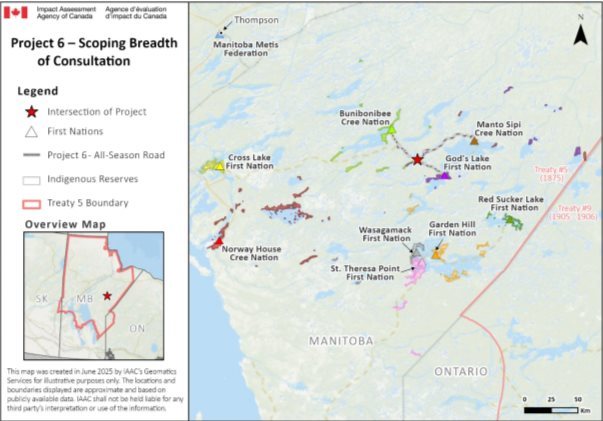
Source: Impact Assessment Agency of Canada, June 2025.
Figure Description
The reserve lands of Bunibonibee Cree Nation, Manto Sipi Cree Nation, and God's Lake First Nation are located at the three end points of the road. The main reserve lands of Red Sucker Lake First Nation, Garden Hill First Nation, Wasagamack First Nation, and St. Theresa Point First Nation are located approximately 70 to 85 kilometres south and southeast of the project. The main reserve lands of Norway House Cree Nation and Pimicikamak Okimawin (Cross Lake First Nation) are located approximately 120 and 170 kilometres west of the project, respectively.
The proponent indicated that the project overlaps with the traditional territories of Indigenous groups located adjacent to the Project Footprint, including Bunibonibee Cree Nation, God's Lake First Nation, and Manto Sipi Cree Nation. These groups define their rights and the conditions needed to exercise their rights as hunting, trapping, fishing, access to traditional travel routes, plant gathering, and cultural practices and sites. The other Indigenous groups not located directly adjacent to the Project Footprint were also given the opportunity to provide comments regarding the potential environmental effects of the project on the exercise of their section 35 rights; these also included hunting, trapping, fishing, access to travel routes, plant gathering, and cultural practices and sites. The proponent committed to continuous engagement with all Indigenous groups to seek additional information regarding each group's Aboriginal and Treaty rights through its Indigenous and Public Engagement Program.
9.2 Potential Adverse Impacts of the Project on Section 35 Rights
9.2.1 Hunting, Trapping, and Fishing Rights
The project overlaps with the asserted traditional territories of all Treaty 5 First Nations and Métis Nations who hold and practice their section 35 rights within the Project Footprint, LAA, and/or RAA.
The assessment of project impacts to hunting, trapping, and fishing rights includes consideration of the project's residual and cumulative effects to the physical and biological conditions of resources which support the exercise of those rights. The assessment also considers cultural factors and socio-economic conditions that support the exercise of each right.
Hunting and Trapping
The project's residual and cumulative environmental effects could impact hunting and trapping rights through adverse effects on the availability, quality, and quantity of species of cultural and traditional importance that support the right to hunt and trap, including moose, caribou, furbearers, and migratory and non-migratory birds:
- clearing of native vegetation during construction and operation within the Project Footprint could result in alteration, fragmentation, and/or loss of habitat for wildlife species;
- vegetation clearing during construction and operation could result in the loss of nests and mortality of young migratory and non-migratory birds;
- vehicle and equipment noise and vibration during construction and operation could result in increased sensory disturbance and displacement of wildlife species;
- an increased number of hunters during construction and increased access during operation of the project could result in increased hunting pressure, predation by wolves, and the potential for the introduction and spread of diseases; and
- project construction and operation could increase the risk of injury or mortality to wildlife due to collisions with equipment and vehicles.
The proponent predicted that, following the implementation of mitigation measures, residual and cumulative project effects on the biological and physical conditions that support the right to hunt and trap would be adverse, low to moderate in magnitude, infrequent to continuous, short to long term in duration, reversible, and would occur within the LAA during construction and operation. Further, the proponent predicted that residual adverse effects would largely affect species at the individual level and would not measurably affect wildlife populations.
God's Lake First Nation and Manto Sipi Cree Nation noted concerns that the project could adversely impact traditional use activities, such as hunting and trapping, by displacing wildlife and reducing their populations, thereby resulting in the need for Indigenous Peoples to travel farther from their communities to exercise their section 35 rights.
IAAC acknowledges that the project's residual and cumulative environmental effects may adversely affect the availability, quality, and quantity of wildlife species of cultural and traditional importance to Indigenous Peoples and that support the right to hunt and trap. IAAC understands that the residual and cumulative environmental effects of the project to wildlife species and their habitat would not measurably affect the distribution of wildlife species or result in adverse effects at the population level within the RAA. IAAC also understands that, although some habitat for wildlife species would be permanently lost as a result of project activities, after the implementation of mitigation measures, including reclamation of temporary project infrastructure following construction, habitat losses would be small relative to the availability of wildlife habitat in the RAA. The proponent also committed to implementing an Environmental Protection Plan for wildlife using an adaptive management approach to enable continuous improvement. IAAC highlights the importance of continued engagement with Indigenous groups to identify and monitor project effects to wildlife species of cultural importance, and the implementation of a follow-up and monitoring program to verify the results of the environmental assessment, verify the effectiveness of mitigation measures, and inform the need for the implementation of contingency measures.
Taking into account the implementation of the mitigation, follow-up, and monitoring measures proposed by the proponent (Appendix C), the key mitigation measures identified by IAAC in this EA Report, and the importance of wildlife species to local communities, IAAC is of the view that the severity of project impacts to the exercise of hunting and trapping rights as a result of adverse effects to wildlife species of cultural and traditional importance would be low to moderate and local in extent, with the greatest impacts occurring within the Project Footprint.
Fishing Rights
Indigenous groups fish for sustenance, recreation, and cultural purposes within the Project Footprint and LAA. Construction and operation of the project could impact fishing rights through effects on the availability, quality, and quantity of fish:
- project activities that reduce water quality, such as through increased sedimentation or spills of hazardous materials could result in injuries, impaired health and death to fish, loss of fish habitat, and a reduction in fishing success;
- blasting during construction and operation of the project could result in the direct injury or death of fish, and affect the quality and quantity of fish;
- increased access to the Project Footprint and LAA facilitated by the project could result in increased fishing pressure, potentially adversely affecting fish communities and populations, particularly if overfishing were to occur during critical lifecycle periods for fish;
- project activities, including construction of watercourse crossings, could cause blockages or reduced fish passage and disruption of fish spawning;
- vegetation clearing and in-water works could result in the loss or alteration of fish habitat, potentially affecting fish communities and populations; and
- project activities, including the use of equipment in water during construction and operation, could introduce aquatic invasive species, which could modify fish habitats, and reduce native fish species diversity and abundance.
The proponent predicted that, following the implementation of mitigation measures, residual and cumulative project effects to fish and fish habitat would not be significant as the effects would not result in a measurable reduction in fish populations. Any residual effects to fish, such as from reduced surface water quality, increased fishing pressure, and alteration or loss of fish habitat, would be either short-term and associated with discrete project activities or long-term but limited to the Project Footprint, and would be reversible over time.
God's Lake First Nation noted concerns that contaminants from the project could be released into God's Lake and adversely affect fish, including important spawning areas. Concerns were also noted regarding the potential for the project to facilitate increased access to the Project Footprint and LAA, which could increase fishing pressure and make it harder for community members to exercise fishing rights.
IAAC acknowledges that the project may adversely affect fish and fish habitat of importance to Indigenous groups, thereby impacting their right to fish. IAAC understands that, following the implementation of mitigation measures, residual project effects to fish and fish habitat will likely not result in a measurable reduction in fish populations and that the proponent has committed to implementing an Environmental Protection Plan for fish, and using an adaptive management approach to enable continuous improvement. IAAC also understands that a Fisheries Act authorization may be required for the project, which may include fish habitat offsetting requirements. IAAC highlights the importance of continued engagement with Indigenous groups to identify and address any unanticipated project impacts on fishing rights.
Taking into account the implementation of the mitigation, follow-up, and monitoring measures proposed by the proponent (Appendix C), the key mitigation measures identified by IAAC in this EA Report, and the importance of fish to local Indigenous groups, IAAC is of the view that the severity of project impacts to the right to fish would be low to moderate and local in extent, with the greatest impacts occurring within the Project Footprint.
9.2.2 Right to Cultural Practice
As supported under section 35 of the Constitution Act, 1982, Aboriginal rights include a range of cultural and traditional activities that have been practiced by Indigenous Peoples historically. The right to cultural practice is a key value needed to exercise section 35 rights. IAAC acknowledges that cultural practices are important for safeguarding cultural identity and language, maintaining spiritual connections to the land and sense of place, promoting community well-being, and transferring knowledge.
Plant Harvesting Rights
Indigenous groups harvest plants for sustenance and medicinal purposes throughout the Project Footprint, LAA, and RAA. Potential impacts to plant harvesting, which is incidental to the right of cultural practice, could occur as a result of project effects to the availability or quality of vegetation and wetlands:
- the disturbance, loss, or removal of native vegetation through clearing and construction of the project could result in the loss of plant communities, alteration of the composition, diversity, and structure of plant communities, and fragmentation of vegetation;
- direct or indirect disturbance or loss of wetlands and wetland functions could affect the ability of Indigenous Peoples to practice cultural activities in these areas, or harvest plant and wildlife species of importance that occur in these areas;
- the introduction and spread of invasive and non-native plant species through construction and equipment use may displace native plant communities or modify native vegetation composition and structure;
- accidental spills and non-targeted herbicide application during construction and operation could result in the loss or impairment of vegetation; and
- an increased risk of wildfires due to project activities could measurably affect vegetation species or communities.
The proponent predicted that, following the implementation of mitigation measures, residual and cumulative project effects to vegetation and wetlands would be low to moderate in magnitude, limited to the Project Footprint, and partially reversible through reclamation. The proponent also noted that wetland areas and vegetation species and communities that may be affected by the project are common in the region.
God's Lake First Nation noted concerns regarding the disturbance of rare medicinal plants as a result of project construction and recommended that measures be implemented to identify the location of these plant species and mitigate adverse effects.
IAAC acknowledges that the project may adversely affect plant species and wetland areas of importance for plant harvesting. IAAC understands that effects to vegetation and wetlands would be partially reversible through reclamation of temporary project infrastructure and following the completion of construction activities. While some project-related vegetation and wetland losses would be permanent, IAAC is of the view that, following the implementation of mitigation measures, these losses would result in low to moderate effects to the availability and overall distribution of plant and wetland communities in the RAA. IAAC understands that the proponent committed to continued engagement with Indigenous groups through the Indigenous and Public Engagement Program to provide project updates and create a forum for Indigenous groups to voice their opinions, comments, and suggestions regarding project activities, environmental effects, and impacts to rights.
Taking into account the implementation of the mitigation, follow-up, and monitoring measures proposed by the proponent (Appendix C), the key mitigation measures identified by IAAC in this EA Report, and the importance of plant harvesting to local Indigenous groups, IAAC is of the view that the severity of project impacts to the right to cultural practice as a result of effects to plant harvesting would be low to moderate and local in extent, with the greatest impacts occurring within the Project Footprint.
Access
The exercise of section 35 rights, including hunting, trapping, and fishing, by Indigenous groups in the RAA is facilitated through access to traditional travel routes that connect them to lands and resources necessary to exercise these and other activities. This includes walking, all-terrain vehicle, and snowmobile trails, and open and frozen waterways. The project has the potential to adversely affect access to lands and resources during construction and operation by interrupting and restricting access to travel routes.
The proponent predicted that, following the implementation of mitigation measures, project-related impacts to access would be low in magnitude, as Indigenous groups would likely be able to adapt to these changes with relative ease and maintain predevelopment activities. Further, given that the road would be constructed in segments, access restrictions would be limited to the segment of the road under active construction. When operational, the project would also improve access to resource use areas by facilitating year-round access and a more efficient travel route than the existing winter road.
God's Lake First Nation and Manto Sipi First Nation noted concerns that the project would intersect traplines and impact their ability to exercise trapping rights.
IAAC acknowledges that the project may result in adverse impacts on the ability of Indigenous groups to access areas of importance to exercise their rights, including through disturbance or interruption of traditional travel routes. IAAC agrees that construction of the road in segments would limit access restrictions during construction and that the project would likely facilitate improved access to resource use areas, once operational. IAAC understands that the proponent committed to continued engagement with Indigenous groups through the Indigenous and Public Engagement Program to provide project updates and create a forum for Indigenous groups to voice their opinions, and provide comments and suggestions regarding project activities, environmental effects, and impacts to rights.
Taking into account the implementation of the mitigation, follow-up, and monitoring measures proposed by the proponent (Appendix C) and the key mitigation measures identified by IAAC in this EA Report, IAAC is of the view that the severity of project impacts to the right to cultural practice as a result of effects to the right of access would be low and local in extent.
Quality of Experience
Project effects to the atmospheric environment, including air quality and noise levels, could cause nuisances that may affect the quality of experience of Indigenous Peoples exercising their section 35 rights on the land, leading to avoidance of harvesting areas, and an associated reduction in food supply and negative health outcomes. However, the proponent predicted that, following implementation of mitigation measures, residual and cumulative project effects to air quality and noise levels would be low in magnitude, as any increases in air contaminant concentrations and noise levels would be less than ten percent relative to baseline conditions and would not exceed provincial or federal air quality or noise guidelines.
IAAC acknowledges that the project may result in measurable and perceived increases in air contaminant concentrations and noise levels that may adversely affect the quality of experience of Indigenous Peoples exercising their section 35 rights. IAAC is of the view that the proponent's proposed mitigation measures, monitoring, and follow-up programs and the key mitigation measures identified in Chapter 6.1 (Atmospheric Environment) of this EA Report would adequately address project-related increases in noise levels and air contaminant concentrations that may result in adverse impacts to the quality of experience of Indigenous groups exercising their section 35 rights. IAAC also understands that the proponent committed to continued engagement with Indigenous groups through the Indigenous and Public Engagement Program to provide project updates and create a forum for Indigenous groups to voice their opinions, and provide comments and suggestions regarding project activities, environmental effects, and impacts to rights.
Taking into account the implementation of the mitigation, follow-up, and monitoring measures proposed by the proponent (Appendix C) and the key mitigation measures identified by IAAC in this EA Report, IAAC is of the view that the severity of project impacts to the right to cultural practice as a result of effects to the quality of experience of Indigenous Peoples would be low and local in extent.
Physical and Cultural Heritage Resources and Sites of Cultural Importance
In addition to the physical and cultural heritage resources and sites of significance identified in Chapter 7.4 (Indigenous Peoples – Current Use of Lands and Resources for Traditional Purposes, Physical and Cultural Heritage, and Sites of Significance), the project could adversely affect unidentified sites of physical, cultural, and historical importance to Indigenous groups. These sites are associated with cultural activities of Indigenous Peoples, such as plant gathering, fishing, hunting, ceremonial activities, campsites, current and historic travel routes, gravesites, and archeological and historical artifacts.
IAAC acknowledges that project activities and increased access to the Project Footprint could result in the loss or disturbance of physical and cultural heritage resources and sites of cultural importance to Indigenous groups. IAAC also recognizes that, should unidentified sites of physical, cultural, and historical importance to Indigenous groups overlap with project infrastructure, these sites could be permanently lost or damaged once construction begins. IAAC understands that the proponent designed the project to avoid known sites and resources of importance to Indigenous groups and that a Heritage Resources Artifact Recovery program would be developed to mitigate project effects to heritage and archaeological resources. IAAC also understands that the proponent would be required to comply with Manitoba's The Heritage Resources Act, which includes provisions for the identification and protection of resources and sites of importance. IAAC recommends that the proponent work with Indigenous groups during project construction to monitor for chance finds of sites and resources of importance, notify Indigenous groups of any chance finds, and continue to engage with Indigenous groups prior to and throughout construction to discuss appropriate mitigation measures to address project impacts to resources and sites of cultural importance.
Taking into account the implementation of the mitigation, follow-up, and monitoring measures proposed by the proponent (Appendix C), the key mitigation measures identified by IAAC in this EA Report, and existing provincial mechanisms in place to protect physical and cultural heritage resources and sites of importance, IAAC is of the view that the severity of project impacts to the right to cultural practice as a result of effects to physical and cultural heritage resources and sites of cultural importance would be low and local in extent.
9.3 Issues to be Addressed during the Regulatory Approval Phase
Should the project proceed, federal authorities with regulatory requirements may continue consultation with Indigenous groups after the environmental assessment decision is issued. Specifically, relevant federal authorities may consult with Indigenous groups prior to making decisions related to a Fisheries Act authorization, as appropriate. Comments from Indigenous groups received during the environmental assessment will be shared directly with federal authorities to inform their decision-making. As applicable, decisions by federal authorities would take into account the outcomes of ongoing consultation with Indigenous groups and the consultation record resulting from the environmental assessment.
IAAC recognizes that the project is subject to approvals under provincial legislation and that associated provincial regulations, guidelines, and policies provide for the protection of relevant aspects of both the natural and human environments. Consultation by the Province of Manitoba, as applicable, on those authorizations will also create opportunities for Indigenous groups to have their concerns addressed. The provincial Crown has a duty to consult Indigenous groups, as appropriate, prior to making decisions.
9.4 IAAC Conclusions Regarding Impacts to Section 35 Rights
Should the project proceed, IAAC acknowledges that the project is likely to cause changes to the exercise of section 35 rights. This includes low to moderate severity impacts on the right to hunt, trap, and fish, and low severity impacts on the right to cultural practice.
IAAC is of the view that, taking into account the mitigation, follow-up, and monitoring measures proposed by the proponent (Appendix C), the key mitigation measures identified by IAAC in this EA Report, and existing provincial and federal legislation and regulatory mechanisms, potential impacts of the project on section 35 rights would be appropriately mitigated. The application of mitigation, monitoring, and follow-up measures should allow the continued exercise of section 35 rights in a similar manner as before the project. IAAC recognizes that proponent-led discussions with each Indigenous group regarding the project are ongoing.
10 Conclusions and Recommendations of IAAC
In preparing this EA Report, IAAC considered the proponent's EIS, its responses to information requests, the views of federal authorities, Indigenous Peoples, and the public, measures that would be implemented to mitigate project effects, and follow-up and monitoring programs.
The environmental effects of the project and their significance have been determined using assessment methods and analytical tools that reflect current accepted practices of environmental and socio-economic assessment practitioners, including consideration of potential accidents and malfunctions and cumulative environmental effects.
IAAC recognizes that the project may result in residual adverse effects, after the implementation of mitigation measures, to fish and fish habitat; migratory birds; Indigenous Peoples' current use of lands and resources for traditional purposes; physical and cultural heritage; any structure, site, or thing that is of historical, archaeological, paleontological, or architectural significance to Indigenous Peoples; and Indigenous Peoples' health and socio-economic conditions. A discussion of these effects can be found in the corresponding chapters of this EA Report.
IAAC concludes that, considering the implementation of mitigation measures, monitoring, and follow-up programs, the project is not likely to cause significant adverse residual environmental effects as defined in section 5 of CEAA 2012. IAAC identified key mitigation measures, monitoring, and follow-up programs, for consideration by the Minister of Environment and Climate Change in establishing conditions as part of the Environmental Assessment Decision Statement, should the project be permitted to proceed.
In addition, it is IAAC's expectation that, for the project to be carried out in a careful and precautionary manner, all of the proponent's commitments, including mitigation measures, monitoring, and follow-up programs, as outlined in the EIS and its supporting documents would be implemented as proposed. Further, it is expected that the proponent will continue to engage, inform, and communicate with Indigenous Peoples throughout the life of the project.
Appendices
Appendix A: Environmental Effects Rating Criteria
|
Rating Criteria |
Definition |
Rating |
|---|---|---|
|
Direction of Change |
The relative change compared to existing conditions. |
Neutral or Negligible – no measurable change to the valued component¹. Negative – net loss (adverse or undesirable change) to the valued component. Positive – net benefit (or desirable change) to the valued component. |
|
Duration |
The period of time required until the valued component returns to its existing (baseline) condition, or the residual effect can no longer be measured or otherwise perceived. |
Short Term – the potential effect results from short-term events or activities, such as discrete activities during construction, maintenance, or rehabilitation activities (i.e., a timeframe of several months, up to one year). Medium Term – the potential effect is likely to persist until the completion of construction and rehabilitation activities (i.e., great than one year, up to ten years). Long Term – the potential effect is likely to persist beyond the completion of construction and rehabilitation activities into the operation and maintenance phase of the project (i.e., a timeframe of greater than ten years). |
|
Magnitude |
The degree of change in a valued component relative to baseline conditions. |
Negligible or Low – a change that is not likely to have a definable, detectable, or measurable effect above baseline conditions (i.e., potential effect is within a normal range of variation) or is below established thresholds of acceptable change (e.g., water quality guidelines), as defined by valued component. Moderate – a change that will likely result in a measurable effect that can be detected with a well-designed monitoring program, but is marginally in excess of standards, guidelines, or established thresholds of acceptable change, defined by valued component. High – a change that will likely result in an effect that is easily observed, measured, and described (i.e., readily detectable through a monitoring program) and is well in excess of guidelines or established thresholds of acceptable change, defined by valued component. |
|
Timing² |
Consideration of the periods of time during which a residual effect is expected to occur (e.g., species' breeding season, Indigenous spiritual and cultural practices). |
No Sensitivity – effect does not occur during a critical life stage or during Indigenous harvesting periods, as identified during traditional knowledge studies. Moderate Sensitivity – effect occurs at the start or end of a critical life stage or during opportunistic Indigenous harvesting times, as identified during traditional knowledge studies. High Sensitivity – effect occurs during a critical life stage or during specific Indigenous harvesting times, as identified during traditional knowledge studies. |
|
Geographic Extent³ |
The geographic or spatial area within which the residual effect is expected to occur. |
Project Footprint – effects are restricted to the area within which project components and activities will occur, including the right-of-way and the location of permanent and temporary facilities. Local Assessment Area (LAA) – effects extend beyond the Project Footprint into, but not beyond, the LAA. Regional Assessment Area (RAA) – effects extend beyond the LAA and may interact with those of other projects in the RAA. |
|
Frequency |
How often the residual effect would occur during a project phase or activity in a specified time period. |
Infrequent – the potential effect occurs once or seldom during the life of the project. Sporadic/Intermittent – the potential effect occurs only occasionally and without any predictable pattern during the life of the project. Regular/Continuous – the potential effect occurs at regular and frequent intervals during any given project phase or over the life of the project. |
|
Reversibility |
Whether the residual effect on the valued component can be returned to its previous condition or other target (e.g., a reclamation target) once the activity or component causing the disturbance ceases. |
Reversible (short-term) – potential effect is readily reversible over a relatively short period (i.e., less than eight years). Reversible (long-term) – potential effect is potentially reversible but over a long period (i.e., greater than eight years). Irreversible – project-specific potential effects are permanent and irreversible. |
|
Ecological and Socio-economic Context |
The current degree of anthropogenic disturbance and/or ecological sensitivity in the area in which the residual effect would occur. |
Ecological Low – valued component is not rare or unique, and is resilient to imposed change. Moderate – valued component is moderately or seasonally fragile, and has capacity to adapt to imposed change. High – valued component is a protected or designated species under Manitoba's The Endangered Species and Ecosystems Act or Species at Risk Act, or a species listed by the Committee on the Status of Endangered Wildlife in Canada or the Manitoba Conservation Data Centre as very rare (S1) to rare (S2) or fragile, with low resistance to imposed change or part of a very fragile ecosystem. Social Low – Indigenous Peoples in the RAA are able to adapt to effects with relative ease and maintain pre-project development activities. Moderate – Indigenous Peoples in the RAA are able to adapt to effects with some adjustments and maintain pre-project development activities but only with a degree of support. High – Indigenous Peoples in the RAA will not be able to adapt to effects or maintain pre-project development activities. |
¹ Definitions by valued component are provided in Table 1.
² Critical life stages include nesting, breeding, spawning, and calving periods, which may vary by valued component and seasonal conditions.
³ The LAA and RAA vary by valued component; valued component specific figures depicting the spatial extent of the LAAs and RAAs are provided in Chapter 2 (Project Overview) of this EA Report.
|
Valued Component |
Rating |
|---|---|
|
Fish and Fish Habitat |
Negligible or Low – the effect is considered minor, resulting in no net loss of the productive capacity of fish habitat and no measurable reduction to fish communities or populations. Moderate – a potential measurable effect on individuals, resulting in a net loss of the productive capacity of fish habitat affecting local fish communities and populations. High – potential effects at the population level, resulting in a net loss of the productive capacity of fish habitat affecting regional fish communities and populations. Fish Species at Risk – Lake Sturgeon Negligible or Low – the effect is considered minor, and habitat alteration or loss is restricted to non-critical habitat and considered minor relative to availability. Moderate – a potential measurable effect on individuals, such as displacement of critical life stages, but at a level considered minor relative to population size or habitat availability. No effects would occur on critical habitat. High – potential effects on individuals, such as mortality, that are easily observed, measured, and described, and affects critical habitat. |
|
Migratory Birds |
Negligible or Low – not likely to have a definable, detectable, or measurable effect, and considered to occur at the individual level, not affecting the population or habitat availability. Moderate – potential measurable effects at the population level and considered moderate relative to habitat availability. High – potential effects at the population level that are easily observed, measured, and described, and considered to have a major effect on habitat availability. |
|
Species at Risk |
Negligible or Low – effects are considered minor, and habitat alteration or loss is limited to non-critical habitat and considered minor relative to availability. Moderate – potential measurable effects on individuals, such as displacement of critical life stages. Effects to habitat are considered minor relative to habitat availability, and critical habitat is not affected. High – potential effects on individuals, such as mortality or destruction of nests, that are easily observed, measured, and described, and effects to critical habitat would occur. |
|
Federal Lands |
Atmospheric Environment (Air Quality) Negligible or Low – emissions result in contaminant concentrations above baseline levels but within guidelines established within the Canadian Ambient Air Quality Standards (CAAQS) and Manitoba Ambient Air Quality Criteria (MAAQC). Moderate – emissions result in contaminant concentrations in excess of CAAQS or MAAQC limits, resulting in the potential for adverse environmental effects. High – emissions are likely to result in exceedances of CAAQS or MAAQC limits, resulting in adverse environmental effects. Vegetation and Wetlands Negligible or Low – effects are considered minor, only affecting common species or communities. Moderate – measurable effects to vegetation communities or species but limited to common species or communities. High – measurable effects to vegetation communities or species and may affect rare or protected species. Surface Water Quantity Negligible or Low – changes to watercourse flows are within the range of natural variation or less than 15 percent of the seasonal average. Moderate – changes to watercourse flows are outside the range of natural variation and within 15 to 25 percent of the seasonal average. High – changes to watercourse flows are outside the range of natural variation and greater than 25 percent of the seasonal average. Surface Water Quality Negligible or Low – contaminant concentrations in receiving waters are within Canadian Council of Ministers of the Environment's Canadian Water Quality Guidelines for the Protection of Aquatic Life (CWQG-PAL) and Manitoba Water Quality Standards, Objectives, and Guidelines (MWQSOG); or if guidelines are exceeded, there are no anticipated adverse environment effects beyond any defined mixing zones. Moderate – water quality effects in receiving waters exceed CWQG-PAL and MWQSOG, and have the potential to adversely affect drinking water uses, aquatic life, and/or wildlife beyond any defined mixing zones. High – water quality effects in receiving waters exceed CWQG-PAL and MWQSOG, and are likely to adversely affect drinking water uses, aquatic life, and/or wildlife beyond any defined mixing zones, likely resulting in unacceptable adverse environmental effects. Groundwater Quality Negligible or Low – contaminant concentrations in receiving waters are within applicable federal and provincial regulations and guidelines; if guidelines are exceeded, the change is within the natural range of variability of existing conditions and adverse environment effects are not anticipated. Moderate – contaminant concentrations in receiving waters exceed applicable federal and provincial regulations and guidelines, are not within the natural range of variability, and have the potential to adversely affect drinking water and aquatic life within the Project Footprint and LAA. High – contaminant concentrations in receiving waters exceed applicable federal and provincial regulations and guidelines, are not within the natural range of variability, and are likely to adversely affect drinking water and aquatic life within the Project Footprint or LAA, likely resulting in serious adverse effects. Groundwater Quantity Negligible or Low – changes to groundwater-fed creek flows, river flows, or well production are less than 15 percent of the seasonal average. Moderate – changes to groundwater-fed creek flows, river flows, or well production are within 15 to 25 percent of the seasonal average. High – changes to groundwater-fed creek flows, river flows, or well production are greater than 25 percent of the seasonal average. |
|
Indigenous Peoples – Current Land Use of Lands and Resources for Traditional Purposes |
Negligible or Low – current land and resource uses by Indigenous Peoples in the RAA would be able to continue with relative ease and pre-project activities could continue. Moderate – current land and resource uses by Indigenous Peoples in the RAA would be able to continue with some adaptation and pre-project activities could continue but only with a degree of support. High – current land and resource uses by Indigenous Peoples in the RAA would not be able to continue and pre-project activities could not continue. |
|
Indigenous Peoples – Health and Socio-economic Conditions |
Indigenous Peoples' Health Negligible or Low – selected parameter changes by less than ten percent relative to baseline conditions within the RAA. Moderate – selected parameter changes by ten to 20 percent relative to baseline conditions within the RAA. High – selected parameter changes by greater than 20 percent relative to baseline conditions within the RAA. Indigenous Peoples' Socio-economic Conditions Negligible or Low – Indigenous Peoples in the RAA are able to adapt with relative ease and maintain pre-project activities. Moderate – Indigenous Peoples in the RAA are able to adapt with some adjustments and maintain pre-project activities but only with a degree of support. High – Indigenous Peoples in the RAA will not be able to adapt to changes or maintain pre-project activities. |
|
Indigenous Peoples – Physical and Cultural Heritage, and Any Structure, Site, or Thing that is of Historical, Archaeological, Paleontological, or Architectural Significance |
Negligible or Low – resources and sites would be disturbed by the project and are recoverable. Moderate – resources and sites of local importance would be disturbed by the project and are not recoverable. High – resources and sites of regional and national importance would be disturbed by the project and are not recoverable. |
Appendix B: Summary of Crown Consultation with Indigenous Groups
Appendix B contains a summary of the key issues of concern related to the Project 6 – All-season Road Linking Manto Sipi Cree Nation, Bunibonibee Cree Nation, and God's Lake First Nation (the project) that were identified by Indigenous groups throughout the environmental assessment, along with Manitoba Transportation and Infrastructure's (the proponent) and the Impact Assessment Agency of Canada's (IAAC) responses.
|
# |
Indigenous Group |
Comment or Concern |
Summary of Proponent's Response |
IAAC Response |
|---|---|---|---|---|
|
A |
Accidents and Malfunctions |
|||
|
A1 |
Bunibonibee Cree Nation, God's Lake First Nation, Manitoba Métis Federation, Manto Sipi Cree Nation, Norway House Cree Nation |
Concerns regarding the potential for accidents and malfunctions (i.e., spills, explosions, fires, construction debris) that may affect Indigenous Peoples' traditional and current land and resource use, physical and cultural heritage, and health and socio-economic conditions, and the need for mitigation, follow-up, and monitoring measures to address these effects. |
The proponent completed an effects assessment for accidents and malfunctions based on the project components, activities, equipment, and materials (i.e., type and quantity) associated with each project phase. The proponent is of the view that, following the implementation of mitigation measures, potential effects to human receptors, including human health, sites of cultural and heritage value, species of importance to Indigenous Peoples, Indigenous Peoples' access and travel routes, and impacts to Aboriginal and Treaty rights, as protected by section 35 of the Constitution Act, 1982 (section 35 rights) would be appropriately mitigated. The proponent committed to following the Environmental Protection Procedures and Environmental Protection Specifications established by Manitoba Transportation and Infrastructure, including development of an Environmental Emergency Plan for Spill Response and Remediation, Material Management Plan, Evacuation and Emergency Preparedness Plan, and Explosives and Blasting Management Plan that would be implemented in the event of an accident or malfunction scenario to mitigate adverse effects to the environment and Indigenous Peoples. |
IAAC is satisfied with the proponent's response and is of the view that the proponent's proposed mitigation measures, including the proponent's commitment to develop emergency response procedures, are appropriate to mitigate potential adverse environmental effects and effects to Indigenous Peoples as a result of potential accidents and malfunctions. IAAC recommends, for inclusion in the Minister of Environment and Climate Change's (the Minister) Decision Statement, that the proponent include in the development of the Emergency Response Plan for the project: worst-case scenarios, spill response measures, including on-site response times and spill notification measures, and proposed measures to mitigate potential effects to the environment. IAAC also recommends that the proponent develop and implement a follow-up program, in consultation with Indigenous groups and relevant authorities, for accidents and malfunctions describing the means of communication, notification procedures, and urgent and long-term communication requirements for possible emergency events, including notification of affected Indigenous groups, and that summary reports following accident or malfunction events be made available to Indigenous groups. |
|
B |
Alternative Means of Carrying Out the Project |
|||
|
B1 |
Bunibonibee Cree Nation, God's Lake First Nation, Manitoba Métis Federation, Manto Sipi Cree Nation, Pimicikamak Okimawin |
Need for a comprehensive assessment of project components and alternative means of carrying out the project, including alternative transportation options, road alignments, temporary access routes, bridge and culvert locations, location options for borrow areas and quarries, and fueling stations. Request that the proponent conduct additional studies and engagement with Indigenous groups to determine appropriate locations for project components and potential effects. |
The proponent considered alternative transportation modes including rail, hovercraft, ferries, air, and upgrades to the existing winter roads. It was determined that these alternatives were not suitable permanent solutions based on cost, reliability, environmental effects, and safety. The proponent indicated that the selected road alignment, crossing locations, and borrow area and quarry locations were based on existing environmental baseline information; engineering considerations; fish and fish habitat, wildlife, soil, and vegetation assessments; the location of heritage resources; and traditional knowledge studies. The proponent also committed to conducting a review of data validity prior to construction to verify key environmental predictions and to ongoing engagement with Indigenous groups. |
IAAC is satisfied with the proponent's response and is of the view that the proponent's commitments to conduct a review of data validity, and to ongoing engagement and information sharing with Indigenous groups are appropriate to address outstanding concerns. |
|
C |
Atmospheric Environment |
|||
|
C1 |
Manitoba Métis Federation, Manto Sipi Cree Nation, Pimicikamak Okimawin |
Need for a detailed air quality assessment, including baseline information, data sources, thresholds used, and anticipated emissions for all air pollutants that may be released from project activities and components during all project phases. Request that the proponent monitor air quality throughout project construction and maintenance, and develop a mitigation plan to prevent increases in particulate matter concentrations in nearby Indigenous communities. |
The proponent acknowledged that dust and particulates could be transported towards nearby communities, however only for a limited time frame. The proponent committed to developing a follow-up program prior to construction, in consultation with Indigenous groups and relevant authorities, to verify the accuracy of the environmental assessment as it pertains to adverse environmental effects on air quality and potential human health outcomes. Dust conditions would be monitored throughout construction to evaluate the effectiveness of mitigation measures and affected Indigenous groups would be informed in advance of all project activities. The proponent also committed to conducting a data validity review prior to construction, which may include additional baseline data collection and field surveys to inform existing conditions and support the development of a follow-up and monitoring program. The proponent was of the view that, with the implementation of mitigation measures, including the use of low sulphur fuels, limiting vehicle and equipment idling, conducting regular vehicle maintenance, and limiting traffic to construction vehicles and equipment during construction, dust and particulate emissions would be low. |
IAAC recognizes that the project may result in exceedances of the Manitoba Ambient Air Quality Criteria (MAAQC) and Canadian Ambient Air Quality Standards (CAAQS) limits for nitrogen oxides (NOx), carbon monoxide (CO), sulphur oxides (SOx), particulate matter (PM2.5 and PM10), and total suspended particulates during construction and operation, and that uncertainty remains regarding air quality and potential effects to human health as a result of project-related dust and particulate matter emissions. IAAC recommends, for inclusion in the Minister's Decision Statement, that the proponent develop and implement a follow-up program, in consultation with Indigenous groups and relevant authorities, to verify the results of the environmental assessment, verify the effectiveness of mitigation measures, and inform the need for the implementation of contingency measures, should exceedances of MAAQC and CAAQS limits at sensitive receptors be detected. |
|
C2 |
Manto Sipi Cree Nation |
Concerns regarding temporary or permanent sensory disturbances due to lighting associated with project activities, the lack of noise and sensory disturbance studies completed by the proponent, and the validity of data sources used to inform the assessment of effects. Request that the proponent monitor noise levels during construction and implement mitigation measures to reduce effects to Indigenous groups and wildlife from sensory disturbances, including from light, noise, and vibrations. |
The proponent indicated that no lighting would be required for the project during construction and operation. However, if lighting is needed, it would be further evaluated during the detailed design phase and incorporated into the project's Environmental Management Plan. The proponent also noted that anticipated noise levels from construction and operation would adhere to occupation exposure limits identified by the Canadian Centre for Occupational Health and Safety and the Manitoba Safety and Health Regulation. The proponent was of the view that the mitigation measures proposed would effectively reduce potential project effects to Indigenous groups and wildlife as a result of elevated noise and vibration levels. |
IAAC is satisfied with the proponent's assessment of potential project effects to light, noise, and vibration levels and is of the view that the proponent's proposed mitigation measures would adequately address potential effects to Indigenous groups and wildlife. IAAC agrees with the proponent's commitment to implement a follow-up and monitoring program with respect to noise and vibration levels. IAAC recommends, for inclusion in the Minister's Decision Statement, that the proponent consult with Indigenous groups during the development of this follow-up and monitoring program to ensure that potential effects to Indigenous Peoples' health and Indigenous knowledge are adequately considered. |
|
D |
Cumulative Effects |
|||
|
D1 |
Bunibonibee Cree Nation, God's Lake First Nation, Manto Sipi Cree Nation, Pimicikamak Okimawin |
Concerns regarding the project's contribution to cumulative effects on the disruption of lands and resources (e.g., fish, aquatic species, birds, and wildlife) in the Regional Assessment Area (RAA) and northern areas, in combination with other past, present, and reasonably foreseeable projects and physical activities, including industrial activity. |
The proponent indicated that past, present, and reasonably foreseeable projects and physical activities would not overlap temporally or spatially with the proposed project. Therefore, it is unlikely that the project would contribute to adverse cumulative effects to valued components. The proponent acknowledged that, although there is potential that the project would facilitate other developments in the region, such as mines, exploration projects, hydroelectric facilities, and transmission lines, there are no known foreseeable activities to assess or consider at this time. Tourism and recreational activities within the RAA would not be anticipated to change as the project is not connected to the provincial transportation network except by winter road. |
IAAC is of the view that the proponent adequately characterized potential cumulative effects of the project in combination with other past, present, and reasonably foreseeable projects and physical activities, and that the proponent's proposed mitigation measures are appropriate to limit the project's contribution to cumulative effects. IAAC is of the view that, after taking into consideration the effects of the project and its interactions with the effects of past, present, and reasonably foreseeable projects and physical activities, the project is not likely to cause significant adverse cumulative environmental effects on fish and fish habitat, migratory birds, species at risk, and Indigenous Peoples. |
|
D2 |
Manitoba Métis Federation, Manto Sipi Cree Nation |
Concerns regarding the selection of valued components for the cumulative effects assessment and the proponent's analysis. Request that Indigenous groups be given an opportunity to provide input on the selection of valued components to ensure that cumulative effects are properly identified and assessed. |
The proponent conducted a cumulative effects assessment for each valued component having the potential to combine residual adverse effects of the project with potential adverse effects from other past, present, and reasonably foreseeable projects and physical activities. The proponent followed IAAC's Operational Policy Statement for Addressing Cumulative Environmental Effects under the Canadian Environmental Assessment Act, 2012 and the Technical Guidance for Assessing Cumulative Environmental Effects Under the Canadian Environmental Assessment Act, 2012. Additional information and input from Indigenous groups will be sought through the ongoing Indigenous and Public Engagement Program which would include opportunities for dialogue with Indigenous groups and regular reports on engagement and project status updates. These engagement activities would inform project planning, provincial and federal environmental regulatory requirements, and support Crown-Indigenous consultation. |
IAAC acknowledges that concerns remain regarding potential cumulative effects to the landscape, fish and fish habitat, migratory birds, species at risk, and Indigenous Peoples' current use of lands and resources for traditional purposes (current use), including access to lands and resources, as a result of the project in combination with other past, present, and reasonably foreseeable projects and physical activities. IAAC is satisfied with the proponent's assessment of cumulative effects and is of the view that the proponent's proposed mitigation, follow-up, and monitoring measures are appropriate to address the project's contributions to cumulative effects in the region. |
|
E |
Current Use of Lands and Resources for Traditional Purposes by Indigenous Peoples |
|||
|
E1 |
God's Lake First Nation, Manitoba Métis Federation, Manto Sipi Cree Nation |
Request for a comprehensive assessment of project effects on current use, including consideration of potential effects to Treaty Land Entitlement areas, traditional territories, including areas of known contemporary traditional land use, Indigenous community plans, land use plans, or other initiatives related to Indigenous lands and communities. Request that the proponent provide opportunities and resources for Indigenous groups to conduct traditional land use studies to inform the project assessment. |
The proponent indicated that the Indigenous Land and Resource Use Local Assessment Area (LAA) and RAA spatial boundaries include local Indigenous communities and traditional territories, and consider the maximum extent of areas where measurable changes resulting from the project are expected to occur. The traditional territory boundaries and traditional land use areas for the three most directly affected Indigenous groups were identified through traditional knowledge studies; these studies were also used to inform the planning and assessment of the project and project effects. The proponent was of the view that traditional land and resource use areas beyond the LAA and RAA would not experience project effects. The proponent committed to ongoing engagement with Indigenous groups to validate their understanding of each group's traditional territory and how that may overlap with potential project effects. Should current use areas differ from what was understood by the proponent, the effects assessment would be updated. Further, traditional land use plans developed by Indigenous groups would be reviewed and assessed to determine whether they are applicable to the project. The proponent anticipated that land use plans would be limited to within Indigenous groups' traditional territories and would not overlap with the project for most Indigenous groups. |
IAAC is satisfied with the proponent's response and is of the view that the proponent's Indigenous Land and Resource Use LAA and RAA adequately reflect the areas in which changes to the environment as a result of the project may affect Indigenous groups' traditional land and resource use. IAAC is also of the view that the proponent adequately considered areas of known traditional land use and other initiatives related to Indigenous land use within the project area, in relation to project effects on current use. IAAC recognizes that Indigenous groups are currently developing traditional land use plans and is satisfied that the proponent would consider the applicability of traditional land use plans to the project. |
|
E2 |
God's Lake First Nation, Manto Sipi Cree Nation, Norway House Cree Nation, Pimicikamak Okimawin |
Concerns that increased access to traditionally used lands due to project activities may lead to a reduction in available resources and affect the ability of Indigenous Peoples to exercise their section 35 rights and current use activities (e.g., fishing, hunting, and trapping). |
The proponent was of the view that, following the implementation of mitigation measures, potential effects to current use as a result of increased access that would be facilitated by the project would be addressed. Increased access may affect the availability and quality of vegetation, wildlife, and fish species for current use; however lands and resources of importance for current use, including areas that are preferred, are distributed across the LAA and RAA. Therefore, the proponent anticipated that, while the locations in which current use activities are conducted may be redistributed, the effects would not be significant. The proponent indicated that, through traditional knowledge studies, Indigenous groups identified areas of importance for gathering and harvesting, which the proponent considered during project planning and design. The proponent committed to measures to mitigate effects from increased access on current use, including providing construction activity updates to Indigenous groups to support the planning of current use activities, restricting access to areas beyond the Project Footprint, and prohibiting project employees from hunting and trapping. Overall, the proponent was of the view that increased access to currently isolated areas, as a result of the project, would result in positive effects to current use and would allow Indigenous groups to access new lands and more resources for current use during operation. |
IAAC is satisfied with the proponent's response and is of the view that the proponent's proposed mitigation measures are appropriate to address potential adverse effects to current use from increased access. IAAC recommends, for inclusion in the Minister's Decision Statement, that the proponent prohibit non-local project employees from fishing, gathering, hunting, and trapping for any purposes not associated with the project, or using the project to access lands outside the Project Footprint for these activities, unless the employee is an Indigenous group member that is provided access for traditional purposes or for exercising section 35 rights. |
|
E3 |
Bunibonibee Cree Nation, God's Lake First Nation, Manto Sipi Cree Nation |
Concerns regarding the potential alteration of travel routes used for traditional land use practices. Request that the proponent engage with Indigenous groups to determine travel routes that may be affected by the project, and inform affected Indigenous groups when and where project activities may affect these routes and how the proponent intends to provide safe access or alternative travel routes. |
The proponent was of the view that, following the implementation of mitigation measures, potential effects on travel routes would be appropriately addressed. The proponent committed to ongoing communication and engagement with Indigenous groups regarding construction activities that may temporarily affect land and water-based travel routes and solutions to preserve access, including the identification of alternative means to access current use areas should travel routes be affected by project activities. The proponent also committed to providing safe access and navigation by using ramps for land users to cross the road and signs to indicate road crossings. |
IAAC is satisfied with the proponent's response and is of the view that the proponent's proposed mitigation measures are appropriate to address potential adverse project effects on travel routes. IAAC highlights the importance of ongoing engagement with Indigenous groups to determine appropriate and safe measures to access and protect travel routes, and whether alternative means of accessing current use areas are appropriate and feasible. |
|
E4 |
Bunibonibee Cree Nation, Garden Hill First Nation, God's Lake First Nation, Manitoba Métis Federation, Manto Sipi Cree Nation, Norway House Cree Nation, Pimicikamak Okimawin, St. Theresa Point First Nation |
Concerns regarding the disturbance or loss of traditional lands and resources (e.g., muskeg, wetlands, fish, caribou, furbearers, moose, wolverine, and wolves) and traditional land use activities (e.g., canoeing quest, fishing, gathering, harvesting, hunting, and trapping) due to project activities. |
The proponent was of the view that, following the implementation of mitigation measures, potential project effects on lands and resources of importance for current use would be adequately addressed. While changes to lands and resources of importance for current use activities may occur as a result of the project, the proponent concluded that effects would be sporadic, and that plant species and wildlife that may be affected are abundant within the LAA and RAA. Therefore, while the locations in which current use activities are conducted may be redistributed, effects to the ability of Indigenous groups to practice current use activities would not be significant. The proponent committed to implementing mitigation measures to minimize disturbances to current use and support the continued ability of Indigenous Peoples to practice current use activities, including identifying and mapping areas of importance, maintaining buffers to designate the limits of project activities, restricting access to important harvesting areas to minimize disturbances, and ongoing communication with Indigenous groups to ensure awareness of project activities. |
IAAC is satisfied with the proponent's response and is of the view that the proponent's proposed mitigation measures are appropriate to address potential adverse effects on current use. IAAC agrees with the proponent's commitment to identify and map areas of importance and ongoing communication with Indigenous groups regarding project activities. IAAC recommends, for inclusion in the Minister's Decision Statement, that a communication plan be developed that includes maps of project activities in relation to lands and resources of importance for current use for all potentially affected Indigenous groups, a schedule of planned project activities so that areas and time periods of activity can be avoided by Indigenous groups should they wish, and a schedule of days of cultural significance and key fishing, gathering, harvesting, hunting, and trapping periods to inform project scheduling and modification of the project schedule to minimize or avoid disturbance of culturally significant activities and periods. |
|
E5 |
Bunibonibee Cree Nation, Garden Hill First Nation, God's Lake First Nation, Manitoba Métis Federation, Manto Sipi Cree Nation |
Concerns regarding inadequate engagement with Indigenous groups to gather traditional knowledge and determine potential project effects on current use, areas and species of cultural importance, the exercise of section 35 rights, traditional and cultural activities, and the connection of Indigenous Peoples with the land and nature. Request that the proponent engage with Indigenous groups, including with respect to retaining salvageable materials of value during construction for community use. |
The proponent indicated that traditional knowledge studies were conducted with the three most directly affected Indigenous groups to determine the location and nature of traditional land and resource use, and project effects on current use. The proponent anticipated that current use areas beyond the Indigenous Land and Resource Use RAA would not experience project effects and were therefore not considered in the project assessment. The proponent also engaged with potentially affected Indigenous groups prior to and during the environmental assessment for the project; however, limited information was received regarding project effects and land use within the Project Footprint. The proponent committed to continued engagement with Indigenous groups and incorporating feedback received into project design, including exploring feasible options for salvaging resources of value prior to and during construction. The proponent also committed to revising the effects assessment, if needed. |
IAAC agrees with the proponent's commitment to conduct ongoing engagement with Indigenous groups to gather feedback and consider this information in project design. IAAC recommends, for inclusion in the Minister's Decision Statement, that the proponent develop a communication plan that includes measures to identify and map project activities in relation to lands and resources of importance for current use for all potentially affected groups, and for this information to be shared with Indigenous groups prior to the commencement of construction activities. |
|
E6 |
Bunibonibee Cree Nation, Garden Hill First Nation, God's Lake First Nation, Manitoba Métis Federation, Manto Sipi Cree Nation |
Concerns regarding potential project effects to traplines and trapping, as the project is expected to intersect multiple traplines. Concerns regarding the limited assessment of effects on trapped species and trapline lands, and the use of provincial trapline boundaries for the assessment, as these are not reflective of traditional trapping areas. Request that the proponent engage with trapline users and trappers prior to construction to determine potential effects, mitigation measures, and monitoring. |
The proponent was of the view that, following the implementation of mitigation measures, potential effects on hunting and trapping would be adequately addressed. The proponent indicated that the Indigenous Land and Resource Use RAA, which was informed by traditional knowledge studies, encompassed the traditional territories of the three most directly affected Indigenous groups and aligns with the trapline areas held by members of these three communities. The trapper sampling/survey program selected trappers based on input from Indigenous groups, and considered the location of traplines and harvesting activities. Trappers were invited to participate in this program on a voluntary basis and data collected through the program informed environmental baseline data for wildlife used for the assessment. The proponent committed to implementing mitigation measures to reduce potential project effects on traplines and trapping, including providing Indigenous groups with information regarding the timing of construction activities and working with trappers to ensure that traps are not damaged by construction activities. The proponent also committed to engaging with trappers whose traplines are intersected by the project to validate their understanding of potential project effects and to determine appropriate measures to allow continued use of traplines. Should current use areas differ from what was understood, the proponent would update the assessment of project effects accordingly. |
IAAC acknowledges the engagement the proponent has conducted to date to identify trapping areas and effects on traplines. IAAC agrees with the proponent's measures to reduce disturbances to traplines and trapping, including continued engagement with trappers to understand potential project effects on trapping and to determine appropriate mitigation measures to allow for continued use of traplines. IAAC recommends that the proponent engage with all potentially affected Indigenous groups and Registered Trapline holders to determine the location of traplines that will be directly disturbed by the project and discuss mitigation measures to be implemented. |
|
E7 |
Bunibonibee Cree Nation, God's Lake First Nation, Manitoba Métis Federation, Manto Sipi Cree Nation |
Concerns regarding the proponent's conclusion that Indigenous groups can adapt to project effects to current use. Concerns regarding the effects of compensation and offsetting measures on current use and the mitigation measures proposed to address effects on land and resource use. Request that the proponent engage with Indigenous groups to develop and implement additional mitigation and monitoring measures to address project effects. |
The proponent concluded that Indigenous groups would be able to adapt to project effects on current use as project activities would be sporadic, temporary, and localized; therefore, Indigenous groups would be able to use other lands and resources within their traditional territories. Further, as the project would provide more reliable and safe access to areas within the Project Footprint and LAA, it would facilitate access to additional lands and resources than are available under baseline conditions. The proponent indicated that, if Indigenous groups are unable to locate alternative areas to practice current use activities due to the project, the proponent would engage with the affected Indigenous group to determine appropriate mitigation and contingency measures through adaptive management approaches. Mitigation measures were proposed to reduce or avoid project effects on current use, with specific mitigation measures being informed by the results of traditional knowledge studies and engagement with Indigenous groups. Further, engagement would be conducted with Indigenous groups during construction and operation to address outstanding concerns related to potential effects to current use. Through the Indigenous and Public Engagement Program, the proponent would provide information and opportunities for Indigenous groups to provide input on monitoring plans and activities. |
IAAC is satisfied with the proponent's response and the mitigation measures proposed to address effects to current use. IAAC highlights the importance of ongoing engagement with Indigenous groups to identify and address any outstanding concerns related to project effects on current use, and allow Indigenous groups to provide input regarding follow-up and monitoring plans and the implementation of additional mitigation measures, should communities be unable to adapt to project effects and locate alternative areas to practice current use activities. |
|
F |
Effects of the Environment on the Project |
|||
|
F1 |
Manto Sipi Cree Nation |
Concerns regarding potential effects of permafrost on the project, and associated effects on the environment. Request that the proponent provide available permafrost mapping and other data for the Project Footprint, LAA, and RAA. |
The proponent indicated that, should the road be constructed over areas of permafrost, as these areas thaw and settle, any potential effects on the project would be addressed through road maintenance, such as adding soil or aggregate material in select locations where settlement is observed or sloping the road from settled areas to adjacent high ground so that horizonal profiles remain safe for vehicular traffic. The proponent was of the view that, with ongoing maintenance and inspections over the lifecycle of the project, sudden failure of the roadway would not be anticipated. However, the proponent committed to monitoring and implementing appropriate maintenance measures, should there be changes to ground stability, drainage, or the road surface. |
IAAC acknowledges that uncertainty remains regarding potential effects to the project as a result of permafrost thaw, given uncertainty regarding the extent of permafrost within the Project Footprint. IAAC understands that the proponent committed to completing further geotechnical investigations as part of detailed road design to identify the location, extent, and degree of permafrost along the road alignment, and that the road would be designed to minimize disturbance of frozen soils. IAAC recommends, for inclusion in the Minister's Decision Statement, that the proponent develop and implement a follow-up program, in consultation with Indigenous groups and relevant authorities, should permafrost soils remain within the Project Footprint following construction. |
|
F2 |
Manto Sipi Cree Nation |
Request that the proponent provide updated information, including data sources, regarding fire history in the RAA, including a wildfire map. Request that information on the potential for increased wildfire risk and changing temporal and spatial patterns of wildfires due to climate change be provided. |
The proponent acknowledged that wildfires could occur sporadically throughout the life of the project and would have the potential to extend beyond the LAA and RAA. The proponent committed to developing, prior to construction, an Evacuation and Emergency Preparedness Plan to be implemented in the event of a wildfire. Additional mitigation measures to reduce the potential for wildfires would be implemented, including proper storage and handling of combustible materials, conducting any burning under controlled conditions, and prohibiting open fires from April 1 to November 15 annually. In the event that burning is required during that period, an application for a burning permit would be submitted to Manitoba Environment and Climate Change for approval. |
IAAC recognizes the unpredictability of forest fires and is of the view that the proponent adequately characterized the likelihood and magnitude of potential fire hazards that may adversely affect the project. IAAC is of the view that the proponent's commitment to developing an Evacuation and Emergency Preparedness Plan for wildfires would address potential effects to the project as a result of wildfires. IAAC recommends, for inclusion in the Minister's Decision Statement, that the proponent develop and implement a wildfire management plan, in consultation with Indigenous groups and relevant authorities, which will include an evacuation and emergency response plan, and mitigation measures to be implemented to limit or prevent potential adverse effects to the project as a result of wildfires. |
|
F3 |
Bunibonibee Cree Nation, God's Lake First Nation, Manitoba Métis Federation, Manto Sipi Cree Nation |
Request that the proponent describe climate conditions and the potential for extreme weather events, including heavy rain events, under various climate change scenarios and assess how these may affect the project during all phases. Concerns regarding the effects of culverts and road construction on water flow and localized flooding. Request that a rationale be provided to justify the use of a 1-in-50 year flood event as a design benchmark, and information on drainage maintenance and protection of the road, nearby communities, and traditional resource use areas in the event of flooding in excess of a 1-in-50 year event. Recommend that drainage infrastructure be designed to accommodate a 1-in-100 year flood event. |
The proponent predicted that the project would be subject to occasional severe or extreme weather events (i.e., heavy snow falls and intense rainstorms) that could adversely effect the project and environment in the LAA, including erosion of the road bed, potential downstream sedimentation, and potential stream washouts. The proponent was of the view that the design of culverts and crossings to accommodate a 1-in-50 year flood event would be adequate to accommodate anticipated flood conditions along the project alignment and would reduce the risk of damage to project infrastructure. Further, this design would preserve existing surface and shallow flow patterns; regular culvert maintenance and cleanouts would occur to limit the potential for blockage and subsequent flow restrictions. Bridge and culvert design and maintenance would be conducted in accordance with the Manitoba Stream Crossing Guidelines for the Protection of Fish and Fish Habitat, Fisheries and Oceans Canada's Measures to Protect Fish and Fish Habitat, and the following provincial Environmental Procedures: Stream Crossings and Culvert Maintenance and Replacement. |
IAAC acknowledges that climate change may result in more frequent extreme weather events, including floods of a higher frequency and magnitude. IAAC is satisfied with the proponent's response and its assessment of effects of extreme weather on the project, and is of the view that the proponent's proposed mitigation measures would adequately address potential effects of extreme weather on the project. |
|
G |
Federal Lands |
|||
|
G1 |
Manto Sipi Cree Nation |
Concerns regarding the proponent's assertion that no project effects are expected on federal lands. |
The proponent indicated that, while no project components would be located on reserve or Treaty Land Entitlement areas, the project may use resources and services located on reserve lands, such as existing waste treatment services (i.e., sewage treatment facilities and landfills) and potable water for construction camps may be sourced from on-reserve water treatment plants. As these facilities are pre-existing, located near developed communities, and are actively being used, the proponent predicted that project use of these facilities would not result in new or measurable effects to valued components or to section 35 rights. The proponent predicted that there may be a risk of accidents and malfunctions occurring during transportation of waste materials and use of services on reserve lands. There is also potential for the availability of water on-reserve to be affected by project-related withdrawals for construction camps. However, the proponent predicted that proposed mitigation measures and contingency plans, including plans to source water off-reserve should the capacity of on-reserve water sources be exceeded, would adequately address potential project effects on reserve lands. |
IAAC is of the view that the project is unlikely to result in new, measurable effects to valued components or section 35 rights on federal lands, as the services located on reserve to be used for the project are pre-existing and actively being used for the same purpose. IAAC is also satisfied that the measures proposed to mitigate project effects on federal lands as a result of accidents and malfunctions would adequately address any potential effects on federal lands. |
|
H |
Fish and Fish Habitat |
|||
|
H1 |
Bunibonibee Cree Nation, God's Lake First Nation, Manitoba Métis Federation, Manto Sipi Cree Nation, Norway House Cree Nation, Pimicikamak Okimawin |
Concerns regarding potential project effects from bridge crossings and culverts on fish and fish habitat and on areas of known fish spawning and critical habitat for fish species. Request that the proponent implement additional restrictions on the timing of project activities and engage with Indigenous groups to develop mitigation measures. |
The proponent committed to conducting project activities in accordance with the Canadian Council of Ministers of the Environment's Canadian Water Quality Guidelines for the Protection of Aquatic Life (CWQG-PAL), Manitoba Water Quality Standards, Objectives, and Guidelines (MWQSOG), and Fisheries and Oceans Canada's Measures to Protect Fish and Fish Habitat; and adhering to Manitoba Restricted Timing Windows for the Protection of Fish and Fish Habitat and Manitoba Stream Crossing Guidelines for the Protection of Fish and Fish Habitat. The proponent also committed to providing additional information regarding effects and mitigation measures for fish and fish habitat to Fisheries and Oceans Canada, as required, through the Fisheries Act authorization process, if required, and designing all temporary and permanent water crossing structures in compliance with provincial and federal fish passage criteria. |
IAAC is satisfied that the proponent will conduct project activities in or near fish-bearing waterbodies in accordance with Fisheries and Oceans Canada's Measures to Protect Fish and Fish Habitat, adhering to Manitoba Restricted Activity Timing Windows for the Protection for Fish and Fish Habitat, when required, and in accordance with any other mitigation measures stipulated by Fisheries and Oceans Canada as part of any Fisheries Act authorizations that may be required for the project. IAAC recommends, for inclusion in the Minister's Decision Statement, that the proponent review all water crossing structure designs with Fisheries and Oceans Canada prior to construction, and design all crossing structures following relevant Fisheries and Oceans Canada standards and codes of practice, including the Fish Swimming Performance User Guide, the Swim Performance Online Tool, Code of practice: clear span bridges, and Code of Practice: culvert maintenance. |
|
H2 |
Manitoba Métis Federation, Manto Sipi Cree Nation |
Concerns regarding the proponent's methodology for collecting aquatic environment data, including fish and mussel sampling methodologies. Request that the proponent identify potential fish species that may be found in small streams and conduct an assessment of potential effects to benthic invertebrates. Request that the results of these studies be used to inform monitoring and follow up programs for water quality and sediment. |
The proponent designed their assessment to collect the level of information that is consistent with the level of potential project effects, including through the use of existing information from similar all-season road crossings, field investigations, and Indigenous knowledge. Assessments to determine the presence or absence of fish during fish surveys were used to confirm species presence, collect habitat information related to fish use at all fish-bearing watercourse crossing sites within the Project Footprint, and inform monitoring locations. The proponent committed to developing a follow-up and monitoring program, prior to construction, for water quality and sediment that would be outlined in the Aquatic Environment Monitoring Plan, and would include input and engagement from provincial and federal authorities and Indigenous groups. |
IAAC is satisfied with the proponent's assessment of effects to fish and fish habitat and is of the view that the proponent used appropriate site-specific methodology for fish and mussel sampling. IAAC understands that the proponent committed to conducting a review of data validity prior to construction, which may include additional baseline studies for fish and fish habitat and a review of potential project effects, residual effects, and cumulative effects, if required. IAAC also understands that the proponent committed to developing measures to mitigate adverse project effects to fish habitat, in collaboration with Fisheries and Oceans Canada, as required, through the Fisheries Act authorization process. IAAC recommends, for inclusion in the Minister's Decision Statement, that the proponent develop and implement a follow-up and monitoring program with respect to fish and fish habitat to verify the results of the environmental assessment, verify the effectiveness of mitigation measures, and inform the need for the implementation of contingency measures. |
|
H3 |
Manitoba Métis Federation, Pimicikamak Okimawin |
Concerns regarding project effects to fish passage and the proponent's methodology for collecting baseline information for fish passage, including the effects of beaver dams on fish passage under baseline conditions. |
The proponent classified streams according to the level of connectivity to downstream fish-bearing waterbodies and watercourses using aerial or satellite images and aerial surveys, and verified this information through physical field assessments. Beaver dams were included as a habitat type supporting fish, and were found to be present at 18 of 25 watercourse crossing sites characterized as marginal fish habitat. The proponent committed to conducting a review of data validity during the preconstruction phase. Data verification would include a desktop exercise incorporating detailed design, newly collected data available to the proponent, and may be followed by field studies, if required. Should there be significant changes in baseline data, a review of potential effects may also be conducted. |
IAAC is satisfied with the proponent's methodology to classify fish-bearing watercourses that may be affected by the project. IAAC recommends, for inclusion in the Minister's Decision Statement, that the proponent develop and implement a follow-up and monitoring program, in consultation with Indigenous groups and relevant federal and provincial authorities, to verify the presence of fish upstream of the project within the LAA in watercourses classified as fish-bearing and non-fish bearing that may be affected by the project. |
|
H4 |
Manitoba Métis Federation |
Concerns regarding project-related erosion and sedimentation, and associated effects on fish and fish habitat. Request that the proponent conduct aquatic environment monitoring and provide information on thresholds to be used and standards to be implemented. |
The proponent acknowledged that short-term changes in suspended sediment concentrations may occur in waterbodies and watercourses near the project; however, the proponent was of the view that these changes would be negligible to low in magnitude. The proponent committed to implementing measures to mitigate erosion and sedimentation and associated potential effects to fish and fish habitat, including avoiding in-stream construction activities, where possible. If these activities cannot be avoided, the area would be isolated and construction activities would adhere to the Fisheries Act, and Fisheries and Oceans Canada's Interim Standard: in water site isolation and provincial standards and procedures. The proponent committed to developing an Aquatic Environment Monitoring Plan, in consultation with Indigenous groups and federal and provincial authorities, which would include follow-up and monitoring for potential project effects to water quality and fish and fish habitat. Turbidity monitoring would also be conducted during in-stream construction activities to monitor erosion and sedimentation and ensure that mitigation measures are effective. Where turbidity monitoring results demonstrate exceedances of either the MWQSOG or the CWQG-PAL, the activity would cease until effective mitigation measures can be implemented. |
IAAC is satisfied with the proponent's assessment of potential project effects to fish and fish habitat as a result of erosion and sedimentation. IAAC recommends, for inclusion in the Minister's Decision Statement, that the proponent implement sediment and erosion control measures and a follow-up and monitoring program to verify the effectiveness of mitigation measures and inform the need for contingency measures to protect surface water quality and fish and fish habitat, including for total suspended solids and turbidity. IAAC recommends, for inclusion in the Minister's Decision Statement, that the proponent develop and implement a follow-up and monitoring program, in consultation with Indigenous groups and relevant authorities, to monitor changes in fish spawning, abundance, and movement at fish-bearing watercourses and their tributaries within the LAA that may be affected by the project, and any other locations determined in consultation with Indigenous groups and relevant authorities during review of final monitoring plans, to verify the results of the environmental assessment, verify the effectiveness of mitigation measures, and inform the need for contingency measures. |
|
H5 |
Manitoba Métis Federation, Manto Sipi Cree Nation |
Concerns regarding potential changes to fish and fish habitat as a result of the introduction of aquatic invasive species (e.g., zebra mussels, spiny water flea, and rusty crayfish). Request that the proponent provide offsetting plans to compensate for potential project-related habitat alteration or loss of fish habitat. |
The proponent committed to adhering to provincial standards and procedures related to aquatic invasive species, including the Manitoba Environmental Protection Protocol Prevention of the Transfer of Invasive Species, which includes requirements to transport equipment during winter and cleaning and disinfecting protocols for equipment. The proponent committed to working with Fisheries and Oceans Canada, the Province of Manitoba, and Indigenous groups to develop a fish habitat offsetting plan, if required, that would follow the Policy for Applying Measures to Offset Harmful Impacts to Fish and Fish Habitat pursuant to the Fisheries Act, to counterbalance unavoidable alteration, disturbance, or destruction of fish habitat caused by the project. |
IAAC is satisfied with the proponent's response and is of the view that potential project effects to fish and fish habitat related to the introduction and spread of aquatic invasive species were adequately considered. IAAC recommends, for inclusion in the Minister's Decision Statement, that the proponent transport all construction equipment to the project site from its site of origin during the winter months and implement appropriate cleaning protocols to mitigate the potential spread of aquatic invasive species. IAAC also understands that the proponent would be required to comply with Fisheries and Oceans Canada's Policy for Applying Measures to Offset Harmful Impacts to Fish and Fish Habitat, adhere to Manitoba Restricted Activity Timing Windows of the Protection of Fish and Fish Habitat, when required, and conduct project activities in accordance with any other mitigation measures stipulated by Fisheries and Oceans Canada as part of any Fisheries Act authorizations that may be required for the project. |
|
I |
General Follow-up and Monitoring |
|||
|
I1 |
God's Lake First Nation, Manitoba Métis Federation, Manto Sipi Cree Nation, Pimicikamak Okimawin |
Need for a robust long-term follow-up and monitoring program throughout all project phases and for all valued components to ensure that project components meet compliance standards. Need for third-party inspectors to be present during construction to maintain impartiality, and ongoing consultation with federal and provincial authorities that have subject matter expertise, particularly with respect to project-related plans and contract documents. Request that the proponent provide opportunities for Indigenous groups to review all project-related plans and be involved in monitoring activities, particularly reclamation monitoring. |
The proponent noted that follow-up and monitoring plans would be finalized prior to construction and following consultation with Indigenous groups and relevant authorities. The proponent committed to conducting follow-up and monitoring for valued components to verify the accuracy of the environmental assessment, verify the effectiveness of mitigation measures, and inform the need for contingency measures. The proponent committed to the reclamation and closure of temporary construction facilities, borrow areas, and winter roads and the implementation of provincial Environmental Protection Procedures and Environmental Protection Specifications. The proponent also committed to ongoing engagement with Indigenous groups and relevant authorities, including with respect to the status of monitoring studies. |
IAAC is satisfied with the proponent's response and agrees with the proponent's commitment to develop follow-up and monitoring plans for the project, in consultation with Indigenous groups and relevant authorities. IAAC recommends, for inclusion in the Minister's Decision Statement, that the proponent develop, in consultation with Indigenous groups and relevant authorities, follow-up and monitoring programs for all valued components under federal jurisdiction. |
|
I2 |
God's Lake First Nation, Manitoba Métis Federation, Manto Sipi Cree Nation, Pimicikamak Okimawin |
Request for additional information on proposed mitigation measures, including details regarding the purpose, implementation, expected outcomes, and enforcement of proposed measures. Request that the proponent provide opportunities for Indigenous groups to review and provide input on mitigation measures prior to construction. |
The proponent noted that no functional or detailed design has been completed for the project at this time; however mitigation measures proposed were based on standard roadway geometric design criteria. Further, the mitigation measures proposed have been applied during the construction of similar all-season road projects, such as the Project 1 – All-season Road from Provincial Road 304 to Berens River First Nation and the Project 4 - All-season Road Connecting Berens River First Nation to Poplar River First Nation. Additional information and input from Indigenous groups will be sought through the ongoing Indigenous and Public Engagement Program which would include opportunities for dialogue with Indigenous groups and regular reports on engagement and project status updates. These engagement activities would inform project planning, provincial and federal environmental regulatory requirements, and support Crown-Indigenous consultation. |
IAAC recognizes the importance of utilizing Indigenous knowledge and information gathered from Indigenous groups to inform proposed mitigation and adaptive management measures to address unanticipated project effects that may arise. IAAC is satisfied with the proponent's response and highlights the importance of ongoing engagement with Indigenous groups and to provide opportunities for the review and input of proposed mitigation measures during the detailed design phase. |
|
J |
Groundwater |
|||
|
J1 |
Manto Sipi Cree Nation |
Concerns regarding potential project effects on groundwater, and the project's contribution to cumulative effects to groundwater in northern Manitoba. |
The proponent predicted that project effects to groundwater would be limited to localized areas near quarries and borrow areas within the Project Footprint. With the implementation of mitigation measures, the proponent predicted that contaminant concentrations would remain within provincial regulatory limits, including MWQSOG and CWQG-PAL limits. The proponent also committed to complying with provincial Environmental Protection Procedures, such as Spill Response and Water Quality Monitoring, and provincial Environmental Protection Specifications, such as Working Within or Near Water. The project would also be subject to compliance inspections by provincial authorities. |
IAAC is of the view that the proponent adequately characterized potential project effects to groundwater. IAAC recommends, for inclusion in the Minister's Decision Statement, that the proponent collect and manage contact water, including groundwater seepage that may discharge into the environment from quarries and borrow areas, prior to release into the receiving environment, to ensure compliance with CWQG-PAL standards. IAAC also recommends, for inclusion in the Minister's Decision Statement, that the proponent develop, in consultation with Indigenous groups and relevant authorities, a follow-up and monitoring program to provide a framework for monitoring project-related changes to groundwater quantity and quality, to verify the results of the environmental assessment and inform adaptive management decisions. |
|
K |
Health and Socio-economic Conditions of Indigenous Peoples |
|||
|
K1 |
Bunibonibee Cree Nation, God's Lake First Nation, Manto Sipi Cree Nation, Pimicikamak Okimawin |
Concerns regarding whether the anticipated positive socio-economic benefits of the project will be realized, including improved affordability of the cost of living, travel and access to other communities, employment and training opportunities, and access to services. Need for Indigenous Peoples to benefit from project-related employment, contract, and training opportunities during all project phases. |
The proponent provided both qualitative and quantitative data regarding the potential positive socio-economic benefits of the project, including the potential for increased employment and training opportunities, increased inter-community travel, and decreased cost of living. The proponent also committed to participating in Manitoba's Indigenous Procurement Initiative, which requires that a percentage of construction tenders, such as equipment, services, and employment, be supplied locally. The proponent also committed to providing training to local Indigenous Peoples that may be employed for the project. |
IAAC is of the view that the proponent adequately characterized potential project effects to the socio-economic conditions of Indigenous Peoples. IAAC highlights the importance of ongoing engagement and information sharing with Indigenous groups to ensure that Indigenous knowledge and views regarding project effects on the socio-economic conditions of Indigenous Peoples are adequately considered. IAAC recognizes that equal access to economic and employment opportunities associated with the project is important to Indigenous groups. IAAC encourages the proponent to work with Indigenous groups to provide opportunities for Indigenous Peoples and Indigenous-owned businesses to benefit from employment and contract opportunities associated with the project. |
|
K2 |
God's Lake First Nation, Manitoba Métis Federation, Manto Sipi Cree Nation, Norway House Cree Nation, Pimicikamak Okimawin |
Concerns regarding potential project effects to the health, socio-economic, and cultural environment of Indigenous Peoples, including health effects from dust and effects on ecotourism. |
The proponent indicated that project activities that may generate dust would be undertaken during favorable conditions and mitigation measures, such as the application of dust suppressants, would be implemented to reduce dust generation and dispersion. Should dust be deposited on country foods, such as vegetation, the proponent was of the view that it would be unlikely to affect the quality of country foods after the implementation of mitigation measures, including washing plants prior to ingestion. Further, the abundance of alternate harvesting locations and resources within the LAA and RAA would also minimize project effects. With respect to the socio-economic conditions of Indigenous Peoples, the proponent noted that increased access that would be facilitated by the project would improve the ability of Indigenous Peoples to access harvesting and cultural areas, leading to potential long-term socio-economic benefits. |
IAAC is of the view that the proponent adequately characterized potential project effects to Indigenous Peoples' health and socio-economic conditions, and that the proponent's proposed mitigation measures are appropriate to address potential project effects. IAAC highlights the importance of ongoing engagement and information sharing with Indigenous groups to address potential effects and outstanding concerns related to Indigenous Peoples' health and socio-economic conditions. IAAC recommends, for inclusion in the Minister's Decision Statement, that the proponent develop a follow-up program, prior to construction and in consultation with Indigenous groups and relevant authorities, to monitor, during construction, project-related changes in contaminant concentrations in country foods and soil where country foods are harvested to verify the results of the environmental assessment, verify the effectiveness of mitigation measures, and inform the need for contingency measures. |
|
K3 |
God's Lake First Nation, Manto Sipi Cree Nation, Pimicikamak Okimawin |
Request that the proponent ensure cultural sensitivity and Indigenous awareness training is provided to all non-Indigenous project employees. |
The proponent committed to requiring all employees and contractors to attend Indigenous Awareness Training to help reduce conflicts between Indigenous and non-Indigenous employees. |
IAAC is satisfied with the proponent's response and highlights the importance of ongoing engagement with Indigenous groups to address potential effects and outstanding concerns related to Indigenous Peoples' socio-economic conditions. |
|
K4 |
Manitoba Métis Federation, Manto Sipi Cree Nation |
Concerns regarding the proponent's methodology for conducting the assessment of potential project effects to Indigenous Peoples' socio-economic conditions, including how Gender-based Analysis Plus was applied, socio-economic factors and risks considered, and the need for consideration of distinct Métis social and economic interests. |
The proponent's assessment of potential project effects to Indigenous Peoples' socio-economic conditions was conducted in accordance with the requirements of the Environmental Impact Statement (EIS) Guidelines issued for the project. Potential pathways of effect considered included project effects to the availability, quality, and access to lands and resources of importance for Indigenous Peoples to practice commercial and subsistence harvesting, and recreational activities; and the availability and access to community services. While the project is located outside of the provincially recognized Métis harvesting zone, the Manitoba Métis Federation was engaged during the environmental assessment as a potentially affected Indigenous group, as identified in the EIS Guidelines for the project. Information provided by the Manitoba Métis Federation was considered in project design and the environmental assessment for the project. The proponent committed to ongoing engagement with Indigenous groups to provide project updates and provide opportunities for Indigenous groups to provide input on project effects, mitigation measures, and follow-up and monitoring programs. |
IAAC is of the view that the proponent adequately characterized potential project effects to Indigenous Peoples' socio-economic conditions, and that the proponent's proposed mitigation measures are appropriate to address potential project effects. IAAC highlights the importance of ongoing engagement and information sharing with Indigenous groups to address potential effects and outstanding concerns related to Indigenous Peoples' socio-economic conditions. |
|
K5 |
Manitoba Métis Federation, Manto Sipi Cree Nation, Pimicikamak Okimawin |
Concerns regarding project effects on resources of importance for sustenance or commercial use, including fish and drinking water, and resulting effects on the health and socio-economic conditions of Indigenous Peoples. |
The proponent concluded that, following the implementation of mitigation measures and given the availability of sites and resources of importance within the LAA and RAA, project effects to the availability of resources of importance for sustenance and commercial use by Indigenous Peoples would be minimal. Further, the project would facilitate increased access to areas and resources of importance for traditional, recreational, and commercial activities, resulting in potential positive effects to Indigenous Peoples' socio-economic conditions. The proponent committed to ongoing engagement with Indigenous groups and trappers through the Indigenous and Public Engagement Program. Trappers and traditional land users would be provided with safe access to traplines and harvesting areas during construction, and trail crossings would be maintained to ensure continued access to traplines. The proponent did not anticipate that the project would adversely affect on-reserve drinking water sources. No other seasonal, periodic, or temporary drinking water sources within the Project Footprint or LAA were identified by Indigenous groups. |
IAAC is satisfied with the proponent's characterization of potential project effects on the health and socio-economic conditions of Indigenous Peoples and is of the view that the proponent's proposed mitigation measures are appropriate to address potential project effects. IAAC highlights the importance of ongoing engagement and information sharing with Indigenous groups to address potential effects and outstanding concerns related to Indigenous Peoples' health and socio-economic conditions. |
|
K6 |
Bunibonibee Cree Nation, God's Lake First Nation, Manitoba Métis Federation, Manto Sipi Cree Nation, Norway House Cree Nation |
Concerns regarding potential socio-economic effects and community capacity to manage changes to the availability and capacity of health, social, and infrastructure resources and services, due to increased wildfire risk, contraband trafficking, violence, and communicable diseases. Need for clarity on proposed mitigation measures to prevent adverse effects to the socio-economic conditions of Indigenous Peoples. |
The proponent proposed mitigation measures to reduce the potential for the project to cause wildfires, including maintenance of on-site fire suppression equipment and preparation of an Emergency Response Plan. These mitigation measures were expected to reduce the potential for increased pressure on community services, such as medical services and fire response. To limit potential adverse effects to Indigenous Peoples socio-economic conditions as a result of contraband trafficking, violence, and communicable diseases, the proponent proposed creating a community-led initiative to establish checkpoints and patrols, introducing access controls to limit the introduction of drugs and alcohol, and collaboration between the Chief and Council of local Indigenous groups, the Royal Canadian Mounted Police, and Manitoba Natural Resources and Indigenous Futures. The proponent also committed to requiring all employees and contractors to attend Indigenous Awareness Training to help reduce conflicts between Indigenous and non-Indigenous employees. |
IAAC is satisfied with the proponent's response and is of the view that the proponent's proposed mitigation measures are appropriate to address potential project effects to Indigenous Peoples' socio-economic conditions. IAAC highlights the importance of ongoing engagement and information sharing with Indigenous groups to address potential effects and outstanding concerns related to Indigenous Peoples' socio-economic conditions. |
|
L |
Impacts to Rights and Consultation |
|||
|
L1 |
Manitoba Métis Federation |
Concerns regarding the lack of consideration of Métis-specific information in the environmental assessment process, including effects to Métis-specific claims, experiences, interests, and rights. |
While the project is located outside of the provincially recognized Métis harvesting zone, the Manitoba Métis Federation was engaged during the environmental assessment as a potentially affected Indigenous group, as identified in the EIS Guidelines for the project. Information provided by the Manitoba Métis Federation was considered in project design and the environmental assessment for the project. The proponent committed to ongoing engagement efforts with potentially affected Indigenous groups, providing regular project updates, opportunities for meetings, and open channels for feedback. Any new information obtained through these engagement activities would be documented and shared with applicable regulators. Planned engagement activities may include in-community meetings, public open houses, and a structured communications plan to maintain collaboration. |
IAAC highlights the importance of ongoing engagement and information sharing with Indigenous groups to consider and address potential effects of the project and outstanding concerns. |
|
L2 |
God's Lake First Nation, Manitoba Métis Federation, Manto Sipi Cree Nation |
Concerns regarding how Indigenous traditional knowledge was collected and considered by the proponent in the environmental assessment, including conclusions regarding the significance of effects. |
The proponent conducted traditional knowledge studies with Indigenous groups to inform the planning and assessment of the project. Traditional knowledge was used to understand land use in areas surrounding the project, such as vegetation, wildlife and fish habitat; land use by community members; and areas that are particularly important or sensitive for cultural, historical, or other reasons. Traditional knowledge studies were conducted using a workshop and interview-based methodology, with all research being completed in-community, based on informed consent, and with ownership of the information gathered remaining with the individual participants and communities. Information collected through traditional knowledge studies remained confidential and was used only to inform the design, construction, and environmental approvals for the project and future discussions with the respective communities. |
IAAC is satisfied with the proponent's response. IAAC highlights the importance of ongoing engagement and information sharing with Indigenous groups to consider and address potential effects of the project and outstanding concerns. |
|
L3 |
Bunibonibee Cree Nation, Manto Sipi Cree Nation, Pimicikamak Okimawin |
Request for the timely and transparent sharing of information and reports, including maps and presentations, with respect to the project's environmental assessment process and engagement activities. |
The proponent and its contractors will directly notify the three Indigenous communities connected by the road of project activities that will be occurring within their respective traditional territories. The method of communication will include in-community meetings, a Communications Plan, and notices regarding construction activities, such as blasting schedules and temporary effects on water travel and snowmobile access. For Indigenous communities not directly located in the project area, the proponent will provide regular updates via monthly or quarterly newsletters and public postings on the proponent's website. Indigenous groups may also initiate contact with the proponent through its website, email address, telephone, and fax numbers. |
IAAC is satisfied with the proponent's response and highlights the importance of ongoing engagement and information sharing with Indigenous groups to consider and address potential effects of the project and outstanding concerns. IAAC recommends, for inclusion in the Minister's Decision Statement, that the proponent develop a communication plan, in consultation with Indigenous groups, that would include maps denoting the location of project activities; a schedule of planned construction and maintenance activities; a schedule of days of cultural significance and key fishing, gathering, harvesting, hunting, and trapping periods; and communication and notification protocols for construction and maintenance activities, including notification timing and methods for monitoring opportunities. |
|
L4 |
Garden Hill First Nation, God's Lake First Nation, Manitoba Métis Federation, Manto Sipi Cree Nation, Pimicikamak Okimawin |
Concerns that the proponent did not adequately understand the context of section 35 rights, land entitlements, and traditional territories in the area of the project, and that this may affect the accuracy of the environmental assessment. Concerns regarding potential effects of the project on Indigenous groups' ability to exercise their section 35 rights in the project area, such as fishing, hunting, trapping, and cultural practices. |
The proponent assessed potential effects of the project on lands and resources that support the exercise of section 35 rights, including predicted effects on hunting, fishing, trapping, plant gathering, travel routes, and cultural and traditional practices. The proponent was of the view that the project would not hinder the ability of Indigenous groups to exercise their section 35 rights, following the implementation of mitigation measures. The proponent was of the view that the environmental assessment was conducted in a manner consistent with the EIS Guidelines issued for the project. The proponent indicated that traditional knowledge studies were conducted with the three Indigenous communities connected by the project to identify their traditional territories. The proponent also engaged with all Indigenous groups identified by IAAC in the EIS Guidelines issued for the project and provided opportunities for these Indigenous groups to provide input, including the identification of valued components, potential environmental effects, and mitigation measures. The proponent committed to ongoing engagement efforts with potentially affected Indigenous groups, providing regular project updates, opportunities for meetings, and open channels of communication to provide feedback. Any new information obtained through these engagement activities would be documented and shared with applicable regulators. Planned engagement activities may include in-community meetings, public open houses, and a structured communications plan to maintain collaboration. |
IAAC is satisfied with the proponent's response and that the proponent assessed impacts to section 35 rights in a manner consistent with the EIS Guidelines. IAAC highlights the importance of ongoing engagement and information sharing with Indigenous groups to consider and address potential effects of the project and outstanding concerns. |
|
L5 |
Bunibonibee Cree Nation, Garden Hill First Nation, God's Lake First Nation, Manitoba Métis Federation, Manto Sipi Cree Nation, Pimicikamak Okimawin |
Request for meaningful engagement and consultation with specific members of Indigenous groups, including youth, that may be affected by the project. |
The proponent committed to ongoing engagement efforts with potentially affected Indigenous groups, providing regular project updates, opportunities for meetings, and open channels of communication to provide feedback. Any new information obtained through these engagement activities would be documented and shared with applicable regulators. Planned engagement activities may include in-community meetings, public open houses, and a structured communications plan to maintain collaboration. |
IAAC is satisfied with the proponent's response and highlights the importance of ongoing engagement and information sharing with Indigenous groups to consider and address potential effects of the project and outstanding concerns. |
|
M |
Migratory Birds |
|||
|
M1 |
Manitoba Métis Federation, Manto Sipi Cree Nation |
Concerns regarding the methodology used for bird surveys, including the use of aerial observations, acoustic recorders, and outdated data sources that may not be representative of the project area or available bird habitat. Concerns regarding the lack of ground-truthing of bird survey data and the lack of consideration of Indigenous traditional knowledge to inform baseline data with respect to migratory birds. |
The proponent indicated that the assessment of potential project effects to migratory birds and their habitat was conducted using public information sources, such as desktop studies, field investigations, and traditional knowledge studies conducted with local communities. The proponent committed to conducting a review of data validity during the preconstruction phase. If there are changes in potential effects and/or associated mitigation measures, these would be discussed with regulators and Indigenous groups whose traditional territory may be affected, and appropriate mitigation measures would be selected and implemented to minimize or avoid adverse effects. Additional field surveys may also be conducted, if required, based on advanced engineering design and existing environmental conditions. |
IAAC is of the view that the proponent adequately characterized potential project effects to migratory birds, including migratory bird species at risk. IAAC recommends, for inclusion in the Minister's Decision Statement, that the proponent develop and implement a follow-up and monitoring program for migratory birds to verify the results of the environmental assessment, verify the effectiveness of mitigation measures, and inform the need for the implementation of contingency measures. IAAC highlights the importance of continued engagement with Indigenous groups and their involvement in follow-up and monitoring programs to ensure that Indigenous knowledge is considered. IAAC recommends that the proponent work with Indigenous groups to identify migratory bird species of importance that may be present within the Project Footprint. |
|
M2 |
Manitoba Métis Federation, Manto Sipi Cree Nation, Pimicikamak Okimawin |
Concerns regarding potential project effects on migratory bird populations and habitat, including habitat disturbance and availability, particularly if project activities were to occur during breeding and nesting periods. Request that mitigation measures be implemented to avoid disturbance of breeding birds, such as avoiding project activities during breeding and nesting periods, conducting nest surveys prior to project activities, and establishing no work buffers. |
The proponent acknowledged that the project may result in adverse effects to migratory birds, including habitat loss or disturbance, increased mortality risk, and effects to bird health. The proponent was of the view that, following the implementation of mitigation measures, such as avoiding blasting and vegetation clearing during critical breeding and nesting periods and measures to mitigate effects to the atmospheric environment and surface water, adverse effects to migratory birds and their habitat would be minimal and unlikely to result in measurable changes at the population level. |
IAAC is of the view that the proponent adequately characterized potential project effects to migratory birds, including migratory bird species at risk. IAAC recommends, for inclusion in the Minister's Decision Statement, that the proponent conduct all project activities in a manner that protects migratory birds and avoids injuring, killing, or harassing migratory birds; destroying, taking, or disturbing their eggs; or damaging, destroying, removing, or disturbing their nests, while taking into account Environment and Climate Change Canada's Guidelines to Avoid Harm to Migratory Birds. |
|
N |
Physical and Cultural Heritage and Sites of Historical, Archaeological, Paleontological, or Architectural Significance to Indigenous Peoples |
|||
|
N1 |
God's Lake First Nation, Manitoba Métis Federation, Manto Sipi Cree Nation |
Concerns regarding potential project effects on Indigenous Peoples' physical and cultural heritage, and any structure, site, or thing of historical, archaeological, paleontological, or architectural significance to Indigenous Peoples (sites of significance) due to incomplete provincial archaeological and historical records for the region. Request that the proponent conduct further studies and engagement with Indigenous groups to identify and record knowledge on resources and sites of importance prior to construction, including through the use of predictive modeling. Need for the implementation of mitigation measures to protect physical and cultural heritage resources and sites of significance, such as stop work procedures, allowing ceremonies and proper collection of artifacts prior to construction, development of an Indigenous monitoring program to identify and protect sites of importance, and notification procedures in the event of chance finds. |
The proponent conducted an assessment of potential project effects on physical and cultural heritage, and sites of significance based on information provided by Indigenous groups during engagement activities, including the three most directly affected Indigenous groups, and based on the results of provincial Heritage Resource Impact Assessments. The proponent used the information gathered to identify sites of significance within the Heritage Resources LAA and RAA that may be adversely affected by the project, and factored this information into the determination of the final road alignment. The proponent committed to implementing mitigation measures to prevent or limit adverse effects to physical and cultural heritage resources and sites of significance, including the development of an artifact recovery program, implementation of protection measures for known sites of significance (e.g., maintaining no work buffers and access controls), identification and mapping of areas of cultural importance to Indigenous groups prior to construction, and providing opportunities for Indigenous groups to conduct ceremonies and other cultural activities prior to construction in the vicinity of sites of significance. The proponent committed to ongoing engagement efforts with potentially affected Indigenous groups, providing regular project updates, opportunities for meetings, and open channels of communication to provide feedback. Any new information obtained through these engagement activities would be documented and shared with applicable regulators. Planned engagement activities may include in-community meetings, public open houses, and a structured communications plan to maintain collaboration. |
IAAC is of the view that the proponent adequately characterized potential project effects to Indigenous Peoples' physical and cultural heritage and sites of significance and that the proponent's proposed mitigation measures are appropriate to address potential project effects. IAAC also understands that the proponent would be required to comply with Manitoba's The Heritage Resources Act, which includes provisions for the identification and protection of resources and sites of importance. IAAC recommends, for inclusion in the Minister's Decision Statement, that the proponent consult with Indigenous groups to identify physical and cultural heritage resources and sites of significance within the Project Footprint that could potentially be affected by the project; identify and map where heritage resources or sites could be located; offer opportunities for Indigenous groups to access and visit these locations and conduct ceremonies; and discuss opportunities for further studies to investigate the Project Footprint for resources and sites of importance that could be affected by project-related changes. IAAC recommends, for inclusion in the Minister's Decision Statement, that the proponent retain Indigenous monitors to participate in the follow-up and monitoring program for physical and cultural heritage and sites of significance. |
|
N2 |
God's Lake First Nation, Manitoba Métis Federation, Manto Sipi Cree Nation |
Concerns regarding the removal of artifacts from the Project Footprint and the need for a chance finds protocol and artifact protection or recovery program. Request that the proponent provide opportunities for Indigenous groups to review and provide input on these plans and protocols. |
The proponent committed to implementing plans and protocols related to the discovery of physical and cultural heritage and sites of significance, including an artifact recovery program for the discovery of artifacts that would consist of the implementation of mitigation measures for artifact removal, cleaning, protection, and storage. The recovery program would adhere to standard archaeological practices and consist of chance find protocols that would be developed in consultation with Indigenous groups. The proponent also indicated that artifacts excavated and recovered from discovery sites would be managed using culturally appropriate protocols and would be returned to Indigenous communities, per requests made by Indigenous groups to the Manitoba Historic Resources Branch. |
IAAC is of the view that the proponent's proposed mitigation measures are appropriate to address potential project effects to unidentified physical and cultural heritage resources and sites of significance. IAAC recommends, for inclusion in the Minister's Decision Statement, that the proponent retain Indigenous monitors to participate in the follow-up and monitoring program for physical and cultural heritage and sites of significance. |
|
N3 |
Pimicikamak Okimawin |
Concerns regarding increased access to the Project Footprint by non-local individuals that would be facilitated by the project, which may result in damage to physical and cultural heritage resources and sites of significance. |
The proponent was of the view that, following implementation of mitigation measures, potential effects to physical and cultural heritage resources and sites of significance from increased access would be appropriately mitigated. The proponent committed to implementing mitigation measures to limit access to heritage resources and sites of significance, including non-disclosure of the location of sites of significance and restricting access to areas beyond the Project Footprint during construction and operation by project personnel. |
IAAC is satisfied with the proponent's response and is of the view that the proponent's proposed mitigation measures are appropriate to address potential adverse effects of the project on Indigenous Peoples' physical and cultural heritage and sites of significance. IAAC understands that the proponent would take reasonable measures to reduce potential effects of increased access to physical and cultural heritage resources and sites of significance. |
|
O |
Species at Risk |
|||
|
O1 |
Manitoba Métis Federation, Manto Sipi Cree Nation, Pimicikamak Okimawin |
Request that the proponent update the list of species at risk considered in the environmental assessment to include current federally and provincially listed species, species identified by Indigenous groups, and regionally relevant species that may occur within the Project Footprint. Request that the proponent clarify how potential effects to species at risk were considered in the effects assessment. Request the proponent conduct additional surveys for species at risk in the Wildlife LAA and RAA prior to construction. |
The proponent indicated that all provincially and federally listed wildlife species at risk potentially occurring in the Wildlife RAA were included in the effects assessment for species at risk. The proponent assessed potential pathways of effect through which the project could affect species at risk, including changes in habitat, mortality risk, and wildlife health. The proponent concluded that, following the implementation of mitigation measures, residual project effects on species at risk would not result in measurable changes at the population level and would not threaten the long-term persistence or viability of species at risk. The proponent committed to conducting a review of data validity during the preconstruction phase, which would focus on key topics where legislative changes may occur (e.g., updates to species at risk listings). If there are changes in potential effects and/or associated mitigation measures, these would be discussed with regulators and Indigenous groups whose traditional territory may be affected, and appropriate mitigation measures would be selected and implemented to minimize or avoid potential effects. Additional field surveys for valued components, including species at risk, may be performed based on changes to provincial and federal protections for plants and wildlife, including updates to Schedule 1 of the Species at Risk Act. |
IAAC is of the view that the proponent adequately characterized potential project effects on species at risk. IAAC recognizes that boreal woodland caribou, eastern migratory caribou, and wolverine are species of cultural and traditional importance to Indigenous Peoples. IAAC is of the view that the proponent's proposed mitigation measures would adequately address potential project effects to species at risk, including caribou and wolverine. |
|
O2 |
Bunibonibee Cree Nation, God's Lake First Nation, Manto Sipi Cree Nation, Norway House Cree Nation, Pimicikamak Okimawin |
Concerns regarding project effects on caribou and wolverine, including effects on habitat, sensory disturbance, and migration routes. Request that mitigation and monitoring measures for caribou and wolverine be implemented during project construction and operation to protect these species and their habitat, including mineral licks. Concerns regarding the selection of the boundaries of the Ungulate LAA and that it may not capture the full migratory range of caribou. |
The proponent indicated that telemetry data for caribou was used to determine the distribution, seasonal occupation, and migration patterns of caribou populations near the Project Footprint, and was used to inform selection of the boundaries of the Ungulate LAA. The proponent considered potential pathways of effect through which the project could affect caribou and wolverine, including changes in habitat, mortality risk, and health. The proponent predicted that, following the implementation of mitigation measures, effects to wolverine and caribou would likely be limited and would be unlikely to result in effects at the population level. The proponent proposed species-specific mitigation measures to address project effects on caribou and wolverine, including restricting project activities during critical lifecycle periods, identifying the location of natal and maternal denning sites for wolverine prior to construction and avoiding these areas to the extent possible, and measures to limit project-related noise increases. |
IAAC is of the view that the proponent adequately characterized potential project effects on species at risk. IAAC recognizes that boreal woodland caribou, eastern migratory caribou, and wolverine are species of cultural and traditional importance to Indigenous Peoples. Given the minimal amount of habitat likely present within the Project Footprint and LAA, the limited number of individuals detected during baseline field studies, and the proponent's proposed mitigation measures to address effects to caribou and wolverine, IAAC is of the view that project-related effects would be unlikely to threaten the long-term persistence or viability of these species. |
|
P |
Surface Water |
|||
|
P1 |
Manitoba Métis Federation, Manto Sipi Cree Nation |
Concerns that not all waterbodies within the LAA and RAA were sampled to determine baseline water quality. |
The proponent's assessment focused on those watercourses that intersected the Project Footprint. No watercourses or waterbodies outside of the Project Footprint were anticipated to receive project runoff or to be affected by project activities; therefore these areas were not sampled. The proponent committed to conducting a review of data validity during the preconstruction phase. Data verification would include a desktop exercise incorporating detailed design, newly collected data available to the proponent, and may be followed by field studies, if required. Should there be significant changes in baseline data, a review of potential effects may also be conducted. |
IAAC is of the view that the proponent's baseline data for surface water is adequate to inform the environmental assessment. IAAC recommends, for inclusion in the Minister's Decision Statement, that the proponent develop, in consultation with Indigenous groups, a follow-up and monitoring program to provide a framework for monitoring project-related changes to surface water quantity and quality, to verify the results of the environmental assessment and inform adaptive management decisions. |
|
P2 |
Bunibonibee Cree Nation, Manitoba Métis Federation, Manto Sipi Cree Nation |
Concerns regarding water quality monitoring in relation to potential blasting activities, sediments, and deleterious substances. Request that the proponent provide additional details regarding aquatic and water quality monitoring, mitigation measures, and waterbodies selected for water quality comparisons. |
The proponent committed to implementing measures to mitigate project-related effects to surface water quality, including from sedimentation and erosion, and to conducting turbidity monitoring during in-stream construction activities. Blasting activities would be carried out by appropriately trained, licensed, and authorized personnel only, and blasting plans would be developed that would comply with blasting regulations, including water quality monitoring for working in or near fish-bearing and fish-supporting watercourses or waterbodies. The proponent committed to collecting additional seasonal baseline water quality data for the project area during the detailed design stage, for water quality comparisons. Baseline water quality data at sites that would receive project runoff from areas of blasting, rock cutting, and quarries would also be collected prior to construction when quarry and borrow area locations are identified. This information would be used to support future monitoring. |
IAAC is of the view that the proponent adequately characterized potential project effects to surface water quality and that the proponent's proposed mitigation and monitoring measures are appropriate to address and monitor potential project effects to surface water. IAAC recommends, for inclusion in the Minister's Decision Statement, that the proponent develop, in consultation with Indigenous groups, a follow-up and monitoring program to provide a framework for monitoring project-related changes to surface water quantity and quality, to verify the results of the environmental assessment and inform adaptive management decisions. |
|
P3 |
Manitoba Métis Federation, Manto Sipi Cree Nation, Norway House Cree Nation |
Concerns regarding a lack of hydrological baseline data collected and predictive modeling conducted for major waterbodies that may be affected by the project. Concerns regarding the lack of consideration and assessment of project effects to sub-watersheds and lakes within the Project Footprint and LAA, effects to navigation due to ice jams and flooding, effects to surface water due to soil and riverbank erosion, and effects of project components (e.g., bridges and culverts) on stream and river flows. |
The proponent anticipated that potential project effects to surface water quantity would be limited to watercourses and waterbodies intersecting the Project Footprint. The proponent committed to conducting final geotechnical investigations to inform and finalize designs for all watercourse crossings, and committed to designing all watercourse crossings to meet a 1-in-50 year flood scenario. The proponent also did not anticipate that flooding would impede drainage within the Project Footprint or regional drainage network. The proponent committed to adhering to the requirements of the Canadian Navigable Waters Act and its regulations when designing project watercourse crossings. The proponent also committed to conducting a re-evaluation of effects should the design or location of project components substantially change during detailed design, prior to construction. This information would be shared with IAAC and Indigenous groups for review. The proponent proposed mitigation measures to address potential project effects to surface water quality and quantity, including from erosion and sedimentation and changes to water flows. |
IAAC is of the view that the proponent adequately characterized baseline conditions for major watercourses and waterbodies, and their tributaries, that may be affected by the project. IAAC is of the view that the proponent's proposed mitigation measures are appropriate to address potential project effects to surface water. IAAC recommends, for inclusion in the Minister's Decision Statement, that the proponent develop, in consultation with Indigenous groups, a follow-up and monitoring program to provide a framework for monitoring project-related changes to surface water quantity and quality, to verify the results of the environmental assessment and inform adaptive management decisions. |
|
Q |
Terrestrial and Riparian Environment |
|||
|
Q1 |
Manto Sipi Cree Nation |
Concerns regarding the identification and selection of the boundaries of the vegetation LAA and RAA and plant species of cultural importance to include in the assessment. Concerns regarding potential project effects on vegetation, including plant species of importance. |
The proponent conducted various surveys and studies to inform the selection of the boundaries for the vegetation LAA and RAA, and the vegetation species and habitat types to include in the effects assessment. Plant species of importance to local Indigenous groups were determined through engagement activities, including workshops, open houses, and community discussions. Additional field assessments were conducted to identify sensitive sites and the location of plants of importance identified by members of Manto Sipi Cree Nation, Bunibonibee Cree Nation, and God's Lake First Nation within the vegetation LAA. The proponent considered potential pathways of effect through which the project could affect the terrestrial landscape, including plant species of importance to Indigenous groups and wildlife habitat. The proponent concluded that, following the implementation of mitigation measures, project effects to plant species, communities, and landscapes within the LAA would be negligible to low in magnitude. The proponent committed to conducting a review of data validity during the preconstruction phase. Data verification would include a desktop exercise incorporating detailed design, newly collected data available to the proponent, and may be followed by field studies, if required. Should there be significant changes in baseline data, a review of potential effects may also be conducted. |
IAAC is of the view that the proponent's selection of spatial boundaries are appropriate to inform the environmental assessment for the project. IAAC is also of the view that the proponent adequately characterized potential project effects to the terrestrial landscape, including plant species of importance to Indigenous groups, and that the proponent's proposed mitigation measures would adequately address potential project effects. IAAC recommends, for inclusion in the Minister's Decision Statement, that the proponent develop, in consultation with Indigenous groups and relevant authorities, a follow-up and monitoring program that will provide a framework for monitoring project effects to wetlands and plant species of cultural importance to Indigenous groups. |
|
Q2 |
Manitoba Métis Federation, Manto Sipi Cree Nation |
Concerns regarding the methodology used by the proponent to collect vegetation baseline data and modelling, and limitations in spatial and temporal coverage. Request that additional sampling sites be assessed to reflect areas of temporary or permanent disturbance or use, and that the effects assessment be updated prior to construction. |
The proponent indicated that baseline studies prepared for the Manitoba East Side Road Authority, which informed the environmental assessment for the project, used a variety of available spatial data to select potential vegetation sampling sites. Vegetation and soil surveys were planned within a one-kilometre radius of the proposed project, where direct environmental effects were considered likely. Sites were selected based on accessibility, vegetation cover type, disturbance, and potential to support species of conservation concern. Traditional knowledge studies and information gained from engagement activities with Indigenous groups were also referenced. The proponent committed to conducting a review of data validity during the preconstruction phase. Data verification would include a desktop exercise incorporating detailed design, newly collected data available to the proponent, and may be followed by field studies, if required. Should there be significant changes in baseline data, a review of potential effects may also be conducted. |
IAAC is of the view that the proponent's baseline data with respect to the terrestrial landscape is adequate to inform the environmental assessment for the project. IAAC is also of the view that the proponent adequately characterized potential project effects to the terrestrial landscape, including plant species of importance to Indigenous groups, and that the proponent's proposed mitigation measures would adequately address potential project effects. IAAC recommends, for inclusion in the Minister's Decision Statement, that the proponent develop, in consultation with Indigenous groups and relevant authorities, a follow-up and monitoring program that will provide a framework for monitoring project effects to wetlands and plant species of cultural importance to Indigenous groups. |
|
Q3 |
Bunibonibee Cree Nation, God's Lake First Nation, Manitoba Métis Federation, Manto Sipi Cree Nation |
Concerns regarding project effects on old-growth forests and potential effects to vegetation and wildlife habitat as a result of the potential introduction of invasive species. Request that robust mitigation, offsetting, and monitoring measures be implemented to protect and preserve plant species of cultural importance to Indigenous groups, including an invasive species management and revegetation plan that incorporates Indigenous involvement in the selection of plant species. |
The proponent acknowledged that the project may affect old-growth forests and species that rely on these forests as a result of clearing activities during construction. The proponent committed to implementing mitigation measures to protect old-growth forests, including limiting clearing to designated areas within the Project Footprint, restricting equipment and vehicle use outside of cleared areas, and adhering to pre-established clearing and grubbing timelines. If clearing of old-growth forests cannot be avoided, construction activities would be restricted during critical periods for wildlife that depend on these habitats. The proponent indicated that no non-native or invasive plant species were observed during field surveys for the project. The proponent committed to implementing mitigation measures to limit the introduction and spread of invasive species, such as properly cleaning construction equipment, machinery, and vehicles prior to arrival at the Project Footprint to ensure that no soil or vegetative debris of invasive or non-native plant species is attached. |
IAAC is of the view that the proponent adequately characterized potential project effects to the terrestrial landscape and is of the view that the proponent's proposed mitigation measures would adequately address potential project effects. IAAC recommends, for inclusion in the Minister's Decision Statement, that the proponent consult with Indigenous groups during the development of revegetation plans for the project to ensure that Indigenous knowledge is considered in the selection of plant species. IAAC also recommends, for inclusion in the Minister's Decision Statement, that the proponent develop, in consultation with Indigenous groups and relevant authorities, a follow-up and monitoring program that will provide a framework for monitoring project effects to wetlands and plant species of cultural importance to Indigenous groups. |
|
Q4 |
Bunibonibee Cree Nation, Manitoba Métis Federation, Manto Sipi Cree Nation, Norway House Cree Nation, Pimicikamak Okimawin |
Concerns regarding potential project effects to wetlands and riparian areas, including the proponent's identification and analysis of the location and nature of riparian and wetland areas and assessment of effects, including the lack of consideration of beaver-influenced wetlands. Request that the proponent implement mitigation and offsetting measures to mitigate effects to wetlands and riparian habitats. Need for the involvement of Indigenous groups in wetland data collection and interpretation. |
The proponent conducted various field and desktop studies and surveys to inform baseline data with respect to riparian and wetland areas and the effects assessment. The proponent committed to implementing mitigation measures to limit or prevent project effects to wetlands, including wetland functions and connectivity, such as selecting an alignment that avoids low-lying wetland areas where feasible and ensuring that construction camps, temporary access roads, and other facilities are located outside of wetland areas. Quarries and borrow areas would also be located a minimum of 100 metres from waterbodies or sensitive wildlife habitat. Following the implementation of mitigation measures, the proponent was of the view that project effects to wetlands would be largely limited to the construction phase, and potential effects on wetland functions and connectivity would be moderate and localized in extent. |
IAAC is of the view that the proponent adequately characterized potential project effects to the terrestrial landscape and is of the view that the proponent's proposed mitigation measures would adequately address potential project effects. IAAC recommends, for inclusion in the Minister's Decision Statement, that the proponent develop, in consultation with Indigenous groups and relevant authorities, a follow-up and monitoring program that will provide a framework for monitoring project effects to wetlands and plant species of cultural importance to Indigenous groups. |
|
R |
Other |
|||
|
R1 |
Bunibonibee Cree Nation, God's Lake First Nation, Manitoba Métis Federation, Manto Sipi Cree Nation, Pimicikamak Okimawin |
Need for a clear description of the methodologies and approach taken by the proponent with respect to the environmental assessment, including the determination of spatial boundaries and residual effects criteria thresholds used for the assessment. Concerns regarding the use of outdated data for the environmental assessment that lacks comprehensive spatial and temporal coverage of northern Manitoba. Need for valued components to adequately reflect the lands and resources of importance to Indigenous groups. |
Spatial and temporal boundaries for the effects assessment were selected using similar methodologies and approaches employed for other federally reviewed environmental assessments, including the Project 4 – All-season Road Connecting Berens River First Nation and Poplar River First Nation. The RAA represents the area of maximum anticipated direct, indirect, and cumulative effects of the project, centered to the proposed project alignment. Therefore, important areas utilised by Indigenous groups which fall beyond the RAA were not anticipated to experience project effects and were therefore not included in the assessment. The proponent committed to conducting a review of data validity during the preconstruction phase. Data verification would include a desktop exercise incorporating detailed design, newly collected data available to the proponent, and may be followed by field studies, if required. Should there be significant changes in baseline data, a review of potential effects may also be conducted. |
IAAC is of the view that the proponent's methodologies, including the selection of spatial and temporal boundaries, are adequate to inform the environmental assessment for the project and adequately reflect areas where direct and indirect project effects and cumulative effects may occur. |
|
R2 |
Bunibonibee Cree Nation, God's Lake First Nation, Manto Sipi Cree Nation, Pimicikamak Okimawin |
Concerns regarding project timelines and the environmental assessment process, including the distant construction start date, potential changes to the project landscape, and the applicability of the environmental assessment, given the extended project time frame. Need for information regarding the status of the project, including details of exploratory clearing and maintenance work completed; regulatory approvals, permits, and licences; and the potential for cost-sharing between the provincial and federal governments for the project. |
The proponent provided a detailed schedule of project activities in the EIS. The proponent committed to conducting a review of data validity during the preconstruction phase. Data verification would include a desktop exercise incorporating detailed design, newly collected data available to the proponent, and may be followed by field studies, if required. Should there be significant changes in baseline data, a review of potential effects may also be conducted. The proponent also committed to ensuring that all updates to federal and provincial protections would be accounted for as part of the data validity review. |
IAAC is satisfied with the proponent's response and agrees with the proponent's commitment to continue to verify data, predictions, mitigation measures, and monitoring plans, in consultation with Indigenous groups and relevant authorities. IAAC highlights the importance of ongoing engagement and information sharing with Indigenous groups to ensure that Indigenous knowledge and views regarding potential project effects and timelines are adequately considered. |
Appendix C: Proponent Proposed Mitigation Measures, Monitoring, and Follow-up Programs
|
Mitigation Measures |
Follow-up and Monitoring Measures |
|---|---|
|
Atmospheric Environment (Chapter 6.1) |
|
|
Air Quality
Light, Noise, and Vibration Levels
|
|
|
Groundwater (Chapter 6.2) |
|
|
|
|
Surface Water (Chapter 6.3) |
|
|
Changes to Surface Water Quantity
Erosion and Sedimentation
Acid Rock Drainage and Metal Leaching
|
|
|
Terrestrial Environment (Chapter 6.4) |
|
|
Changes to Plant Species, Communities, and Landscapes
Change in Wetland Area and Functions
|
|
|
Fish and Fish Habitat (Chapter 7.1) |
|
|
Destruction or Alteration of Fish Habitat
Fish Passage
Fish Health and Survival
Fish Species at Risk (Lake Sturgeon)
|
|
|
Migratory Birds (Chapter 7.2) |
|
|
Changes in Habitat
Changes in Mortality Risk
|
|
|
Species at Risk (Chapter 7.3) |
|
|
Changes in Habitat
Change in Mortality Risk
|
|
|
Indigenous Peoples – Current Use of Lands and Resources for Traditional Purposes, Physical and Cultural Heritage, and Sites of Significance (Chapter 7.4) |
|
|
Access for Current Use
Availability and Quality of Resources for Current Use
Physical and Cultural Heritage and Sites of Significance
|
|
|
Indigenous Peoples – Health and Socio-economic Conditions (Chapter 7.5) |
|
|
Economy
Country Foods
Health and Safety of Indigenous Peoples and Workers
|
|
|
Accidents and Malfunctions (Chapter 8.1) |
|
Accidental Release of Hazardous Substances
Vehicle Accidents
Fire or Explosions
Wildfire Emergency Plan
|
|
|
Effects of the Environment on the Project (Chapter 8.2) |
|
|
Weather and Climate Conditions
Flooding
|
|