
Contrecoeur Port Terminal Expansion Project
Analysis of the Montreal Port Authority's proposed changes to the Contrecoeur Port Terminal Expansion Project
Draft report
Document reference number: 215
September 2025
On this page
- 1. Introduction
- 2. Proposed changes to the project
- 3. Analysis of changes under the Physical Activities Regulations
- 4. Consultation and engagement
- 5. Assessment of potential adverse environmental effects
- 6. Conclusion
List of Tables
List of Figures
- Figure 1. Localtion of the Contrecoeur Port Terminal Expansion Project
- Figure 2. Site Boundaries and Impact Study Mapping
1. Introduction
The Montreal Port Authority (the Proponent) proposes the construction of a container port terminal with a maximum annual capacity of 1.15 million containers on its property in Contrecoeur, approximately 40 kilometres downstream from Montreal (Figure 1). The project includes the construction of a 675-metre dock for two berths to accommodate vessels between 39,000 to 75,400 deadweight tonnages. The project also includes a seven-track marshalling yard, a container storage and handling area, an intermodal rail yard, support facilities, rail and road accesses and a truck control area.
The project was assessed under the Canadian Environmental Assessment Act, 2012 (CEAA 2012). On March 1, 2021, the former Minister of the Environment and Climate Change decided that the project was not likely to cause significant negative environmental effects and could proceed with federal permitting, subject to the conditions prescribed in the Decision Statement (Canadian Impact Assessment Registry [CIAR], Reference Number 80116, document 206).
On August 28, 2019, the Impact Assessment Act (IAA) came into force, repealing CEAA 2012. Section 68 of the IAA confers legislative power on the Minister for the Environment and Climate Change to amend a Decision Statement to add new conditions or remove or amend existing conditions. The Minister must be of the opinion that the addition, deletion or modification of a condition does not increase the negative consequences assessed during the environmental assessment. The decision contained in the Decision Statement cannot be modified.
Condition 2.17 of the Decision Statement requires the Proponent to notify the Impact Assessment Agency of Canada (IAAC) before proceeding with any proposed modifications to the Project. On July 11, 2025, the proponent notified IAAC of proposed changes to the project in the document titled Changes to the Designated Project and Environmental Impact Assessment (CIAR, Reference Number 80116, document 212).
IAAC conducted an analysis of the proposed changes, as well as potential adverse environmental effects that fall under federal jurisdiction, including impacts on the rights of Indigenous peoples, to determine:
- whether the changes constitute a new or different designated project under the Physical Activities Regulations (the Regulations) and would therefore require an impact assessment under the IAA;
- whether any changes (including addition or removal) may be required to the key mitigation measures and follow-up program requirements included as conditions in the Decision Statement.
IAAC's analysis is summarized in this report.
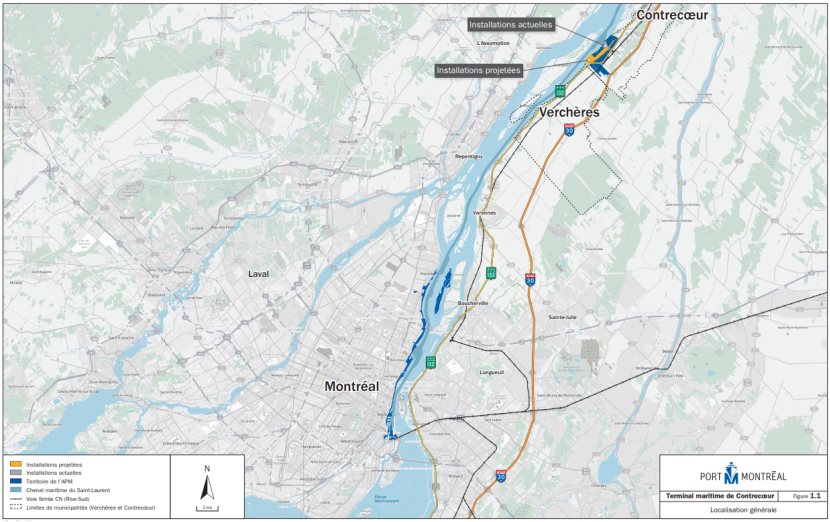
Source: Summary of the project description, Montreal Port Authority (2015)
Figure 1 - Text version
Map showing the location of the Contrecoeur port terminal expansion project. Map shows the location of Montreal port authority properties, future project foot print and actual project foot print.
2. Proposed changes to the project
2.1 Changes included in the designated project
The Proponent proposes to modify its project with the following changes:
- The Fossé Noir (ditch), would be relocated to its former natural bed east of its current location, with landscaping on the banks outside the designated project area.
- A logistics area with a sedimentation basin and stockpiles would be added on former farmland outside the project limits, with treated water discharged into the Fossé Noir.
- Several access roads would be added or widened, including new permanent and temporary routes, bridges, and culverts both inside and outside the designated project area.
- Tree clearing would be required outside the original project boundaries to accommodate a new road east of Basin A.
- Temporary buildings, such as construction trailers, would be relocated closer to the wharf area within the container yard.
- A second refueling zone and mobile fuel tanks would be added, along with a tanker truck to refuel equipment directly on site.
- Instead of washing concrete mixers off-site due to limited market availability of compliant suppliers, all concrete equipment would be washed on-site.
- A new water intake from the St. Lawrence River or drainage system would supply non-potable water for construction needs, with treatment and recirculation planned.
- The dredging footprint would be adjusted, reducing the total area slightly and shifting the upper slopes outside the original project boundaries.
- Updated pile design to circular piles instead of H-shaped ones would be used, and they would be installed using vibratory driving with a hydraulic hammer rather than mechanical methods.
- A temporary berm would be installed outside the designated area to protect the St. Lawrence River from potential spills.
- The wharf height would be increased to 10.5 metre to reduce flood risk, with a six-metre extension of its permanent boundary.
- Rock-socket drilling would be added, using conventional equipment to install seven-metre deep sockets within the piles.
- Reinforcement cages and concrete pouring for piles would be added, with estimated volumes of 100 cubic metres per pile and 30 cubic metres for others.
- Prefabricated vertical drains would be installed in clay soils to accelerate settlement and improve ground stability.
- Oil changes for machinery would take place on a sealed surface within the logistics area, and a dedicated on-site storage system for used oil would be established.
- An ice boom would be added upstream of the wharf to stabilize ice cover, with its design and anchoring details to be finalized during detailed engineering.
2.2 Changes not included in the designated project
It should be noted that the following changes, which were also submitted by the Proponent, are not included in IAAC's analysis, as they do not fall within the scope of the designated project description (that is, the activities and components covered by condition 1.8 of the Decision Statement):
- Dismantling of a gas pipeline;
- Storage of materials;
- Unloading of dredged sediments;
- Reclamation of land;
- Concreting of cope beams and rails for port cranes;
- Storage of sediments;
- Night work;
- Transplanting of status species;
- Site drainage during construction;
- Air quality measurements.
The Proponent presented site boundaries and impact study mapping, identifying areas of proposed changes located outside the designated project boundary (Figure 2). These areas outside the designated project footprint were not analyzed and assessed in the initial 2021 environmental assessment.
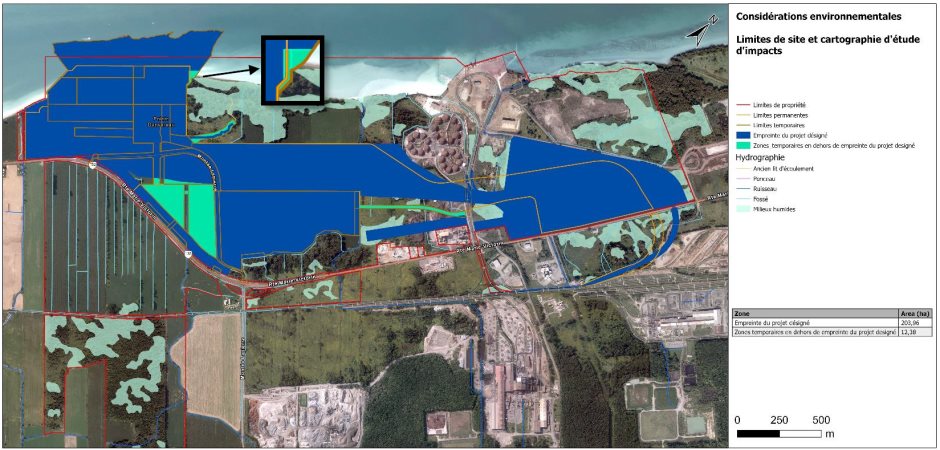
Source: Changes to the designated project and environmental impact assessments, Montreal Port Authority (2025)
Figure 2 - Text version
Map showing the boundaries of project site and impact study. Map shows the Montreal port authority property limits, permanent project boundaries and temporary project boundaries.
3. Analysis of changes under the Physical Activities Regulations
The IAA Physical Activities Regulations describe which physical activities constitute designated projects that may require an impact assessment. Sections 52 and 53 of the Physical Activities Regulations read as follows:
52 The construction, operation, decommissioning and abandonment of a new marine terminal designed to handle ships larger than 25 000 deadweight tonnages (DWT).
53 The expansion of an existing marine terminal, if the expansion requires the construction of a new berth designed to handle ships larger than 25 000 DWT and, if the berth is not a permanent structure in the water, the construction of a new permanent structure in the water.
As mentioned, paragraphs 52 and 53 of the Physical Activities Regulations relate to marine terminals and berths. The changes proposed by the Proponent are physical activities associated with dredging and wharf construction that differ from those initially assessed. There is no question of a new marine terminal or an expansion of an existing one.
Since the proposed change to the project does not fall within the scope of the Physical Activities Regulations under the IAA, IAAC believes that a new federal impact assessment under the IAA is not required.
4. Consultation and engagement
Consultation with Indigenous groups, advice from federal authorities and public participation inform IAAC's analysis of proposed changes and IAAC's recommendations to the Minister.
4.1 Proponent's Engagement of Indigenous groups
On April 11, 2025, the Proponent consulted the following Indigenous peoples on proposed changes to the project: The Mohawks of Kahnawà:ke First Nation, the Indigenous Community of Odanak and Wôlinak, and the Wendat Nation. This initiative was part of the implementation of condition 2.16 of the project Decision Statement. The main concerns reported by the proponent relate to environmental impacts that are not sufficiently justified or mitigated, including the impact on wetlands, the insufficient distance between the construction site and material storage area and the Fossé Noir, and the reduction of buffer zones around watercourses. The following issues were also raised: lack of clarity or justification regarding several technical aspects (e.g., water treatment, contaminated sediment management, etc.) and transparency regarding actual impact analyses, including natural environments and wildlife species. The proponent responded to these concerns in the appendix to the document entitled Changes to the Designated Project and Environmental Impact Assessment (CIAR, Reference Number 80116, document 212).
4.2 IAAC consultations on proposed project changes
IAAC sought the expertise of Environment and Climate Change Canada (ECCC), Fisheries and Oceans Canada (DFO), Health Canada (HC), Transport Canada (TC) and Natural Resources Canada (NRCan) to inform the assessment of potential adverse effects related to the proposed changes to the project, as presented below in section 5.
In addition, IAAC will seek further input from federal authorities, Indigenous peoples and the public on the proposed changes to the project during the public consultation period. The results of the public consultation period will be taken into account in IAAC's analysis to provide advice to the Minister of the Environment and Climate Change on a final recommendation of potential amendments to the Decision Statement.
5. Assessment of potential adverse environmental effects
The following analysis is intended to determine whether the proposed changes would be likely to cause significant adverse environmental effects beyond those assessed during the initial environmental assessment of the project. This analysis also supports determining whether any modifications were required to the mitigation measures and follow-up program requirements included as conditions in the Decision Statement.
It is important to note that no provincial environmental assessment was carried out, as the project is located on federal lands. Pursuant to section 5(1)(b) of CEAA 2012, IAAC therefore examined the potential effects of the project on environmental components outside federal jurisdiction, including changes to the environment on federal lands.
Thus, the review of proposed changes to the project considers potential impacts on several valued components. The detailed analysis in this report focused on the valued components of fish and fish habitat, migratory birds, wetlands and species at risk.
Another valued component analyzed relates to Indigenous peoples, specifically the current use of lands and resources for traditional purposes by Indigenous peoples, the health, social and economic conditions of Indigenous peoples, as well as physical and cultural heritage, and structures, sites or things of historical, archaeological, paleontological or architectural significance to Indigenous peoples.
The effects on the previously identified valued components were analyzed during the project's initial environmental assessment of the project. Mitigation measures and follow-up program requirements were developed, and the Decision Statement includes conditions related to these measures, notably in sections 3 to 11.
5.1 Proponent's Assessment
The proponent analyzed each project change based on its effect on the valued components.
5.1.1 Relocation of the Fossé Noir
As part of the wharf construction work, the Fossé Noir would be relocated to its former natural bed, located to the east of the current bed. Landscaping work would be required on the riverbanks outside the designated project footprint.
According to the proponent's analysis, the addition of landscaping work is not expected to result in additional environmental effects beyond those initially identified. The proponent presented the surface water management measures related to this change and indicated that the natural habitat would be restored. No infrastructure would be added in this area.
5.1.2 Addition of a logistics area comprising a sedimentation pond (water treatment) and storage piles
A logistics area would be added outside the designated project footprint, on former agricultural land that does not contain sensitive species or habitats. This area would include a sedimentation pond (water treatment) and storage piles. The topsoil stored south of this new logistics area is also planned to be reused at the end of the project.
Before being discharged into the Fossé Noir, water from the drainage system of the logistics area would be treated through sedimentation and its quality would be continuously monitored, in accordance with the effluent and surface water management program and any applicable regulatory requirements.
The proponent does not anticipate any effects on valued components, and no mitigation measures would be required. Surface water management measures related to this change were also presented.
5.1.3 Addition and widening of access roads
Site access differs from what was originally planned for the designated project. The proponent has identified five changes related to access roads:
- A light-vehicle access road, located within the project right-of-way, would be built between the logistics area and Route 132.
- The former Montée Lapierre, which serves as the main exit for the project and located within the project footprint, would be widened and rebuilt.
- A permanent access road to the site would be constructed outside the designated project footprint. For the construction of this road, several temporary culverts over ditches and a bridge over Stream 2 would be built. Additional culverts would also be installed to maintain connectivity between wetlands on either side of the road.
- A road would be constructed to provide access to the wharf work area from the logistics area and the former Montée Lapierre.
- Another road would be constructed outside the designated project footprint to access Area B. A temporary free-span bridge over the Fossé Noir would be slightly relocated.
According to the Proponent's analysis, the construction of the permanent access road would affect approximately 5,150 m² of wetlands. The proponent indicates that no adverse environmental effects are anticipated. The proponent mentions that wetland compensation is planned for all losses, and the area affected by the project remains below the total area of wetlands to be compensated.
Regarding access to Area B, the proponent indicates that no sensitive habitat or environmentally sensitive area has been identified within this agricultural zone, and notes that road construction would not result in environmental effects.
Regarding the temporary free-span bridge over the Fossé Noir, which would be slightly relocated, the proponent does not anticipate any impacts from these changes compared to the crossing as it was originally described and assessed.
For the former Montée Lapierre, peak traffic is expected to be approximately 300 vehicle passages per day, which is below the previous estimate of 500 vehicle passages per day.
The Proponent does not identify any impacts related to the other two changes to site access, namely the access for light vehicles and the access to the wharf along the Fossé Noir.
5.1.4 Vegetation clearing and removal of plant cover
The change in site boundaries results in tree clearing outside the designated project area. The proponent indicates that vegetation clearing and removal would be required fort the construction of the new access road located east of Basin A.
The unanticipated clearing of vegetation would span an area of approximately 3,100m², representing about 0.25% of the project's total area to be cleared (124.8 hectares). The proponent indicates that this clearing activity would have an impact on valued components. However, they note that seasonal restrictions for vegetation clearing would be respected and that no clearing would occur between April 15 and August 31. Furthermore, the proponent states that forest habitat compensation measures would be implemented, and that the project's total are to be cleared remains below the originally proposed footprint. As such, the proponent concludes that this additional clearing activity would not result in any new residual effects beyond those already identified and assessed.
5.1.5 Relocation of temporary buildings
The construction trailers would now be located near the wharf area, within the container yard. The proponent had initially committed to maintaining a 30 m protective buffer between the construction trailers and the banks of nearby watercourses. However, this commitment cannot be upheld throughout the entire site. The proponent indicates that, in areas where this buffer cannot be maintained, additional mitigation measures would be put in place, such as the installation of ditches around the trailers to intercept any possible contamination, as well as a protective buffer reduced to 15 m. Drainage ditches encircling the area would discharge into a retention pond, which would then be tested prior to any discharge into watercourses. The proponent does not anticipate any residual effects.
5.1.6 Addition of a refuelling area and mobile tanks
The proponent now plans to have two refueling areas, one more than originally proposed. The location of the second refueling area would depend on the progress of construction activities. In addition to these areas, a fuel truck would circulate on-site to refuel equipment at their work locations. Mobile fuel tanks would also be used for supplementary refueling, which was not initially planned.
According to the proponent's analysis, protective measures would be put in place for each refuelling activity, such as the installation of a membrane at certain workstations, or retention tanks under machines. In addition, spill kits would be available near all machines. The 30-m buffer to protect watercourse banks would be maintained wherever feasible, and employee awareness activities would be conducted to minimize risks. Refuelling procedures and associated risks would be managed and detailed in the Environmental Emergency Preparedness and Response Plan. The proponent indicates that no residual effects are anticipated on fish and fish habitat after the implementation of mitigation and protective measures.
5.1.7 Addition of a concrete mixer washing station
The proponent no longer plans to wash concrete trucks off-site, as initially proposed. They explain that market limitations regarding the limited availability of suppliers capable and willing to perform off-site washouts make this approach technically unfeasible. As a result, concrete hoppers and other equipment (e.g., concrete pumps) would also be washed on-site.
The proponent indicates that a water collection and treatment system will be installed. Water treatment would involve a series of retention ponds to settle concrete residues, with pH adjustment and water sampling prior to discharge into the St. Lawrence River. The proponent notes that there will be no additional effects beyond those initially identified and assessed.
5.1.8 Addition of a water supply intake
During the construction phase, the supply of non-potable water would come from the St. Lawrence River or the drainage system, which was not previously planned. The water would be used for fire protection, dust suppression, and to fill piles to balance pressure. Water would also be used to fill the wheel wash station basins. Once filled, the water would be reused in a recirculation system. The estimated volume of water required, in the most extreme case, is 1,400 m³/day. The water used would be treated and returned to the river through the project's water management system.
According to the proponent's analysis, the water intake would be designed to avoid any impact on fish and fish habitat. The proponent states that no additional effects are anticipated beyond those initially identified and assessed.
5.1.9 New dredging area
The proponent indicates that the dredging area planned for the development of the approach zone would be modified. The footprint of the area would be larger in shallow waters and smaller in deeper waters, due to necessary changes identified during the design of the dredging zone. Following the boundary adjustment, the total dredging area would decrease from 163,000 m² to 156,612 m². However, for stability reasons, the top of the slopes would now be located outside the designated project boundaries.
The proponent indicates that the additional encroachment would be in fish habitat. A permit application was submitted to the DFO, including the impacted area and the change in slope. The proponent does not anticipate any additional effects beyond those initially identified and assessed. They note that changing the boundaries of the dredging area would not result in additional effects, as the change would only affect shallow waters and there are no aquatic grass beds in the area. The proponent also mentions that the total area is smaller than originally planned.
5.1.10 New method for ramming and driving of sheet piles and anchor piles
The proponent indicates that the piles would not have the same shape as initially described. The selected piles would be circular rather than H-shaped. Additionally, the ramming and driving of piles and sheet piles would be carried out using vibro-driving with a hydraulic hammer. Previously, pile and sheet pile driving was performed using mechanical and hydraulic hammers. The proponent states that the change in the method of driving and installing sheet piles and anchor piles is not considered a significant change.
5.1.11 Addition of a temporary berm
A temporary berm would be installed outside the boundaries of the designated project area as initially presented. The proponent indicates that the installation of a temporary berm to protect the St. Lawrence River from spills and potential leaks (e.g., fuels, oils, etc.) is planned partly within fish habitat. However, they note that there are no aquatic grass beds in the new berm's right-of-way. This area is included in the permit application submitted to DFO. As the berm is temporary, the proponent considers that it poses no additional impacts beyond those initially identified and assessed.
5.1.12 Increase in Wharf Elevation
The final elevation of the wharf would now be 10.5 m to reduce the risk of submersion. The initial elevation of the backfill behind the wharf was approximately 9.5 m. The permanent boundaries of the wharf would also be modified, with a difference of approximately 6 m between the old and new boundaries.
According to the proponent's analysis, this modification is considered to have no impacts, as the elevation of the wharf would be higher than originally planned, reducing risk of submersion. Regarding the new permanent boundary of the wharf, the proponent indicates that the change is part of the permit application submitted to DFO. The proponent does not anticipate any impacts different from those of the initial project.
5.1.13 Addition of rock-socket drilling
Rock-socket drilling is an additional activity compared to the initial project. The rock-sockets would be installed to a depth of 7 m using a conventional drill, without the use of additives. Drilling would be carried out within the pile, into the rock. According to the proponent's analysis, no effects are anticipated on valued components.
5.1.14 Addition of reinforcement and concreting of piles
The installation of reinforcement cages and concrete pouring represents an additional activity compared to the initial project. Prior to pouring concrete into the piles, cleaning would be required. Once this step is completed, the reinforcement cages would be installed. The estimated volume of concrete is approximately 100 m³ per pile for those with rock sockets, and 30 m³ for other piles.
According to the proponent's analysis, the concreting activity would generate alkaline water, which would need to be treated for pH and suspended solids before being discharged into the environment. The proponent mentions that water treatment could be carried out in dedicated retention ponds located in the wharf area. Following treatment of the concrete wash water, the proponent does not anticipate any residual effects on fish and fish habitat.
5.1.15 Addition of Prefabriacted Vertical Drains
The installation of prefabricated vertical drains is an additional activity compared to the initial project. These drains, inserted into clay soils in the form of geotextile socks, would facilitate soil consolidation by accelerating and equalizing settlement, thereby reducing the risk of long-term compaction.
According to the proponent's analysis, no effects are anticipated as this method is non-invasive and would not disturb the cause soil disturbance or require large-scale installations.
5.1.16 Addition of a used oil storage area
Oil changes for machinery would be carried out on-site, within the logistics area, on a sealed surface. As these oil changes are planned to take place on-site, a dedicated storage area for used oil would need to be established.
The proponent indicates that containment trays would be installed beneath the tanks in accordance with applicable regulations. Additionally, the proponent indicates that oil changes and used oil storage would be located more than 30 m from watercourses and wetlands. The proponent does not anticipate any residual effects.
5.1.17 Addition of an ice boom
The installation of an ice boom is a new component of the project. The installation of an ice barrier would allow for the creation of a stable and thick ice cover upstream of the wharf to protect the infrastructure. The ice boom would be installed outside the footprint of the designated project area. It could measure between 100 and 200 m in length, with the final size still to be determined. The foundations of the ice boom would consist of dedicated ballast weights or individual piles. The proponent indicates that the number, size, and exact positioning of the anchors would be confirmed during the detailed design phase.
According to the proponent's analysis, this new component would have no effects on the valued components, notably because it would not impede the free passage of fish. They also mention that the footprint on the bed of the St. Lawrence River would be negligible and upstream of any aquatic grass beds.
5.2 Views expressed
On July 31, 2025, IAAC requested the expertise of ECCC, DFO, HC, TC and NRCan to inform the assessment of potential adverse effects associated with the proposed changes to the project. The main points of revision concerned:
- The adequacy of the Proponent's analysis and conclusions on the effects of the proposed changes to the project, including the likelihood and severity of the effects;
- The adequacy of existing mitigation measures and follow-up requirements included in the federal Decision Statement to address effects related to proposed project changes in areas of federal jurisdiction under section 5 of CEAA 2012;
- The status of existing regulatory, approval, licensing or permitting requirements for the project and the processes planned to address the project's proposed change in these requirements; and
- Any additional information required to adequately assess and mitigate the effects of proposed changes to the project.
5.2.1 Environment and Climate Change Canada
ECCC reviewed the proposed changes to the project and indicated that many of the proposed modifications would not cause any additional water quality impacts beyond those initially identified.
Also, ECCC mentions that the conditions set out in the Decision Statement remain adequate to govern project activities related to dredging and sediment management, despite the changes to the project.
With regard to wildlife and habitat, ECCC also states that the conditions set out in the Decision Statement remain adequate to govern project activities, despite the changes to the project.
5.2.2 Fisheries and Oceans Canada
DFO has been kept informed of changes to the project in relation to its regulatory responsibilities under the Fisheries Act and the Species at Risk Act. These requests for authorization are currently being analyzed, and any changes made will be analyzed and, if necessary, included in the eventual authorizations.
The latest surveys carried out by the Proponent indicate that the area of submerged aquatic vegetation in the area impacted by the project would be greater than initially estimated. However, the conclusions of DFO's final view on these impacts and the associated offsetting measures remain valid. Updated surface areas will be considered in DFO's regulatory analysis.
DFO is of the view that the proposed changes are not such as to alter the conclusions on the effects or the adequacy of the mitigation measures. However, these mitigation measures have been the subject of discussion and clarification since 2024 as part of the regulatory process currently underway at DFO. DFO does not require any additional information in connection with these changes.
5.2.3 Health Canada
HC agrees with the Proponent's conclusions that, overall, the proposed changes would not cause any additional impacts on the valued components beyond those initially identified and assessed. For changes causing an impact, no residual impact is expected after the application of various mitigation measures.
HC also considers that the set of proposed mitigation measures and the requirements included in the conditions of the Decision Statement seem sufficient to take into account the changes proposed by the Proponent for the project.
HC would, however, like to reiterate the importance of the advice provided in the past, and that it is still relevant today. In particular, HC recommends that the Proponent confirm that it intends to include the recommended elements in its final view, including HC's comments on the suspended solids follow-up program, in the development of its monitoring plans, which will take into account the changes made to the project. Food security and dialogue with the communities concerned are also on the agenda.
5.2.4 Transport Canada
After reviewing the document outlining the proposed changes to the project, TC has no comments to make.
5.2.5 Natural Resources Canada
NRCan has reviewed the proposed changes to the project and has no particular concerns about seismicity or landslides. NRCan nevertheless recommends that, when referring to seismic hazard information from the National Building Code and/or the National Seismic Hazard Model, the Proponent should use the most recent and relevant model.
5.3 IAAC's analysis
IAAC's detailed analysis, as mentioned above, focused on the valued components of fish and fish habitat, migratory birds, wetlands, status species and Indigenous peoples.
5.3.1 Fish and fish habitat
Based on the views expressed by federal authorities, IAAC is of the view that changes to the project would not result in adverse environmental effects on fish and fish habitat that would alter the conclusions reached in the 2021 environmental assessment. The mitigation measures and follow-up programs included in section 3 of the Decision Statement are sufficient to address the effects associated with the proposed changes. It is also important to remember that all changes made in relation to fish and fish habitat will be analyzed and flagged as necessary in any authorizations issued by DFO under the Fisheries Act.
IAAC notes that the addition of landscaping work on the banks would not cause any additional impacts beyond those initially identified. The Proponent presented surface water management in relation to this change, also indicating that the natural habitat would be restored as originally planned in condition 3.24 of the Decision Statement.
Concerning the addition of a logistics area consisting of a sedimentation pond (water treatment) and storage stockpiles, the proponent presented this change to the DFO, which proposed certain conditions under their regulations. These would reduce the potential impact of water from drainage of the logistics area being discharged into the Fossé Noir ditch. The proponent must implement construction site water management measures to prevent erosion and limit suspended solids, in accordance with condition 3.9 of the Decision Statement. It will also have to monitor the quality of effluents from the sedimentation ponds, as required by condition 3.39.
With regard to the relocation of temporary buildings, IAAC notes that the proponent had initially undertaken to respect a 30-m protective strip between the construction trailers and the banks of the watercourses. However, the proponent will not be able to meet this commitment for the entire site. The proponent proposes 15 m in the locations where there is not enough space. This change and the proposed measure are still consistent with condition 3.12 of the Decision Statement.
IAAC notes that the second location of the refuelling area, on the project site, has not yet been clearly identified. Nevertheless, the Proponent has identified several mitigation measures, as initially set out in condition 11.3 of the Decision Statement, that will minimize the risk associated with accidents and malfunctions.
IAAC notes that the Proponent no longer plans to wash concrete mixers off-site. Nevertheless, IAAC notes that condition 3.14 of the Decision Statement would still be met. According to the latter, the proponent can wash concrete mixers on the territory of the Montreal Port Authority while implementing mitigation measures, as proposed by the proponent.
IAAC notes that the proponent indicates that the water intake planned for the water supply would be designed to avoid any impact on fish. However, since the design of the water intake is not yet finalized and the mitigation measures associated with this change have not been presented, IAAC considers that measures will be necessary to mitigate potential effects on fish and their habitat. More specifically, IAAC proposes to add a condition to the Decision Statement so that the design, installation, and operation of water intake structures in the Saint Lawrence River are carried out in a manner that mitigates potential negative environmental effects on fish and fish habitat (see Table 1).
As for the new dredging area, it would be located in fish breeding habitat. Nevertheless, the Proponent indicates that the total dredging area would be reduced by 163,000 m² to 156,613 m² compared with the initial estimate. It also indicates that there would be no aquatic grass beds in this new area, and that the change would only affect shallow waters. The Decision Statement identifies several conditions aimed at reducing the impact of dredging, including 3.2, 3.7, 3.8, 3.9, 3.17, 3.32, 3.33 and 5.6. A permit application has also been submitted to DFO.
With regard to the new method for ramming and driving of sheet piles and anchor piles, IAAC found no additional negative effects to those initially assessed. The Decision Statement identifies several conditions relating to the installation of anchor piles and sheet piles, in particular 3.19, 3.19.1 and 3.19.2.
IAAC notes that the temporary berm is a temporary encroachment on fish habitat. It will be removed once construction of the wharf is complete. The Proponent indicates nevertheless that there are no aquatic grass beds in the berm's right-of-way. Its installation would protect the St. Lawrence River from spills and possible leaks. This change is considered in the permit application submitted to DFO. In addition, in accordance with condition 3.9 of the Decision Statement, the proponent must implement construction site water management measures to prevent erosion, taking into account sensitive environmental periods. It must also maintain a materials tracking system to comply with applicable rules and requirements, in accordance with condition 3.30, and a surface water quality follow-up program in accordance with condition 3.40.
IAAC notes that the height of the wharf would be greater than initially planned, the aim being to reduce the risk of flooding. In regards to the new wharf boundary, the proponent must carry out work in the aquatic environment outside sensitive periods and implement an offsetting plan, in accordance with conditions 3.1 and 3.22 of the Decision Statement. It must also monitor the use of aquatic environments by fish and changes in the hydrosedimentary regime caused by the building of the wharf, in accordance with conditions 3.36 and 3.37. This change is also part of the permit application submitted to DFO.
With regard to rock socket drilling, IAAC notes that the activity, as indicated by the Proponent, would have no impact on fish and fish habitat.
IAAC notes that the installation of reinforcement and concreting would generate alkaline water, requiring treatment. The proponent mentions that water treatment would be carried out in specific retention ponds located in the wharf area, which is consistent with condition 3.14 of the Decision Statement.
As for the installation of wick drains, IAAC notes that the activity would have no impact on fish or fish habitat.
IAAC notes that the addition of a used oil storage area has no additional negative effects beyond those initially assessed. The Decision Statement identifies several conditions related to accidents and malfunctions in section 11.
Finally, as for the ice boom, IAAC notes that the footprint on the bed of the St. Lawrence River would be upstream of any aquatic grass beds.
5.3.2 Migratory birds
Based on the views expressed by federal authorities, IAAC is of the view that the changes to the project would not result in adverse environmental effects on migratory birds that would alter the conclusions reached in the 2021 environmental assessment. The mitigation measures and follow-up programs included in the conditions of section 4 of the Decision Statement are sufficient to address the effects associated with the proposed changes.
The Proponent indicates that vegetation clearing and removal of plant cover would cover an area of approximately 3,100 m². Nevertheless, the area cleared for the project as a whole would be less than initially presented, and the forest habitat would be offset, as indicated in conditions 4.5 and 4.6.5 of the Decision Statement.
5.3.3 Wetlands
Based on the views expressed by federal authorities, IAAC is of the view that changes to the project would not result in adverse environmental effects on wetlands that would alter the conclusions reached in the 2021 environmental assessment. The mitigation measures and follow-up programs included in the conditions of section 5 of the Decision Statement are sufficient to take into account the effects related to the proposed changes.
IAAC notes that the permanent access proposed by the Proponent would affect approximately 5,150 m² of wetlands. Nevertheless, the proponent indicates that the project would remain below the total area of offset wetlands. Furthermore, IAAC notes that the conditions set out in section 5 of the Decision Statement make it possible to include this wetland, since the environmental assessment report already illustrated it. The latter was assigned to the "low ecological value" category following its assessment. Offsetting its losses is provided for in accordance with condition 5.2 of the Decision Statement.
5.3.4 Status species
Based on the views expressed by the federal authorities, IAAC is of the view that changes to the project would not result in adverse environmental effects on status species that would alter the conclusions reached in the 2021 environmental assessment. The mitigation measures and follow-up programs included in the conditions of section 6 of the Decision Statement, with the exception of condition 6.10, which has been modified to also apply to the logistics area, are sufficient to address the effects associated with the proposed changes.
According to the Proponent's mapping, the proposed changes would be outside the critical habitat and home range of the western chorus frog, a threatened species under the Species at Risk Act. Changes to the project would have no additional impacts beyond the impacts initially identified.
Nevertheless, the new dredging area would lie within the range and critical habitat of the copper redhorse, an endangered species under the Species at Risk Act. As mentioned previously, there are no aquatic grass beds in the area affected by the changes. Furthermore, all the changes made will be analyzed and marked as needed in the upcoming authorizations by DFO under the Species at Risk Act. Additionally, conditions 3.1, 3.21, 3.43 and 8.3 of the Decision Statement take into account potential effects on the copper redhorse, including offsetting measures for the loss of submerged aquatic grass beds that constitute essential habitat for the feeding of adult copper redhorse, as well as the implementation of a technically feasible plan to mitigate the environmental effects of the designated project's operation on the copper redhorse habitat located in the riparian zone of l'Île Bouchard.
5.3.5 Indigenous peoples
Based on the views expressed by federal authorities, IAAC is of the view that changes to the project would not result in adverse environmental effects on Indigenous peoples that would alter the conclusions reached in the 2021 environmental assessment. This applies in particular to the current use of lands and resources for traditional purposes by Indigenous peoples (including the cumulative effects on them), the health and social and economic conditions of Indigenous peoples, as well as to physical and cultural heritage, and structures, sites or things of historical, archaeological, paleontological or architectural significance to Indigenous peoples. The concerns raised in the initial assessment, including those regarding the western chorus frog, the copper redhorse are, moreover, addressed in section 5.3.4 of this report.
Thus, in accordance with conditions 8.1 and 9.3 of the Decision Statement, the proponent will establish communication and liaison protocols with First Nations to share information about the project and respond to their feedback. It will have to maintain navigation areas (condition 9.4), implement a follow-up program to monitor the effects on traditional fishing and hunting activities and on physical heritage (conditions 8.2 and 10.10), carry out an archaeological survey (conditions 10.5 and 10.6), and ensure the follow-up of these measures (condition 10.7). The mitigation measures and follow-up programs included in the conditions of the Decision Statement are sufficient to take into account the effects of the proposed changes on Indigenous peoples.
It is important to remember that IAAC will be seeking feedback from Indigenous peoples on the proposed changes. Comments will be incorporated into the final report.
6. Conclusion
In conclusion, IAAC is of the opinion that, based on the information provided by the Proponent and the various parties consulted, the proposed changes to the project are not likely to cause significant adverse environmental effects beyond those described in the 2021 environmental assessment. This conclusion takes into account the mitigation measures and follow-up programs included in the conditions of the Decision Statement, as well as the new recommended measures to address the proposed changes to the project.
IAAC proposes to add condition 3.45 to the Decision Statement so that the design, installation, and operation of water intake structures in the St. Lawrence River are carried out in a way that mitigates potential adverse environmental effects on fish and fish habitat.
In addition, since the proposed changes to the project and the expansion of the project area, as described in section 2.1 of this analysis report, are not included in the definitions of designated project area (condition 1.8) and designated project (condition 1.7) as currently formulated in the Decision Statement, IAAC recommends that these definitions be modified to include them. These modifications will ensure that the conditions included in the Decision Statement also apply to proposed changes to the project.
IAAC also recommends that conditions 2.16 and 2.17 be amended to be consistent with other, more recently published decision statements, and that there be greater clarity and certainty as to what information the Proponent must submit to IAAC and how IAAC will consider this information.
IAAC proposes to amend condition 6.10 so that it also applies to the logistics area and the sedimentation pond, and condition 9.5 to include the new access roads. These adjustments aim to ensure that the conditions of the Decision Statement also cover these proposed changes to the project.
Table 1 details the recommended modifications.
|
Condition from the Decision Statement published on March 1, 2021 |
Recommended amendment to the Decision Statement |
|---|---|
|
Condition: 1.8 Designated project area means the territory where the Designated Project infrastructures are located, including the area occupied by the new wharf, marshalling yard, intermodal yard, related buildings and road and rail facilities, as identified in Figure 1 of the environmental assessment report. |
Revised condition: 1.8 Designated project area means the territory where the Designated Project infrastructures are located, including the area occupied by the new wharf, marshalling yard, intermodal yard, related buildings and road and rail facilities, as identified |
|
Condition: 1.7 Designated Project means the Contrecoeur Port Terminal Expansion Project as described in sections 2.3 and 2.4 of the environmental assessment report. |
Revised condition: 1.7 Designated project means the Contrecoeur Port Terminal Expansion Project as described in sections 2.3 and 2.4 of the environmental assessment report and section 2.1 of the analysis report prepared by the Impact Assessment Agency of Canada (Canadian Impact Assessment Registry, Reference Number 80116, document 215). |
|
Condition: 2.16 The Proponent shall consult with the Mohawks of Kahnawà:ke First Nation, the Indigenous Community of Odanak and Wôlinak, the Huron-Wendat Nation and relevant authorities prior to notifying the Agency, pursuant to condition 2.17, of any potential change to the Designated Project. |
Revised condition: 2.16
2.16.1 a description of the proposed change(s) to the Designated Project and the environmental effects that may result from the proposed change(s); 2.16.2 any modified or additional measures to mitigate any environmental effects that may result from the proposed change(s) and any modified or additional follow-up requirements; 2.16.3 an explanation of how, taking into account any modified or additional mitigation measures referred to in condition 2.16.2, the environmental effects that may result from the proposed change(s) may differ from the environmental effects of the Designated Project identified during the environmental assessment. |
|
Condition: 2.17 The Proponent shall notify the Agency in writing of any potential change to the Designated Project that would result in a change to the Designated Project description included in this Decision Statement or that may result in adverse environmental effects. In notifying the Agency, the proponent shall provide a description of the change(s) to the Designated Project, the predicted adverse environmental effects and the proposed mitigation measures and follow-up requirements to be implemented by the proponent in relation to the predicted adverse environmental effects. The proponent shall also describe the results of the consultation with the Mohawks of Kahnawà:ke First Nation, the Indigenous Community of Odanak and Wôlinak, the Huron-Wendat Nation and relevant authorities. |
Revised condition: 2.17
|
|
(not applicable) |
Condition 3.45 The Proponent shall design, install, and operate the water intake structures in the St. Lawrence River in a manner that mitigates adverse environmental effects on fish and fish habitat, including by installing exclusion screens on the water intake structures, taking into account Fisheries and Oceans Canada's Freshwater Intake End-of-Pipe Fish Screen Guideline, and in a manner consistent with the Fisheries Act and its regulations. |
|
Condition: 6.10 The Proponent shall develop and implement, prior to any construction activity in Streams 1 and 2, the Fossé Noir, ditches (areas 4A and 4B) and the backfilled area of shoreline near the wharf, a capture and relocation program to remove all northern map turtles (Graptemys geographica), midland painted turtles (Chrysemys picta marginata) and snapping turtles (Chelydra serpentina) observed in any of these areas and relocate them, before the onset of hibernation and pursuant to wildlife care protocols, to a suitable habitat determined by the proponent in consultation with the Quebec's Ministère des Forêts, de la Faune et des Parcs, taking into account the habitat requirements necessary for each species to complete its biological cycle (including feeding, hibernation and egg laying). |
Revised condition: 6.10 The Proponent shall develop and implement, prior to any construction activity in Streams 1 and 2, the Fossé Noir, ditches (areas 4A and 4B) |
|
Condition: 9.5 The Proponent shall participate, at the request of a relevant authority during any phase of the Designated Project, in the implementation of any technically and economically feasible measure or development under its responsibility related to road safety on Route 132, Montée Lapierre and Montée de la Pomme-d'Or. |
Revised condition: 9.5 The Proponent shall participate, at the request of a relevant authority during any phase of the Designated Project, in the implementation of any technically and economically feasible measure or development under its responsibility related to road safety on Route 132, Montée Lapierre, and Montée de la Pomme-d'Or, the road east of Pond A, the access to the wharf along the Fossé Noir, and the access in Area B. |