
Pohénégamook-Picard-Saint-Antonin-Wolastokuk Wind Farm Project
Analysis Report
Designation request for the Pohénégamook–Picard–Saint-Antonin–Wolastokuk (PPAW) wind farm project in Quebec pursuant to the impact assessment act
Document reference number: 4
October 31, 2024
© His Majesty the King in Right of Canada, as represented by the Minister of Environment and Climate Change, 2024
This publication may be reproduced for personal or internal use without permission, provided the source is fully acknowledged. However, multiple copy reproduction of this publication in whole or in part for purposes of redistribution requires the prior written permission from the Impact Assessment Agency of Canada, Ottawa, Ontario K1A 0H3, or information@iaac-aeic.gc.ca.
Catalogue Number: En106-275/2024E-PDF
ISBN 978-0-660-74120-8
This document has been issued in French under the title: Rapport d'analyse - Demande de désignation du projet de parc éolien Pohénégamook–Picard–Saint-Antonin–Wolastokuk (PPAW) au Québec conformément à la Loi sur l'évaluation d'impact
Contents
- Purpose
- Context of Request
- Project Context
- Analysis of Designation Request
- Authority to designate the Project
- Existing legislative mechanisms
- Potential adverse effects within federal jurisdictions
- Potential direct or incidental adverse effects
- Public concerns
- Potential adverse impacts on the section 35 rights of Indigenous Peoples
- Other considerations
- Regional and strategic assessments
- Conclusion
Purpose
The Impact Assessment Agency of Canada (IAAC) prepared this report for consideration by the Minister of Environment and Climate Change (the Minister) in response to the request to designate the Pohénégamook–Picard–Saint-Antonin–Wolastokuk (PPAW) wind farm project (the Project) pursuant to section 9 of the amended Impact Assessment Act (the IAA).
Context of Request
The Minister received requests for designation of the project from two members of the public, the first dated September 9 and the second dated September 14, 2024. The requesters expressed concerns regarding the potential effects of the Project on migratory birds, as well as the cumulative negative effects of existing and planned wind farms in the Bas-Saint-Laurent region on migratory. The second requester is also concerned about the effects on fish, marine aquatic species (St. Lawrence Estuary Beluga) and their habitats, as well as the potential adverse impacts on the section 35 rights of the Indigenous peoples of Canada.
On September 16, 2024, IAAC sent a letter to Énergie éolienne PPAW s.e.c.Footnote 1 (the Proponent) notifying them of the designation request and requesting information on the project. In addition, IAAC requested input from federal authorities, the Quebec's Ministère de l'Environnement, de la Lutte contre les changements climatiques, de la Faune et des Parcs (MELCCFP) and the Indigenous communities likely to be affected by the Project or signatories to a consultation protocol with Canada covering the project area.
The Proponent responded on October 2, 2024, providing information on the Project and its design, potential adverse effects and proposed mitigation measures, and on the authorization process underway with the Province of Quebec as part of the environmental impact assessment and review procedure.
Advice on applicable legislative mechanisms and potential effects due to the Project was received from Employment and Social Development Canada, Environment and Climate Change Canada (ECCC), Women and Gender Equality Canada, Canada Economic Development, Fisheries and Oceans Canada (DFO), Natural Resources Canada, Health Canada, Indigenous Services Canada and Transport Canada (TC). The MELCCFP also provided advice. IAAC also received input from the Wolastoqiyik Wahsipekuk First Nation (WWFN) and the Huron-Wendat Nation (HWN).
Project Context
Project overview
The Proponent is proposing to construct and operate a wind farm located in the regional county municipalities (RCMs) of Kamouraska, Témiscouata, and Rivière-du-Loup in the Bas-Saint-Laurent administrative region in Quebec (figure 1).
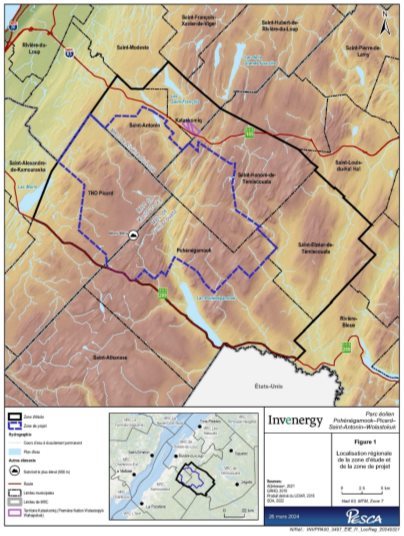
Source: Énergie éolienne PPAW s.e.c. (2024). Étude d'impact sur l'environnement – Parc éolien Pohénégamook–Picard–Saint-Antonin–Wolastokuk. Volume 8: Résumé. Étude réalisée par PESCA Environnement et déposée au ministère de l'Environnement, de la Lutte contre les changements climatiques, de la Faune et des Parcs.
As proposed, the PPAW Wind Farm Project would involve the construction in a forest environment of 56 wind turbines with a maximum total height of 200 metres (figure 2). Each windmill would have a capacity of 6.2 megawattsFootnote 2, for a total capacity of 349.8 megawatts. The project would also include a road network, a substation to the Hydro-Québec grid, and an electrical collector system that would be mostly underground. The project area covers approximately 35,844 hectares and is entirely on lands in the domain of the state, i.e., provincial public lands. The Proponent plans to build the project in 2025-2026 and the commissioning is scheduled for December 1, 2026. The operating life would be around 30 years, based on the current supply contract with Hydro-Québec. The Proponent has undertaken to dismantle the wind farm at the end of the current contract, unless the contract is renewed or there is another opportunity to sell the energy being produced.
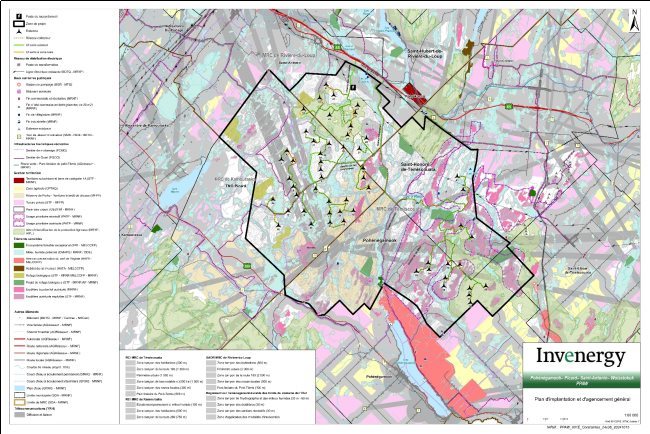
Source: Proponent Submission, October 2024
Project components and activities
The Project will be carried out in three phases: construction, operation and dismantling.
In the construction phase, the Project would include the following activities (Énergie éolienne PPAW s.e.c., 2024):
- Total deforestation required of just over 336 hectares;
- Construction of approximately 22 kilometres of new roads and development of work areas, including soil excavation, culvert installation and ditch profiling;
- Improvement (grading and/or widening) of around 120 kilometres of existing roads;
- Construction of 15 water crossings and rehabilitation of 131 existing water crossings;
- Transportation of project-related components and traffic in the project area, including:
- trucking of wind turbine parts, heavy machinery, sand, gravel, concrete and other equipment; and
- daily circulation of workers.
- Installation or fitting out of equipment, including:
- foundations and assembly of the 56 wind turbines (the most likely model envisioned will have a maximum total height of 200 metres, i.e., a tower of 100 to 120 metres and a rotor with a maximum diameter of 175 metres);
- an underground electrical collector system located mainly in access road rights-of-way, a substation and a service building; and
- temporary site offices.
- Restoration of temporary work areas in forestry production.
The operation phase would include the presence and operation of semi-automated equipment, as well as maintenance of equipment and access roads.
Finally, the dismantling phase would include the following activities:
- Transportation and circulation of workers, heavy machinery and materials to be removed from the site;
- Clearing of a work area at the foot of each wind turbine;
- Dismantling of equipment;
- Restoration of work areas.
Analysis of Designation Request
Authority to designate the Project
The Physical Activities Regulations (the Regulations) identify the physical activities that constitute designated projects under the IAA. The project, as described in the information provided by the Proponent, does not include physical activities described in the Regulations.
The Minister may, on request or on the Minister's own initiative, by order, designate a physical activity that is not prescribed by regulations made under paragraph 109(b) if, in the Minister's opinion, the carrying out of that physical activity may cause adverse effects within federal jurisdiction or direct or incidental adverse effects.
If the Minister is of the opinion that the carrying out of the specific activity may result in adverse effects within an area of federal jurisdiction, or in adverse direct or incidental effects, he may consider the factors listed in subsection 9(2) in deciding whether to make an order.
IAAC is of the opinion that there are no restrictions applicable under subsection 9(7). The carrying out of the Project has not substantially begun and no federal authority has exercised a power or performed a duty or function that could permit the Project to be carried out, in whole or in partFootnote 3. Consequently, the Minister could exercise his power to designate pursuant to subsection 9(1) of the IAA.
Existing legislative mechanisms
Key federal and provincial legislative mechanisms that are or may be relevant to the Project are summarized below. Some mechanisms (authorizations, approvals and permits) include Indigenous consultation and public engagement.
Federal Legislative Mechanisms
Fisheries Act
As part of the Fish and Fish Habitat Protection Program, DFO reviews projects for their effects on fish and fish habitat by ensuring compliance with the Fisheries Act and Species at Risk Act (SARA). Through this program, DFO may provide information to the Proponent to avoid and mitigate the negative project-related effects on fish and fish habitat.
A Fisheries Act authorization is required if the Project is likely to result in the harmful alteration, disruption, or destruction of fish habitat and/or is likely to result in the death of fish. The application process for an authorization would include Indigenous consultation. When granted, this authorization would include legally binding conditions for avoidance, mitigation, and offsetting requirements commensurate with project effects, as well as monitoring the effects and effectiveness of mitigation and offset measures.
In addition, subsection 36(3) of the Fisheries Act, administered by ECCC, prohibits the deposit of deleterious substances into waters frequented by fish, unless authorized by regulations or other federal legislation.
Migratory Birds Convention Act, 1994
The Migratory Birds Convention Act, 1994 (MBCA 1994) protects migratory birds, their eggs and nests wherever they occur, regardless of land tenure. The MBCA 1994 prohibits the disturbance or destruction of migratory bird nests and eggs. It also prohibits the deposit of harmful substances into waters or areas frequented by migratory birds or in a place from which the substance may enter such waters or such an area.
Nests of species listed in Schedule 1 of SARA are protected at all times, except under certain conditions listed in the Migratory Birds Regulations (2022) (MBR 2022). MBR 2022 authorizes the issuance of damage and danger permits, as well as scientific permits, which may apply in specific limited situations.
Species at Risk Act
SARA is a key commitment by the federal government to prevent wildlife species from becoming extinct and to take the steps necessary for their recovery. It provides for the legal protection of wildlife species and the conservation of their biological diversity.
For aquatic species listed in Schedule 1 of SARA as Extirpated, Endangered, or Threatened, a permit may be required from DFO for activities that may cause effects. In the case of this Project, DFO is of the opinion that an authorization under paragraphs 34.4(2)(b) and 35(2)(b) of the Fisheries Act, which also serves as a permit under SARA, would not be required, since it is unlikely that any aquatic species at risk would be present in the watercourses affected by the Project.
For non-aquatic species listed in Schedule 1 of SARA as Extirpated, Endangered, or Threatened, a permit may be required from ECCC under section 73 of SARA for activities that may affect a listed wildlife species or the residences of its individuals, where prohibitions are in place. Species that are both migratory birds protected under the MBCA and species listed on Schedule 1 of SARA as Endangered, Threatened or Extirpated are protected under both Acts. For some species, inactive nesting and/or roosting sites are protected by SARA. These permits may only be issued under specific conditions. In the case of this Project, ECCC considers that there is a small possibility that a SARA permit will be required during the life of the Project.
Canadian Navigable Waters Act
The Canadian Navigable Waters Act (CNWA) provides a framework for projects involving navigable waters. It may be necessary to request authorization from TC under the CNWA when a project involves navigable waters listed in the schedule to the Act. The authorization procedure includes consultation with Indigenous communities.
CNWA approvals are required when major works in watercourses are necessary.
Provincial Legislative Mechanisms
Environment Quality Act
The Environment Quality Act (EQA) is the main legislation that governs environmental protection in Quebec and provides for an authorization system based on the environmental risks associated with the projects to be carried out. High-risk projects are subject to the environmental impact assessment and review procedure (EIARP) and require authorization from the Quebec government. The framework for the various stages of the procedure, and the list of projects subject to the procedure, are set out in the Regulation respecting the environmental impact assessment and review of certain projects. The MELCCFP is responsible for applying this procedure.
The EIARP involves several stages, including the admissibility stage for the Proponent's impact assessment statement and the environmental acceptability stage for the Project. During these stages, the MELCCFP seeks expert advice from various provincial and federal departments and agencies. The EIARP also provides several opportunities for public consultation, some of which are conducted by the Bureau d'audiences publiques sur l'environnement (BAPEFootnote 4). The EIARP also involves an Indigenous consultation process led by the MELCCFP. In addition to the analysis report produced by the MELCCFP, prior to submitting his recommendation to the government, the Minister will take into consideration the BAPE report and the results of the Indigenous consultation carried out as part of the Project. The Quebec government will then decide whether to authorize the Project.
The PPAW wind farm project is subject to the EIARP. The Proponent submitted its environmental impact assessment statement to the MELCCFP in March 2023. As part of the analysis of the admissibility of the Project, ECCC participated by providing an opinion on the admissibility of the impact study, which was deemed admissible in May 2024. BAPE held public hearings from June 10, 2024, to October 10, 2024. The BAPE report was made public on October 25, 2024. ECCC was involved at every stage of the process. The analysis of environmental acceptability is ongoing at the time of writing of this report.
In the event of a favourable decision by the Quebec government (decree), the Proponent may then be required to obtain one or more authorizations from the MELCCFP under section 22 of the EQA before starting work. When these authorization requests are at the analysis stage, additional consultations may be held with experts to ensure compliance with the conditions set out in the decree.
Regulation respecting the sustainable development of forests in the domain of the State
The Regulation respecting the sustainable development of forests in the domain of the State (RSDF) applies to forest land in the domain of the state up to the northern limit of the forest tundra in Quebec. It protects forest, aquatic and wetland environments. In addition, according to advice received from DFO, this regulation ensures consistency with the Fisheries Act with regard to the free passage of fish in watercourse crossing structures (such as bridges and culverts).
Cultural Heritage Act
The purpose of the Cultural Heritage Act is to promote, in the public interest and from a sustainable development perspective, the knowledge, protection, enhancement and transmission of Quebec's cultural heritage. This Act also regulates archaeological excavations and discoveries.
Act respecting threatened or vulnerable species
The main objective of the Act respecting threatened or vulnerable species is to safeguard Quebec's genetic diversity as a whole. It also specifies that wildlife species designated as threatened or vulnerable and their habitats are governed by the Act respecting the conservation and development of wildlife. The Act establishes a list of plant and animal species that are threatened, vulnerable or likely to be designated as threatened or vulnerable.
Act respecting the conservation and development of wildlife
The object of the Act respecting the conservation and development of wildlife is the conservation of wildlife and its habitat, their development in keeping with the principle of sustainable development, and the recognition of every person's right to hunt, fish and trap in accordance with the law. The Act regulates activities carried out in a wildlife habitat.
Potential adverse effects within federal jurisdictions
Taking into account the opinions and comments received from the Proponent, federal authorities, the MELCCFP, the WWFN and the HWN, IAAC identified potential adverse effects within federal jurisdiction that may result from carrying out the Project. As outlined below, IAAC is of the view that existing legislative and regulatory mechanisms provide a framework to address those potential adverse effects.
Fish and Fish Habitat
The Proponent states that none of the Project's wind turbines is located within 60 metres of a mapped water environment, but that road construction and culvert installation could result in changes to surface water flow and sediment input into watercourses and fish habitat.
The Proponent proposes several standard and specific mitigation measures to limit changes to stream flow and sediment input. It agrees to apply the mitigation and protection measures prescribed by the RSDF, as well as DFO's Guidelines for Watercourse Crossings in Quebec and recommended codes of practice when constructing roads and installing culverts to ensure free passage of fish and conserve fish habitat. It also agrees to prioritize, whenever possible, the period from June 1 to September 30 for work in water, in order to minimize the effects on the salmonids present. Should work be required during this period, additional measures would be implemented. It also states that in the operation phase, the effect on fish and fish habitat is considered to be nil or negligible.
The Proponent has submitted a preliminary offsetting plan for all fish habitat losses. As far as possible, it would like to offset by providing in-kind compensation rather than financial compensation, in order to increase the Project's positive effects on the local environment, and to promote solutions based on consultation with stakeholders. The work would be carried out once the necessary authorizations have been obtained.
DFO states that if the Project complies with the provisions of the RSDF regarding the free passage of fish through watercourse crossings, the Proponent may not have to submit its project to DFO for review, but it is not released from other applicable laws and regulations, both provincial and federal.
DFO notes, however, that according to available information, the construction and rehabilitation of watercourse crossings would result in an encroachment of 3.1 hectares of fish habitat, and that this should be analyzed. Following its analysis, DFO may be of the opinion that measures to offset adverse effects, such as an offsetting plan, are necessary and that an authorization under paragraphs 34.4(2)(b) and 35(2)(b) of the Fisheries Act would therefore be required. Moreover, certain aspects of the Project may also be subject to the Aquatic Invasive Species Regulations.
The MELCCFP states that the "initiator" is required to submit a complete fish habitat characterization, in accordance with the MELCCFP protocol, in order to assess the Project's effects on fish habitat and the effectiveness of the mitigation measures proposed by the "initiator." A fish habitat offsetting plan is being analyzed by the MELCCFP at the time of writing. The MELCCFP specifies that this plan must include, among other things, monitoring of the effectiveness of the habitats created for a period of five years following their completion. The MELCCFP also states that temporarily affected areas of fish habitat will have to be restored.
Furthermore, the MELCCFP specifies that if government authorization for the Project is granted, several applications for ministerial authorizations under section 22 of the EQA, without limitation, for clearing, construction and development of permanent roads, operation, closure, etc., would be issued to the "initiator."
Following a review of the information provided by the Proponent, DFO and the MELCCFP, IAAC is of the opinion that the Project is likely to have adverse effects on fish and fish habitat, as defined in subsection 2(1) of the Fisheries Act. However, IAAC is of the opinion that existing provincial and federal legislative and regulatory mechanisms provide a framework for addressing these potential adverse effects.
Aquatic Species
The Project would not result in any change to aquatic species, as defined in subsection 2(1) of the SARA, other than those presented above on fish, particularly because the project will not affect marine environments or marine plants.
Migratory Birds
The requesters expressed concerns about potential effects on migratory birds caused, for example, by collisions with wind turbines, habitat alteration and fragmentation, including wetlands, and sensory disturbance. They also expressed concerns about the potential cumulative effects of existing and planned wind farms in a "migratory bird corridor" in the Bas-Saint-Laurent region.
The Proponent states that the surveys carried out in the study area identified the bird species present, six of which are listed in Schedule 1 of SARA and also protected under the MBCA: the Common Nighthawk, the Evening Grosbeak, the Chimney Swift, the Olive-sided Flycatcher, the Canada Warbler and the Eastern Wood Pewee.
The Proponent mentions that the wind farm's construction and dismantling activities are likely to disturb birds, especially nesting birds. However, the Proponent intends to carry out clearing work outside the nesting period to the extent possible, in order to reduce these effects. Should forest clearing be necessary during this period, additional measures will be implemented. During construction and dismantling, the Proponent undertakes to document the presence of migratory bird nests using environmental monitoring reports, and to pay particular attention to species at risk. It is also committed to following ECCC's Guidelines to avoid harm to migratory birds.
As the pileated woodpecker is one of the migratory bird species whose nests are protected year-round under MBR 2022, the Proponent agrees to conduct an inventory of cavity-bearing trees within the Project right-of-way and, where applicable, to follow the recommendations listed in the Fact sheet: Nest Protection under the Migratory Birds Regulations, 2022. A permit under ROM 2022 may be required.
The Proponent also states that forest clearing during the construction and dismantling phases would alter the habitat of nesting birds. It does mention, however, that their Project has been configured to reduce the areas used for project rights-of-way, in order to limit habitat loss through forest clearing. It also states that habitats suitable for the endangered Bicknell's thrush have been avoided. The work areas would be restored at the end of dismantling.
With regard to the risk of bird collisions with wind turbines, the Proponent mentions that several factors can influence the mortality rate, including the characteristics and layout of the turbines, site topography, the presence of a migration corridor, and weather conditions. In its opinion, taking into account the mortality monitoring carried out at operating wind farms in mountainous forest areas in Quebec, particularly the Témiscouata wind farm near the Project, the risk of collision with the Project's turbines would be low. It points out that the birds most likely to collide with wind turbines are nocturnal migrants. Finally, it states that bird mortality would be monitored during the operation of the wind farm.
ECCC mentions that site preparation activities such as clearing and construction are likely to have adverse effects on migratory birds and their habitat, including habitat destruction, disturbance and fragmentation, habitat avoidance, sensory disturbance, and incidental destruction of individuals, nests and eggs. According to ECCC, migratory birds could also be affected by sensory disturbances during the operation phase (blade rotation, lights, noise). The attractive effect of lights at night or in poor visibility conditions during the day can cause birds to collide with structures, resulting in injury or death. Birds may also become disoriented, depleting their energy reserves and falling to the ground or dying, increasing the risk of predation.
That said, ECCC participated in the provincial project assessment process, from the admissibility of the impact assessment statement to the BAPE public hearings and the Project's environmental acceptability, enabling it to give its opinion and recommendations, particularly on aspects affecting migratory birds, including those protected by SARA. ECCC states that the Project components, applied methodologies, results, and potential effects on avifauna and its habitat have been well presented and documented. ECCC also mentions that the Proponent is committed to implementing measures to mitigate the effects of its Project, some of which were recommended by ECCC during the provincial assessment process. ECCC states that aspects affecting migratory birds, including those at risk, have generally been dealt with satisfactorily by the Proponent.
In its opinion, the MELCCFP states that the information gathered during the impact study's admissibility stage provides a complete picture of the Project's effects on avian fauna, including species protected under the MBCA. The experts (including ECCC) are currently analyzing the Project's environmental acceptability with regard to potential effects on migratory birds and the mitigation measures that the "initiator" has committed to implementing.
The MELCCFP also states that, should the Project receive government authorization, the "initiator" will be required to submit, for approval, an environmental monitoring program for avian fauna, a management plan in the event of the discovery of permanent nests, a management plan in the event of migratory bird mortality, and a follow-up program for avian fauna mortality. Additional mitigation measures may be required to ensure the protection of avian fauna, including migratory birds designated under the MBCA.
IAAC reviewed the information provided by the requesters, the Proponent, ECCC and MELCCFP. IAAC is of the opinion that the Project is likely to have adverse effects on migratory birds within the meaning of subsection 2(1) of the MBCA and Schedule 1 of SARA. However, IAAC is of the opinion that existing legislative and regulatory mechanisms provide a framework for addressing the potential adverse effects on migratory birds.
Indigenous Peoples
Physical and Cultural heritage
The WWFN has raised concerns about the preservation of Mont Bleu and Parke territory, as well as the Kataskomiq reserve. Mont Bleu is of particular importance in terms of natural heritage. The Parke territory covers an area of 120 square kilometres and has been defined as a sanctuary where hunting by non-natives has been prohibited since 1934. WWFN members therefore have exclusive hunting rights on this territory. Finally, the Kataskomiq reserve, of cultural importance to the WWFN, is an Indian reserve territory used but not inhabited by the WWFN.
The HWN has stated that the territory targeted by the Project is a habitat for the aoskway, or moose, a species at the heart of Huron-Wendat culture.
The Proponent stated that the existing access road to Mont Bleu would not be used, and that no new roads would be built, to ensure the protection of biodiversity in the area. Furthermore, no infrastructure or wind turbines are planned for Mont Bleu. The Proponent also stated that, in addition to mitigation measures targeting the protection of the natural and cultural heritage of the WWFN, a study on the traditional knowledge and use of the Wolastokiyik ancestral territory is currently underway, under the direction of WWFN professionals.
The Proponent points out that moose tolerate changes in the forest environment as long as a variety of mature and regenerating stands are maintained in their home range. The presence of workers and machinery during construction could disturb moose and temporarily disrupt their use of the territory. During the operation phase, the Proponent considers that the effects of a wind farm on moose are generally low when it is located on a vast territory where moose density is high. The Proponent also mentions that the effect of wind infrastructures on the ecology and population dynamics of moose in the region was considered low, since this species is generally abundant and shows good resilience. The Proponent also agrees to stop work during moose hunting season.
The MELCCFP states in its questions and comments document (in French)Note de bas de page 5 concerning the impact assessment statement submitted by the Proponent that, according to existing literature, structures such as wind turbines and access roads will probably be avoided. It also mentions that it assumes that the effect of wind farm infrastructures on the ecology and population dynamics of moose in a region where this species is generally abundant should be considered low.
In addition, as part of the EIARP, the MELCCFP will examine the Project's potential effects on the receiving environment and, if the Project is authorized, may require mitigation measures, particularly in relation to the protection of wetlands and water environments, biodiversity (fauna and flora) and built and archaeological heritage, as well as the preservation of landscapes. This procedure considers species protected under the Act respecting threatened or vulnerable species and the provisions of the Act respecting the conservation and development of wildlife. Subsequent ministerial authorizations may be required should the Project receive government authorization.
IAAC has reviewed the information provided by the Proponent, Indigenous groups and the MELCCFP, and is of the opinion that existing legislation and regulatory mechanisms (e.g., the EQA, the Act respecting threatened or vulnerable species and the Act respecting the conservation and development of wildlife) provide a framework for addressing the Project's potential adverse effects on the natural and cultural heritage of the Indigenous peoples potentially affected by the project.
Current Use of Lands and Resources for Traditional Purposes
The second requester expressed concerns about the potential effects of the Project, and the potential cumulative effects of existing and planned wind farms, on the WWFN's use of their traditional territory.
In its brief submitted to the BAPE, the WWFN stated that it uses the entirety of its ancestral territory (Wolastokuk) for the practice of its traditional activities. In the WWFN's opinion, the Project is entirely within the Wolastokuk boundaries and affects part of the Parke territory, where its members practice community hunting. In 2022, the WWFN signed an agreement with the Quebec government to promote the practice of hunting, trapping and gathering activities for food, ritual or social purposes for members of this community on the Parke territory. Thus, given the importance of the Parke territory for the practice of these activities, the WWFN considers that the installation of approximately 11 wind turbines in the northeast sector would constitute a net loss of territory for the practice of traditional activities. However, the WWFN is sensitive to the importance of renewable energies in the energy transition. In this respect, the WWFN considers that the use of its ancestral territory for the development of the Project would generate positive repercussions for society as a whole.
The WWFN also emphasized the existence of a framework agreement with the Proponent that serves as an ongoing mechanism for dialogue between the parties. Through the framework agreement, the WWFN and the Proponent have made improvements to the Project. According to the WWFN, the measures taken by the Proponent in relation to hunting seasons, offsetting for wetland losses and improved access to certain parts of the traditional territory via new roads, demonstrate the Proponent's desire to minimize impacts on the practice of traditional activities by the WWFN.
As part of the EIARP, the MELCCFP will examine the potential effects of the Project on the receiving environment and may require mitigation measures if the Project is authorized, in connection with the protection of habitats, flora and fauna.
IAAC has reviewed the information provided by the requesters, the Proponent, Indigenous groups and the MELCCFP and is of the opinion that the existing legislation and regulatory mechanisms provide a framework for addressing the potential adverse effects of the Project on the current use of lands and resources by the potentially affected Indigenous peoples.
Structure, site or thing of historical, archaeological, paleontological or architectural significance
In its impact assessment statement, the Proponent states that one of the concerns raised during the consultations was the protection of built and archaeological heritage. In particular, this concern was raised by the WWFN concerning the preservation of sites of Indigenous archaeological interest and heritage properties and sites, including the Parke territory and the Kataskomiq reserve.
As part of the Project's provincial impact assessment process, the Proponent conducted an archaeological potential study. According to this study, archaeological sites are present in the study area, but none are affected by the project right-of-way. The study also identified areas of potential Indigenous occupation. The Proponent states that no work areas for the installation of wind turbines are planned in any of these areas, but that some would be affected by the Project's rights-of-way, notably as part of the work to improve existing roads. In this regard, the Proponent undertakes to carry out an archaeological inventory at any location involving work in areas of archaeological potential. The Proponent has also committed to implement measures in the event of accidental discovery of an archaeological property or site during construction work.
In the event of the discovery of archaeological property or sites during construction, Quebec's Cultural Heritage Act can also provide an appropriate framework for protecting discoveries of importance to Indigenous peoples.
IAAC has reviewed the information provided by the Proponent and Indigenous groups, and is of the opinion that existing legislation and regulatory mechanisms provide a framework for addressing the potential adverse effects of the Project on structures, sites or things of historical, archaeological, paleontological or architectural significance.
Health, social and economic conditions
The second requester expressed concerns about the involvement of the WWFN as a Proponent, due to the Project's financing model and the potential effects on the economic integrity of the Indigenous community should the wind farm and its dismantling not be viable.
In the brief submitted to the BAPE, the WWFN points out that it is a member of the Alliance de l'énergie de l'Est (one of the two parties in the Proponent's partnership), and that its participation in the Project would bring economic benefits. The WWFN also points out that the implementation of the Project would become a means of economic reconciliation that would contribute to achieving the goal of self-government for this First Nation. The WWFN has stated that the Project represents an additional lever to increase business opportunities for its members who are contractors.
The Proponent mentioned that it would like to hire contractors and workers from the WWFN. In fact, a liaison committee would be set up during the Project's operation to ensure, among other things, that economic benefits and employment are maintained for the WWFN.
In its impact assessment statement, the Proponent states that during the operation phase, the Project's effects on air quality (dust) and noise would be nil or negligible, given the nature of the Project or the application of mitigation measures. It also states that no permanent residences, health care facilities or social services would be located within four kilometres of the wind farm infrastructures. The Proponent would also implement mitigation measures to limit nuisances during construction.
IAAC has reviewed the information provided by the requesters, the Proponent, Indigenous groups and the MELCCFP and is of the opinion that the existing legislative and regulatory mechanisms provide a framework for addressing the potential adverse effects of the Project on the health, social and economic conditions of Indigenous peoples potentially affected by the Project.
Federal Lands
The Project would be located entirely on lands in the domain of the state (provincial public lands). The Kataskomiq Indian Reserve (formerly the Whitworth Reserve) is less than two kilometres from the northeastern boundary of the project area, but on the opposite side of Highway 85 from the planned infrastructure. This territory is used but not inhabited by the WWFN. The WWFN's Cacouna Indian Reserve is located some twenty kilometres from the northern boundary of the project area.
Considering the distance from the Cacouna Indian Reserve, IAAC is of the opinion that the Project should not cause any non-negligible adverse effects on this territory. With regard to the Kataskomiq reserve, IAAC is of the opinion that existing legislative and regulatory mechanisms provide a framework for addressing potential effects on this territory.
Other Effects
Taking into account the location of the Project, IAAC considers that it is unlikely that the Project will result in non-negligible adverse changes caused by pollution to boundary waters or international waters, as defined in subsection 2(1) of the Canada Water Act, or to interprovincial waters, or adverse changes to the marine environment and that would occur outside Canada, as defined in section 2 of the IAA.
Potential direct or incidental adverse effects
Direct or incidental adverse effects refer to non-negligible adverse effects that are directly linked or necessarily incidental to a federal authority's exercise of a power or performance of a duty or function that would permit the carrying out, in whole or in part, of a project, or to a federal authority's provision of financial assistance to a person for the purpose of enabling that project to be carried out, in whole or in part.
The Project, as described and according to the information currently available to IAAC, could require the exercise of the following federal powers:
- An authorization under paragraphs 34.4(2)(b) and 35(2)(b) of the Fisheries Act may be required for proposed works, undertakings or activities that are likely to result in the death of fish, other than by fishing, and/or the harmful alteration, disruption or destruction of fish habitat administered by DFO;
- A permit under MBR 2022, administered by ECCC.
The direct or incidental effects of the attributions described would be limited or resolved through the due diligence of the federal authority. Those two legislative mechanisms provide for consultation with Indigenous communities.
Public concerns
The second requester raised concerns about the Project's effects on fish, aquatic species and their habitats in connection with the shipping of wind turbine components to the port of Gros-Cacouna, citing in particular the effects of shipping on the St. Lawrence beluga whale, a species at risk. However, this activity is not part of the Project. The shipping of wind turbine components would be the responsibility of the turbine manufacturer, not the Proponent. Receiving goods such as wind turbine components is also a regular service at the commercial port of Gros-Cacouna, which is managed by the Société portuaire du Bas-Saint-Laurent et de la GaspésieFootnote 6.
The public hearings held by the BAPE gave citizens and organizations the opportunity to express their questions, concerns and opinions on the PPAW Wind Farm Project. A compilation of the issues submitted during the provincial public consultation held by the BAPE between June 10, 2024, and October 10, 2024, was made public in a report published online on October 25, 2024. Issues related to the adverse effects within federal jurisdiction or the direct and incidental adverse effects that have been expressed by the public and Indigenous communities and documented in the Proponent's impact assessment statement include:
- preservation of Mont Bleu;
- preservation of Indigenous sites of interest, heritage and archaeological properties and sites, including Parke territory and the Kataskomiq reserve;
- potential effects on the hunting and fishing territories of Indigenous communities;
- community involvement to create opportunities, in particular by hiring Wolastoqey contractors and workers;
- maintaining the diversity of plant and animal species, in particular by protecting special-status species and conserving their habitats.
The analysis presented in the previous sections considers the potential adverse effects within federal jurisdiction in relation to these concerns. Consequently, IAAC believes that existing legislative and regulatory mechanisms provide a framework for addressing these concerns or any potential public concerns related to these effects.
Potential adverse impacts on the section 35 rights of Indigenous Peoples
The Project is located in the territory covered by the protocol of consultation (Wolastokuk Region) signed between the WWFN and Canada, within the asserted traditional territory of this First Nation. The Project area lies close to the Kataskomiq reserve, associated with the WWFN. The Kataskomiq is a 163-hectare territory used but not inhabited by members of this First Nation. The WWFN is a signatory to the Peace and Friendship Treaties (1775–1779).
The Project is also located on the eastern edge of the territory covered by the protocol of consultation signed between the HWN and Canada, namely the Nionwentsïo, the asserted traditional territory of this First Nation. HWN is a signatory to the Huron-British Treaty of 1760.
IAAC took into account the views of the WWFN and the HWN, as well as information provided by the Proponent, federal authorities and provincial ministries in its analysis of potential impacts on the rights of Indigenous peoples.
In its comments to IAAC, the WWFN mentioned that the First Nation is currently carrying out studies on knowledge and use of the land and archaeological potential. The WWFN states that it will only be able to adequately assess the potential impact on its Aboriginal and treaty rights once these studies are completed. The WWFN stressed, however, that active collaboration and ongoing dialogue with the Proponent enable the community to discuss impacts on their rights and their mitigation and/or compensation.
In addition, the WWFN raised the existence of a framework agreement with the Proponent, which allows for ongoing dialogue between the parties on issues related to Aboriginal rights and interests on Wolastokuk. For the WWFN, this framework agreement ensures better consultation and accommodation throughout the various phases of the Project. The agreement does not limit or affect Aboriginal or treaty rights. According to the WWFN, it provides all the information needed so that it can give its free, prior and informed consent to the Project.
The HWN pointed out that the Project area is moose habitat, a species that is central to their culture and over which their community has rights. In view of the fact that the Project would have little potential effect on this species (see the Natural and Cultural Heritage section) and the legislative mechanisms in place, IAAC is of the opinion that the Project would have little impact on the HWN's rights over this species.
IAAC is of the opinion that the Project could have negative impacts on the rights recognized and affirmed by section 35 of the Constitution Act, 1982. However, existing legislative and regulatory mechanisms (such as the Fisheries Act, the SARA, the MBCA, the EQA, the RSDF and the Threatened or Vulnerable Species Act) provide a framework for addressing potential negative impacts on the rights of First Nations potentially affected by the Project.
Other considerations
Cumulative Effects
The requesters expressed concerns on the Project's cumulative adverse effects on migratory birds, in combination with other existing or developing wind farms in the Bas-Saint-Laurent region, that might not be mitigated by project design or the application of standard mitigation measures.
The Proponent mentions in its impact assessment statement that the Project would have a low contribution to a cumulative effect on birds based on the low mortality rates at nearby operating wind farms. Bird mortality would be monitored during operation of the Pohénégamook–Picard–Saint-Antonin wind farm.
The MELCCFP specifies that the "initiator" must include in its impact assessment statement the environmental and social components to be covered by the cumulative effects assessment. The "initiator" must therefore plan stringent mitigation measures for the protection of wildlife, including migratory birds, and their habitats in order to limit cumulative effects, for all phases of the Project (i.e., during construction, including clearing, operation and dismantling). Information on cumulative effects on these species is currently being assessed by the competent authorities.
IAAC has reviewed the information provided by the requesters, the Proponent and the MELCCFP with respect to the effects referred to in subsections 9(1) and 9(2) of the IAA and is of the opinion that the existing legislative and regulatory mechanisms, as well as associated consultation processes, provide a framework for addressing the Project's potential contributions to cumulative effects.
Regional and strategic assessments
There are no regional or strategic assessments pursuant to sections 92, 93 or 95 of the IAA that are relevant to the Project.
Conclusion
IAAC considered the information received as part of the designation request process for the Project to inform its analysis.
IAAC is of the view that there are means other than an impact assessment, including existing provincial and federal legislative and regulatory mechanisms (such as the Fisheries Act; the Migratory Birds Convention Act, 1994, and Quebec's Environmental Protection Act) that provide a framework to address the potential adverse effects within federal jurisdiction or direct and incidental adverse effects, as described in subsection 9(1) of the IAA.
In relation to subsection 9(2) of the IAA, IAAC also is of the view that the existing legislative and regulatory mechanisms, some of which include public engagement and consultation with Indigenous communities, provide a framework to address concerns raised by the public about adverse effects within federal jurisdiction and potential adverse impacts on the rights of Indigenous Peoples that are recognized and affirmed by section 35 of the Constitution Act, 1982.