
Projet du Terminal 2 à Roberts Bank
From the Canadian Environmental Assessment Agency to Pacheedaht First Nation re: Invitation to comment on the completeness of the Addendum to the Environmental Impact Assessment and updated Consultation Plan
Numéro de référence du document : 327
November 12, 2015
Subject: Roberts Bank Terminal 2 Project – Seeking Pacheedaht First Nation Comments on the Completeness of the Marine Shipping Addendum to the Environmental Impact Statement and Updated Consultation Workplan
Sent by Email: <email address removed>
Dear Chief Arliss Daniels and Councillors,
Completeness Review of Marine Shipping Addendum
The proposed Roberts Bank Terminal 2 Project (the Project) is currently undergoing an environmental assessment by Review Panel. On October 16, 2015, the proponent, Port Metro Vancouver, submitted its marine shipping addendum to the Environmental Impact Statement (EIS addendum) to the Canadian Environmental Assessment Agency (the Agency).
By this time you should have received a copy of the EIS addendum from the proponent. Please let the Agency know if Port Metro Vancouver has not provided you with your requested copies of the document.
The Agency is conducting a completeness review of the EIS addendum and is seeking your comments by December 16, 2015. The purpose of the completeness review is to determine if the marine shipping information required by the EIS guidelines (Section 17) can be found in the EIS addendum and if the information is detailed enough for you to understand the Proponent's views and to foster a discussion between participants in the review panel process. The EIS guidelines are available on the Canadian Environmental Assessment Agency Registry Internet Site (public registry) at: http://www.ceaa-acee.gc.ca/050/documents/p80054/101303E.pdf.
At this time, the Agency is not seeking a review of technical aspects of the Proponent's information, whether the information is correct or whether or not you agree with the conclusions of Port Metro Vancouver. These matters will be discussed after the Review Panel is appointed.
Earlier in the year, the Agency held a comment period on the completeness of the main EIS and issued additional information requirements to Port Metro Vancouver. Any additional comments submitted to the Agency on the completeness of the main EIS during the present comment period will be posted on the public registry but will not be considered in the context of the completeness review of the EIS addendum. However, any such comments will form part of the record for the environmental assessment and be considered by the Review Panel, once appointed.
Once the Review Panel is appointed, it will conduct a review, including a comment period, to determine whether the EIS and the EIS addendum have enough technical information to proceed to the public hearing. This includes deciding whether information and methods provided in the EIS are technically appropriate, and whether additional baseline studies or analyses are required from the Proponent prior to the public hearing.
In order to assist you in understanding the types of questions the Agency is looking for in the completeness review, please see the Agency's responses to comments from Cowichan Tribes on the initial completeness review of the EIS, available on the public registry at: http://www.ceaa-acee.gc.ca/050/documents/p80054/103283E.pdf (document #306 on the public registry for the environmental assessment).
Attached is a form entitled Roberts Bank Terminal 2 Project: Environmental Impact Statement Marine Shipping Addendum – Comments on Completeness , which may be helpful to you. Filling out this form is not mandatory, and all comments provided on the completeness of the EIS addendum, regardless of the format, will be considered by the Agency. This form is also available on the public registry for the environmental assessment in both Microsoft Word and PDF format (document #317).
The Agency will contact you if it has questions about your comments and will follow up with you after the Agency's completeness decision to discuss how your comments were considered.
Comments on the completeness of the EIS are requested by December 16, 2015. Please send your comments to RobertsBank@ceaa-acee.gc.ca or by mail to:
Canadian Environmental Assessment Agency
Roberts Bank Terminal 2 Project
Att. Panel Manager
160 Elgin St., 22nd floor
Ottawa, Ontario K1A 0H3.
Please be advised that your comments will be posted on the public registry for the environmental assessment unless you notify the Agency otherwise. Note that information not posted to the public registry does not form part of the record for the environmental assessment, and would not be considered by the Review Panel at the time of its appointment. The information would have to be resubmitted later in the process if you wish it to be considered by the Review Panel.
Updated Consultation Work Plan
An updated Aboriginal consultation work plan for Pacheedaht First Nation that explains the consultation and environmental assessment process for both the Project and marine shipping associated with the Project can be found in Attachment #2. The Agency sent a work plan and depth of consultation assessment to Pacheedaht First Nation on April 17, 2015 http://www.ceaa-acee.gc.ca/050/documents/p80054/103213E.pdf (document #280). This November 12, 2015 version is meant to replace the April 17, 2015 version of the consultation work plan.
If you have any questions about the comment period, the EIS Completeness Review process or the updated consultation work plan, you can contact Analise Saely at (604) 666 -9169 or by email at Analise.Saely@ceaa-acee.gc.ca. Analise is available by phone, email or in person should you wish to meet or discuss anything in relation to the EA or consultation process.
Sincerely,
<Original signed by>
Analise Saely and Candace Anderson
Crown Consultation Coordinators, Review Panels
(604) 666-9169
Analise.Saely@ceaa-acee.gc.ca
Attachment #1- EIS Completeness Check Form
Attachment #2- Updated Consultation Workplan
c.c.:Chris Hamilton, B.C. Environmental Assessment Office
Bryan Nelson, Port Metro Vancouver
Pacheedaht First Nation
PROPOSED CONSULTATION WORK PLAN
Environmental Assessment of the Proposed Roberts Bank Terminal 2 Project
November 12, 2015
1. Introduction
This proposed Aboriginal consultation work plan is intended to guide federal Crown-Aboriginal consultation activities during the environmental assessment of the proposed Roberts Bank Terminal 2 Project (the Project). It communicates the federal Crown's objectives for consultation, the proposed structure for integrating consultation into the environmental assessment process, and the proposed consultation activities for the Pacheedaht First Nation. This document is intended to be a "living document" that will be updated by the Canadian Environmental Assessment Agency (the Agency) and reviewed with the Pacheedaht First Nation regularly during the environmental assessment of the proposed Project.
2. Description of the Proposed Roberts Bank Terminal 2 Project
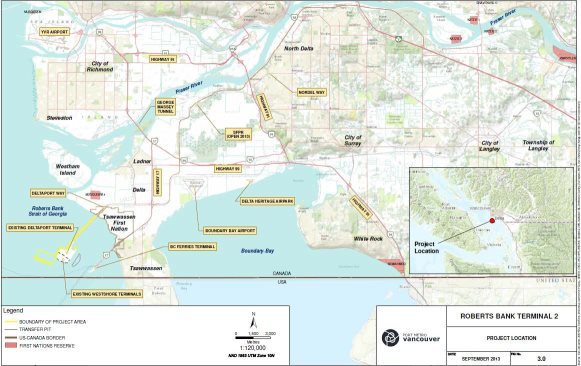
Port Metro Vancouver wants to construct and operate a new three-berth marine container terminal located at Roberts Bank in Delta, British Columbia, approximately 35 kilometres south of Vancouver (Figure 1). The proposed Project would provide an additional 2.4 million units of container capacity at Roberts Bank per year. The full project description and Environmental Impact Statement (EIS) can be downloaded at www.ceaa-acee.gc.ca (Registry reference number 80054).
For additional information on the proposed Roberts Bank Terminal 2 Project, we encourage you to contact Port Metro Vancouver (the proponent) at:
Bryan Nelson
Manager, Project Development – Aboriginal Consultation, Port Metro Vancouver
100 The Pointe, 999 Canada Place Vancouver, BC Canada V6C 3T4
direct: 604.665.9633 main: 604.665.9000 fax: 1.866.284.4271
Bryan.Nelson@portmetrovancouver.com
Figure 1: Regional Setting for the Proposed Roberts Bank Terminal 2 Project
3. Marine Shipping
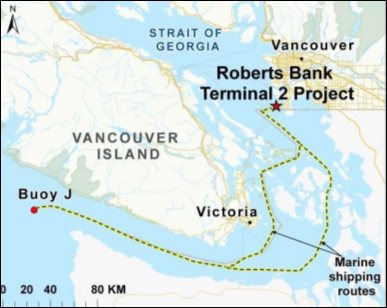
The potential effects on the environment of container ships coming and going from the proposed terminal through Juan de Fuca Strait and the Strait of Georgia will be taken into account during this environmental assessment (see figure 2 below). This is referred to in the Review Panel's Terms of Reference as "the environmental effects of marine shipping associated with the Project which is beyond the care and control of the proponent and within the 12 nautical mile limit of Canada's territorial sea."
The federal government will use the environmental assessment process to the extent possible to consult with Aboriginal groups whose Aboriginal rights may be impacted by the Roberts Bank Terminal 2 Project and/or by marine shipping associated with the Project.
The government would like to understand concerns Pacheedaht First Nation may have about any increase in marine shipping in your territory resulting from the Roberts Bank Terminal 2 Project (see Figure 2). Pacheedaht First Nation is encouraged to provide to the Review Panel for its consideration information regarding any potential or established Aboriginal or Treaty rights that may be impacted by marine shipping associated with the Project, what those impacts may be and suggestions to avoid or reduce impacts from your Nation.
Figure 2: Marine Shipping Associated with the Roberts Bank Terminal 2 Project
4. Aboriginal Groups
The following is a list of Aboriginal groups that have been identified by the federal government for consultation related to the environmental assessment, on the basis that existing or potential Aboriginal or Treaty rights and interests may be affected by the Project and/or marine shipping associated with the Project. This list may change as more information becomes available throughout the process. The Crown will consult with any Aboriginal groups who have asserted or established Aboriginal or Treaty rights which may be impacted by the Project and/or marine shipping associated with the Project.
Aboriginal groups identified by the Agency to be consulted on the Project include:
- Stó:lo Tribal Council (Seabird Island First Nation, Scowlitz First Nation, Soowahlie Band, Kwaw'Kwaw'Apilt First Nation, Kwantlen First Nation, Shxw'ow'hamel First Nation, Chawathil First Nation, Cheam Indian Band); and
- Stó:lo Nation (Aitchelitz First Nation, Leq'a:mel First Nation, Matsqui First Nation, Popkum First Nation, Skawahlook First Nation, Skowkale First Nation, Shxwha:y Village, Squiala First Nation, Sumas First Nation, Tzeachten First Nation, Yakweakwioose Band).
Aboriginal groups identified by the Agency to be consulted on the Project and marine shipping associated with the Project include:
- Tsawwassen First Nation;
- Musqueam First Nation;
- Semiahmoo First Nation;
- Tsleil-Waututh Nation;
- Stz'uminus First Nation;
- Cowichan Tribes;
- Halalt First Nation;
- Lake Cowichan First Nation;
- Lyackson First Nation;
- Penelakut Tribe;
- Métis Nation British Columbia;
Aboriginal groups identified by the Agency to be consulted on marine shipping associated with the Project include:
- Tsawout First Nation;
- Pauquachin First Nation;
- Tsartlip First Nation;
- Tseycum First Nation;
- Malahat First Nation;
- Beecher Bay Indian Band (Scia'new Nation);
- Esquimalt Nation (No'ilung Si'em 'i' sche'le'chu);
- Songhees First Nation;
- T'sou-ke First Nation;
- Pacheedaht First Nation;
- Ditidaht First Nation; and
- Maa-nulth First Nations (Huu-ay-aht First Nations, Ka:'yu:'k't'h'/Che:k'tles7et'h First Nations, Toquaht Nation, Uchucklesaht Tribe and Ucluelet First Nation).
5. Federal Crown's Consultation Objectives
The federal Crown has identified the following as key objectives to achieve throughout the consultation and environmental assessment process:
- To establish a positive and productive working relationship with Aboriginal groups during the environmental assessment and regulatory phases;
- To communicate and listen to potentially adversely impacted Aboriginal groups about marine shipping associated with the Project and the way in which potential or established Aboriginal or Treaty rights and related interests may be affected throughout the environmental assessment and regulatory phases;
- To create an environment that facilitates the identification of potential or established Aboriginal or Treaty rights and related interests that may be adversely impacted by marine shipping associated with the Project so that options can be considered to avoid, mitigate or accommodate adverse impacts to those Aboriginal or Treaty rights, where appropriate;
- To work with Aboriginal groups to identify potential effects of changes to the environment from marine shipping associated with the Project on:
- current use of lands and resources for traditional purposes;
- health, cultural and socio-economic conditions;
- potential or established Aboriginal or Treaty rights; and.
- To work with Aboriginal groups to identify and to consider options for avoiding or mitigating adverse impacts where appropriate.
- To respond to specific requests by potentially impacted Aboriginal groups, address topic-specific issues related to marine shipping associated with the Project, if possible, and to gather input from potentially impacted Aboriginal groups regarding their concerns about marine shipping associated with the Project;
- To cooperate with the Province of British Columbia on Aboriginal consultation;
- To guide the proponent to gather information about potential adverse impacts from marine shipping associated with the Project on established or potential Aboriginal or Treaty rights;
- To work with the Pacheedaht First Nation to respond to specific questions and requests regarding issues raised related to marine shipping associated with the Project; and
- To listen carefully to concerns raised by Pacheedaht First Nation and meaningfully consider your feedback, perspectives and issues in order to inform decision-making.
6. Pacheedaht First Nation Consultation Objectives
This section is intentionally left blank as the federal government would like to invite Pacheedaht First Nation to share your consultation objectives. You may also communicate your objectives directly to Analise Saely at analise.saely@ceaa-acee.gc.ca or 604-666-9169
7. Integrating Consultation into the Environment Assessment
Table 1 provides a description of the main steps in the federal environmental assessment process and a description of how the federal Crown proposes to integrate consultation activities into those steps. This table describes what the Pacheedaht First Nation should receive, have access to or expect from the Agency, on behalf of the federal Crown, and what the Pacheedaht First Nation could share and provide during the environmental assessment process.
Environmental assessments conducted by review panel are subject to timelines under the Canadian Environmental Assessment Act, 2012 (CEAA 2012) . An environmental assessment by review panel must be completed and an environmental assessment decision statement issued by the Minister of the Environment within 24 months of the date of the referral of the project to a review panel. This timeline does not include the time taken by the proponent to provide any information that is requested by the Agency, the review panel or the Minister of the Environment.
The Roberts Bank Terminal 2 Project is currently in the 24 month period. The Minister of the Environment referred the project to review panel on January 7, 2014. Consultation activities with Pacheedaht First Nation, as proposed, are in keeping with these timelines.
While information and concerns relating to many issues associated with the potential impacts of marine shipping associated with the Project may be brought forth and addressed during the various stages of the environmental assessment process, it may not be feasible to address all of these concerns through this process. Some issues and concerns may best be discussed and addressed in other ways, for instance, through the regulatory approvals process that may follow the environmental assessment.
Marine shipping beyond the care and control of Port Metro Vancouver will not be subject to conditions in the decision statement issued to Port Metro Vancouver by the Minister of the Environment under CEAA 2012, should the Project be authorized to proceed. However, inclusion of this matter within the environmental assessment for the Roberts Bank Terminal 2 Project will provide the federal government with information on the potential effects of increased marine shipping for use by programs and activities within federal jurisdiction.
| Environmental Assessment Step | Description of the Environmental Assessment Step/Phase | What the Pacheedaht First Nation should receive, have access to or expect FROM the federal Crown | What the Pacheedaht First Nation may provide TO the federal Crown/ Review Panel (or DO) |
|---|---|---|---|
|
Government Completeness Review on the Marine Shipping Addendum |
The Agency assesses the completeness of the proponent's marine shipping addendum. The marine shipping addendum identifies potential adverse environmental effects of marine shipping associated with the Project, including the environmental effects of malfunctions or accidents and any cumulative environmental effects, the significance of those effects, suggested mitigation measures and the possible requirements of any follow-up program that may be required. |
|
|
|
Panel Environmental Impact Statement (EIS) sufficiency review |
The review panel assesses the sufficiency of the EIS as required by the Terms of Reference. |
|
|
|
Public Hearing |
The review panel will hold a public hearing in a manner that offers any interested party an opportunity to participate in the environmental assessment. |
|
|
|
Panel Report |
The review panel submits its report to the Minister of the Environment, which includes its conclusions, recommendations and rationale regarding the significance of the adverse environmental effects, mitigation measures, and follow up report. The panel may include accommodation measures related to any potential adverse impacts on potential or established Aboriginal or Treaty rights. |
|
|
|
Throughout the Environmental Assessment |
|
|
|
8. Federal Agencies Roles and Responsibilities
Environmental assessment type: Environmental assessment by review panel
Potential decisions by federal agencies (information to be confirmed as environmental assessment progresses):
|
Federal Agency |
Roles and Responsibilities |
|---|---|
|
Canadian Environmental Assessment Agency |
Crown Consultation Coordinator responsible for coordinating federal Crown consultation within the environmental assessment process. |
|
Environment Canada |
Federal Authority responsible for Species at Risk Act (SARA), Section 73 (1) or 74 and Canadian Environmental Protection Act, Section 127 (Disposal at Sea) authorization. Potential expert advice on migratory birds, Species at Risk Act , water quality, wetlands, greenhouse gases and air quality and climate impacts on the project. |
|
Canadian Coast Guard |
The Canadian Coast Guard is the operational arm of the Government of Canada's marine safety system and is available to provide expertise on maritime shipping matters as they relate to the review of the proposed project. |
|
Transport Canada |
Transport Canada administers a comprehensive marine safety system that applies to ocean-going vessels operating in Canadian waters. The Canadian regulatory scheme is based on international conventions adopted and promoted by the International Maritime Organization, and includes provisions to:
|
|
Fisheries and Oceans Canada |
Federal Authority responsible for Fisheries Act, Section 35(2)(b) Authorization and for Section 73(1) or 74 of the Species at Risk Act (SARA) in relation to aquatic species. Potential expert advice on fish and fish habitat. |
|
Natural Resources Canada |
Potential expert advice on geotechnical, geohazards, and coastal geomorphology and seabed stability. |
|
Health Canada |
Potential expert advice on the health impacts of proposed development projects (which involve the federal government) with a focus on the bio- physical environment, including: air quality, country foods contamination, drinking and recreational water quality, radiation effects, electric and magnetic fields, and noise. |